- AMD erzielt einen Rekordumsatz von 9,2 Milliarden US-Dollar, ein Plus von 36 % gegenüber dem Vorjahr und 20 % gegenüber dem Vorquartal, angeführt von der Stärke der Segmente Rechenzentrum, Client und Gaming.
- Die Partnerschaft mit OpenAI positioniert AMD als einen zentralen Anbieter von KI-Rechenlösungen im Vorfeld der Markteinführung der Plattformen MI400 und Helios im Jahr 2026.
- Die Umsätze im Client- und Gaming-Bereich stiegen im Vergleich zum Vorjahr um 73 %, was auf eine starke Nachfrage nach Ryzen- und Radeon-Produkten sowie Rekordumsätze bei PC-Prozessoren zurückzuführen ist.
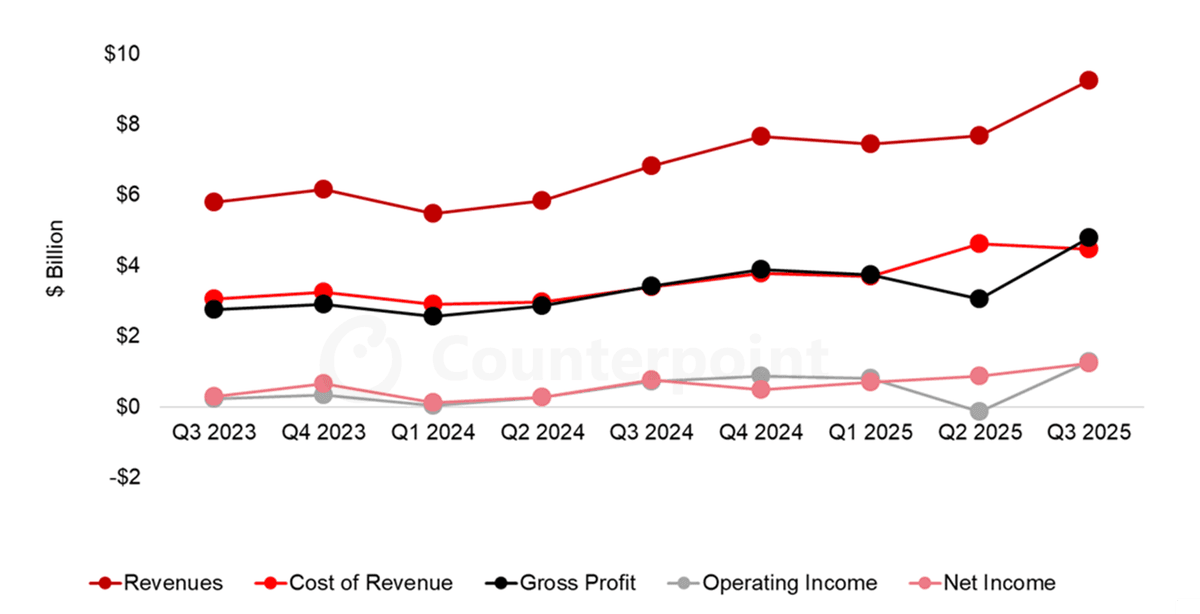
AMD lieferte im dritten Quartal 2025 erneut ein herausragendes Ergebnis ab, übertraf die Erwartungen der Wall Street und baute seine Führungsposition in den Bereichen KI, PC und Gaming weiter aus. Das Unternehmen meldete einen GAAP-Umsatz von 9,2 Milliarden US-Dollar und übertraf damit die Konsensprognose von 8,7 Milliarden US-Dollar. Treiber dieses Wachstums war die breite Nachfrage nach Hochleistungsrechnern.
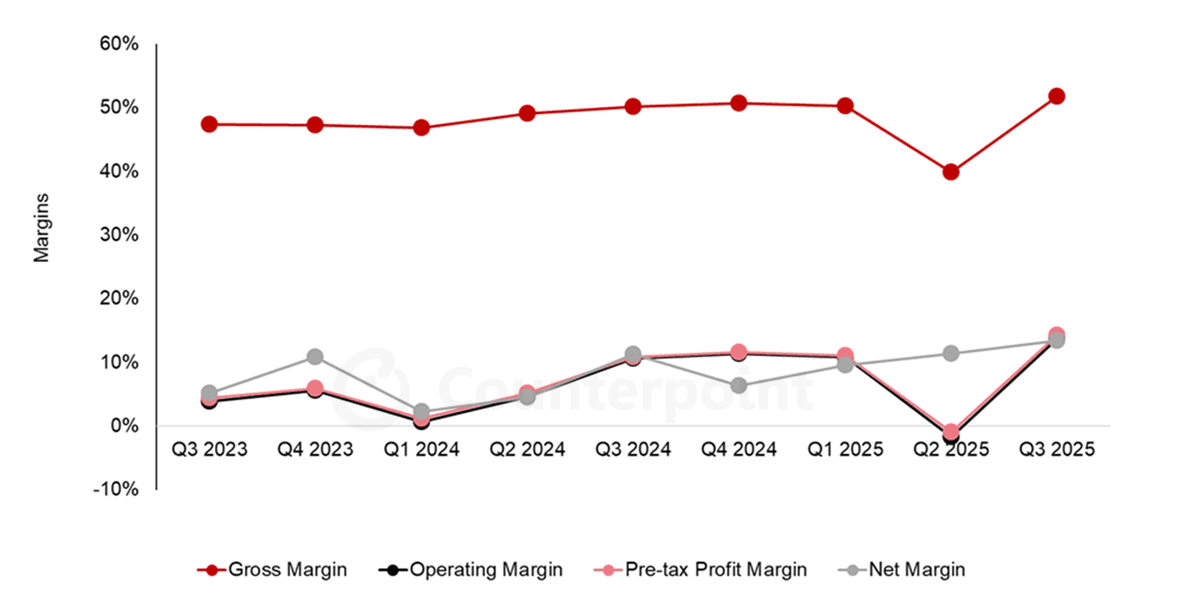
Der Nettogewinn stieg im Vergleich zum Vorjahr um 61 % auf 1,2 Milliarden US-Dollar, während die Bruttomarge dank eines breiteren Produktmixes auf 52 % zulegte. Die Ergebnisse schlossen aufgrund von Exportbeschränkungen jegliche Umsätze aus MI308-GPU-Lieferungen nach China aus. Das Verhältnis von Lagerbestand zu Herstellungskosten (COGS) von AMD stieg von 1,53 im zweiten Quartal auf 1,74 im dritten Quartal, was auf potenziellen Lagerdruck in der Zukunft hindeutet. Das Management geht jedoch davon aus, dass die starke Nachfrage die Lagerbestände im Handel abbauen wird, sobald die Auslieferungen von Ryzen und Instinct im Zuge der Weihnachtszeit und der KI-Upgrade-Zyklen anziehen.
AMD Gewinn- und Verlustrechnung – Highlights, 3. Quartal 2023 – 3. Quartal 2025
Quellen: AMD-GAAP-Finanzberichte
AMD Brutto-, Betriebs-, Vorsteuer- und Nettomargen, 3. Quartal 2023 bis 3. Quartal 2025
Quellen: AMD-GAAP-Finanzberichte
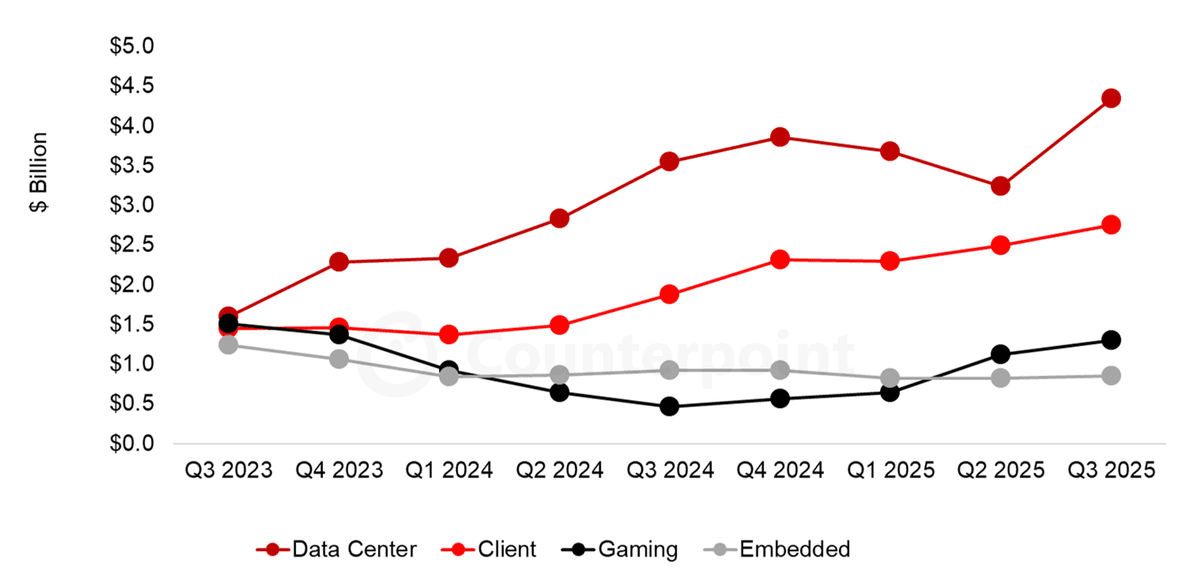
AMD-Umsatz nach Geschäftsbereichen, 3. Quartal 2023 bis 3. Quartal 2025
Quellen: AMD-GAAP-Finanzberichte
Rechenzentrum und KI: Skalierung für die nächste Phase
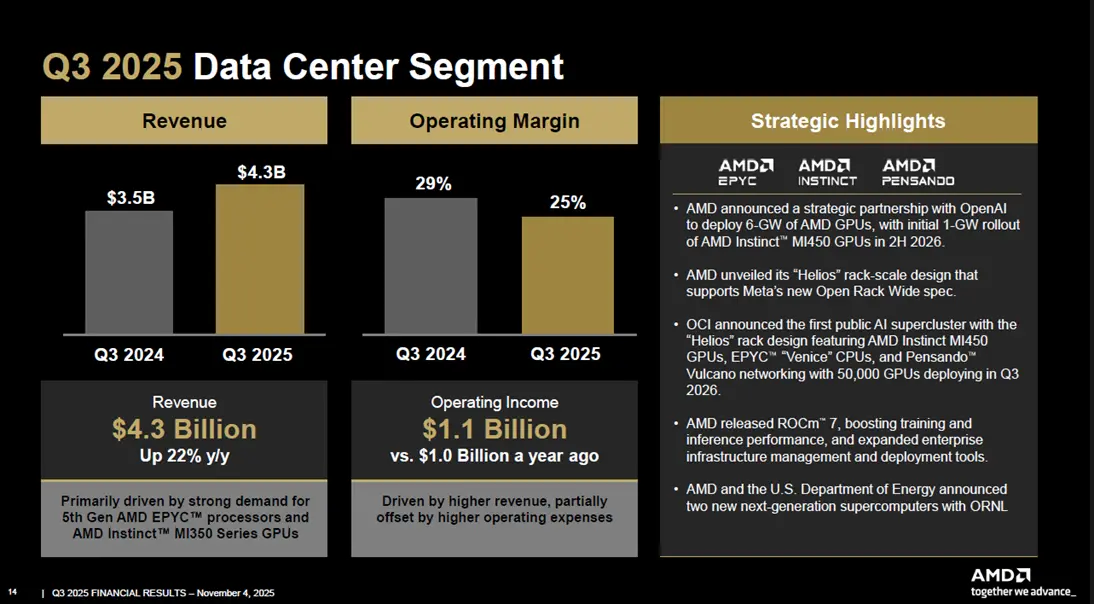
Das Segment Rechenzentren wuchs im Jahresvergleich um 22 % und im Quartalsvergleich um 34 % auf 4,3 Milliarden US-Dollar, angetrieben durch die starke Nachfrage nach GPUs der Instinct MI350-Serie. AMDs KI-Geschäft tritt mit der Markteinführung der Beschleuniger der MI400-Serie und der Helios-Rack-Plattform im Jahr 2026 in die nächste Phase ein. Diese kombinieren fortschrittliche Rechen-, Netzwerk- und Speicherarchitektur, die speziell für KI-Trainings- und Inferenz-Workloads entwickelt wurden.
Ein Highlight des Quartals war die mehrjährige Partnerschaft von AMD mit OpenAI zur Bereitstellung von 6 Gigawatt Instinct-GPUs, wobei die ersten 1 GW MI450-Beschleuniger in der zweiten Jahreshälfte 2026 in Betrieb gehen sollen. Die Partnerschaft festigt AMDs Position als zentraler Rechenanbieter für OpenAI und stärkt seine Full-Stack-KI-Plattformstrategie.
Client- und Gaming-Bereich: Ryzen und Radeon treiben das Wachstum voran
Das Kundensegment erzielte einen Umsatz von 2,8 Milliarden US-Dollar, ein Plus von 46 % gegenüber dem Vorjahr. Dieser Anstieg wurde durch Rekordverkäufe von Ryzen-Prozessoren und die zunehmende Nutzung in Unternehmen befeuert. Der Absatz von Ryzen-PCs stieg im Vergleich zum Vorjahr um mehr als 30 %, unterstützt durch großflächige Unternehmenseinsätze im Gesundheitswesen, Finanzwesen und der Fertigungsindustrie.
Im Gaming-Bereich stieg der Umsatz im Vergleich zum Vorjahr um 181 % auf 1,3 Milliarden US-Dollar. Haupttreiber waren die gestiegene Nachfrage nach Konsolen sowie Rekordverkäufe von Radeon-GPUs und Ryzen-Desktop-CPUs. Insbesondere die Ryzen-9000-Serie erzielte Rekordabsätze im Vertriebskanal und unterstrich damit AMDs führende Position im Bereich Performance Computing für Gaming, Produktivität und Content-Erstellung.
Eingebettet: Bescheidene Leistung in einem schwächelnden Markt
Das Segment Embedded erzielte einen Umsatz von 857 Millionen US-Dollar, ein Plus von 4 % gegenüber dem Vorquartal, jedoch ein Minus von 8 % gegenüber dem Vorjahr, da die Nachfrage im Industrie- und Netzwerkbereich nachließ. Das operative Ergebnis sank auf 33 % des Umsatzes, verglichen mit 40 % im Vorjahr. Dies spiegelt Veränderungen im Produktmix und eine geringere Endmarktnachfrage wider.
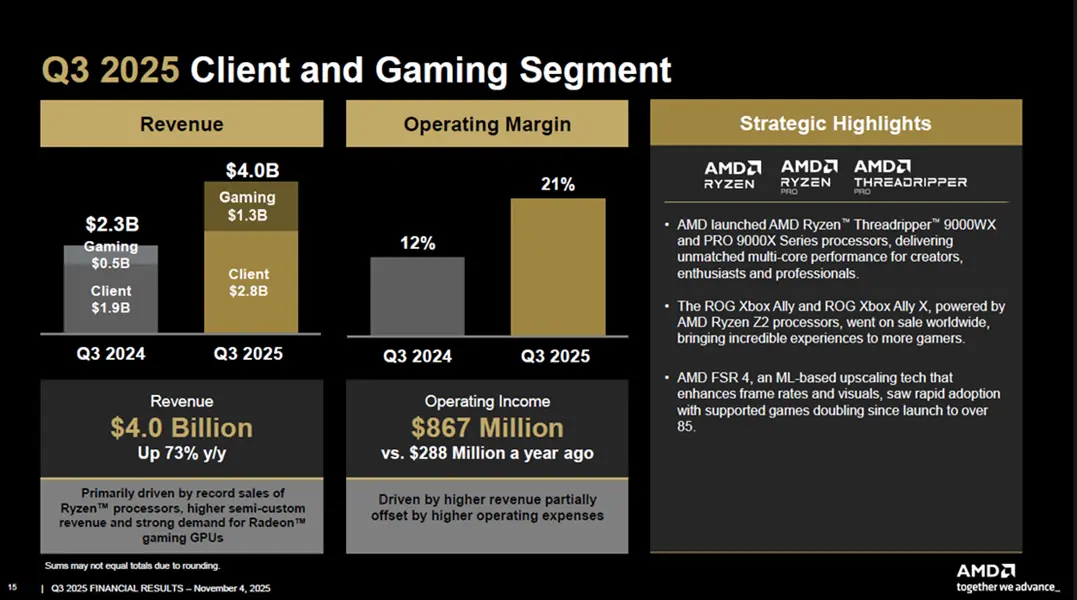
Quelle: AMD-Präsentation für das dritte Quartal 2025
Leitlinien und Ausblick
Für das vierte Quartal 2025 erwartet AMD einen Umsatz von 9,6 Milliarden US-Dollar ± 300 Millionen US-Dollar, was einem Wachstum von rund 25 % gegenüber dem Vorjahr und rund 4 % gegenüber dem Vorquartal entspricht (ohne die Lieferungen des MI308 nach China). Das Unternehmen prognostiziert eine bereinigte Bruttomarge von 54,5 % und operative Aufwendungen von 2,8 Milliarden US-Dollar. Im Bereich Rechenzentren und Embedded-Systeme wird ein zweistelliges Wachstum erwartet.
„AMD erzielt weiterhin herausragende Ergebnisse in seinem gesamten Compute-Portfolio – von EPYC und Ryzen bis hin zu Instinct-GPUs – und demonstriert damit die Vorteile einer diversifizierten Strategie, die KI, PCs und Gaming umfasst“, sagte David Naranjo, Associate Director. „Die Partnerschaft mit OpenAI unterstreicht AMDs KI-Ambitionen und markiert einen wichtigen Meilenstein auf dem Weg zu einer ernstzunehmenden Alternative zu NVIDIA im Bereich großskaliger KI-Berechnungen.“
AMD ist auch hinsichtlich der Kundentrends im Rechenzentrumsbereich gut aufgestellt. „Verteilte Inferenz bleibt ein wichtiges Thema, und AMD glänzt hier dank seiner Stärke in puncto Speicherbandbreite und -kapazität“, bemerkte MS Hwang, Forschungsdirektor.
Zusammenfassung
- Die Ergebnisse von AMD im dritten Quartal unterstreichen den Wandel des Unternehmens zu einem führenden Anbieter umfassender Lösungen im Bereich Computing und KI. AMD profitiert von seiner Diversifizierung in verschiedene Segmente – Client-, Gaming- und Rechenzentrumslösungen treiben das Wachstum parallel voran. Die Vereinbarung mit OpenAI ermöglicht es AMD, seine KI-Hardware-Präsenz ab 2026 deutlich auszubauen, während die Plattformen MI400 und Helios die Grundlage für langfristiges Wachstum der KI-Infrastruktur schaffen.
- Risiken bestehen weiterhin im Bereich des Bestandsmanagements und der schwachen Marktentwicklung im Embedded-Segment, doch der Gesamttrend ist klar: AMD stärkt seine Position im Compute-Bereich segmentübergreifend und rüstet sich für einen weiteren Wachstumsschub durch KI-gestützte Systeme. Sollte die Umsetzung planmäßig verlaufen, könnte AMD im Jahr 2026 zu einem ernstzunehmenden Konkurrenten von NVIDIA im Wettlauf um KI-Beschleunigung werden.
Weiterführende Berichte:
