

Overview
In the last week of October 2026, Volkswagen made two decisions that appear contradictory. On October 26, it named NXP's S32K5 as the zonal control MCU across all Group brands and models. Two days later, Volkswagen Group China unveiled VEGA — a fully locally developed in-house stack spanning platforms, E/E architecture and ADAS.
This report argues that the two moves are not a contradiction but a deliberate act of risk stratification. Volkswagen cannot stake roughly 10 million units of global capacity on a local team that has existed for only four years; nor can it fight Chinese automakers on iteration speed while carrying a Wolfsburg-built architecture. The result is two technology sovereigns inside one company.
A straightforward comparison of the two strategies reveals clear differences between them:
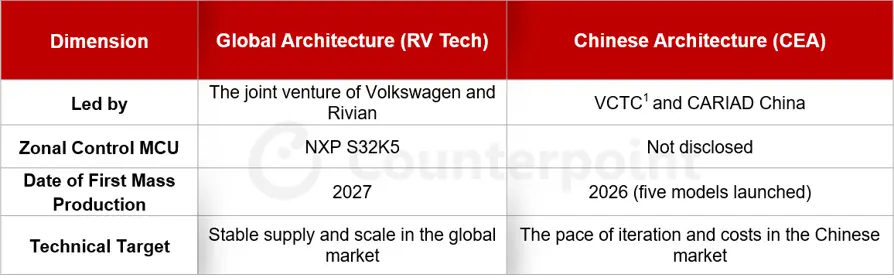
1. VCTC: Volkswagen Group China Technology Company
Source: Counterpoint Research
What the Full Report Will Cover
The full report delivers a structured assessment of Volkswagen's dual-track strategy and its implications. It compares the global RV Tech platform built on NXP's S32K5 against China's CEA architecture, examining governance, timelines and cost structure. It then dissects VEGA's true composition — which elements trace back to XPeng's EEA 3.0, which were rebuilt to Volkswagen's functional safety standards, and what the 18-month development cycle implies — alongside a critical reading of the C-Brain efficiency claims. A dedicated section maps the three parallel ADAS chip roadmaps (XPeng Turing, Horizon Journey 6M/6H and CARIZON's C7H), clarifying that C7H is an in-house SoC rather than a Horizon IP license. The report also separates L3 technology readiness from road-test permits and private-customer market access, explains why CMP plus CEA represents a cost-driven export to the Global South rather than a technology leadership claim, and closes with the supply chain implications — including the still-undisclosed zonal MCU supplier for CEA and what domestic Chinese silicon would mean for the industry.
Key Questions the Report Answers
Why is Volkswagen running two architectures in parallel — and what risk does each one actually carry?
How much of VEGA is truly developed in-house, and how large is the generational gap to XPeng's current EEA 4.0?
Why three ADAS chip roadmaps in a single market, and what does the C7H in-house SoC signal about where compute margin is migrating?
When will L3 be commercially available to private customers in China — as distinct from "L3-ready" hardware?
Who supplies the zonal control MCU for CEA, and if it is a domestic Chinese supplier, what does that mean for the "China technology going global" narrative?
