
Overview
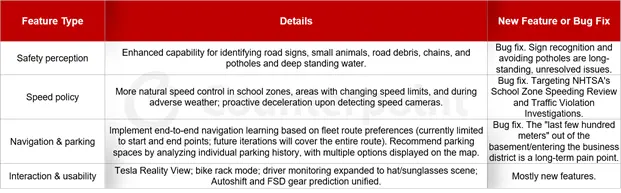
Tesla's FSD v15 rollout in November 2026 looked like another software update. It is not. Three things in the release matter more than the feature list: a claimed 25-fold gain in critical intervention rate, a generative Reality View that replaces the rendering pipeline entirely, and a hardware cutoff that leaves millions of HW3 cars on a dead-end branch.
That last point is the one worth carrying into 2027 planning. Hardware pre-embedded for ADAS does not pay off indefinitely. Its value is bound to a compute generation, and once a new model exceeds the memory bandwidth of the older silicon, the pre-embedded hardware becomes a sunk cost.
Source: Counterpoint Research
What the Full Report Will Cover
The full report examines what FSD v15 actually changed, separating capability claims from architectural shifts. It walks through the three signals in the release — the critical intervention rate, Reality View, and the HW3/HW4 split — and puts each in context.
The report then turns to the compute arithmetic. Camera resolution on AI4 rose nearly 4x while memory bandwidth rose 3.3x. That gap explains why cropping, downsampling and ROI processing are structural necessities rather than engineering choices.
From there it applies the same test to China. Between 2022 and 2024, Chinese NOA launches paired 8MP cameras with Orin-X's 204.8 GB/s. That combination held while on-device models stayed small. The report sets out why it will not hold as parameter counts climb and estimates when Orin-X-class pre-embedding reaches the end of its useful life.
Key Questions the Report Answers
How should the "25x" claim in FSD v15 be read? Tesla gave a multiple without a baseline — what does the implied miles-per-intervention actually fall within, and how far past the industry's unattended-service threshold does it land?
Is Reality View a rendering pipeline or a generative model — and can it be trusted as a surround view? What changes when the display stops reconstructing the physical world and starts generating it, and where should that distinction be flagged in robotaxi and parking use cases?
Why is HW3 permanently capped at v14 Lite, and what does that mean for the millions of cars already on the road? What does the split reveal about how long pre-embedded hardware can pay off?
Why does rising camera resolution outrun memory bandwidth, and where does that constraint bite first? AI4 raised pixels 4x against 3.3x bandwidth — why is that gap structural rather than a design choice?
When will pre-embedded hardware on Orin-X-class platforms stop paying off, and how will Chinese OEMs respond? What does the 2028–2029 estimate rest on, and what does a Lite-variant strategy imply for tiered experience?

