

- Global EV sales grew 16% YoY to 5.8 million units in Q2 2026, with EVs reaching 28% of global PV sales, supported by higher and more volatile oil prices, improving EV economics, wider model availability, and continued expansion of charging infrastructure.
- China remained the largest EV market, contributing 63% of global EV sales, while Europe recorded stronger growth of 20% YoY, highlighting the continued shift toward electrification in both markets.
- The US was a key exception, with EV sales declining 27% YoY following the expiration of the federal EV tax credit, while tariffs and higher vehicle costs further weakened BEV demand. Consumers increasingly shifted toward conventional hybrids, which reached a record 16% share in Q2 as they offered improved fuel economy without requiring a full transition to EVs.
- Emerging markets gained momentum, with EV sales rising 130% in LATAM, 119% in South Korea, 88% in India, and 87% in Oceania, highlighting their growing contribution to global EV growth.
- Chinese automakers continued to expand globally, with BYD and Tesla remaining the leading players, while Leapmotor and Chery grew 102% and 148% YoY, respectively, supported by new model launches and expanding portfolios.
Global electric passenger vehicle (EV) sales expanded strongly in Q2 2026, rising 16% YoY to 5.8 million units, according to Counterpoint Research’s latest Global Passenger Electric Vehicle Model Sales Tracker, Q2 2026, report. Battery electric vehicles (BEVs) led, accounting for 70% of total EV sales, with volumes increasing 24% YoY, while plug-in hybrid electric vehicle (PHEV) sales grew 9% YoY. EV penetration reached 28% of global passenger vehicle sales, indicating that more than one in every four cars sold worldwide was an electric vehicle, which underlines the ongoing move towards electrification.
Passenger Vehicle Sales Share by Powertrain by Top Regions, Q2 2026
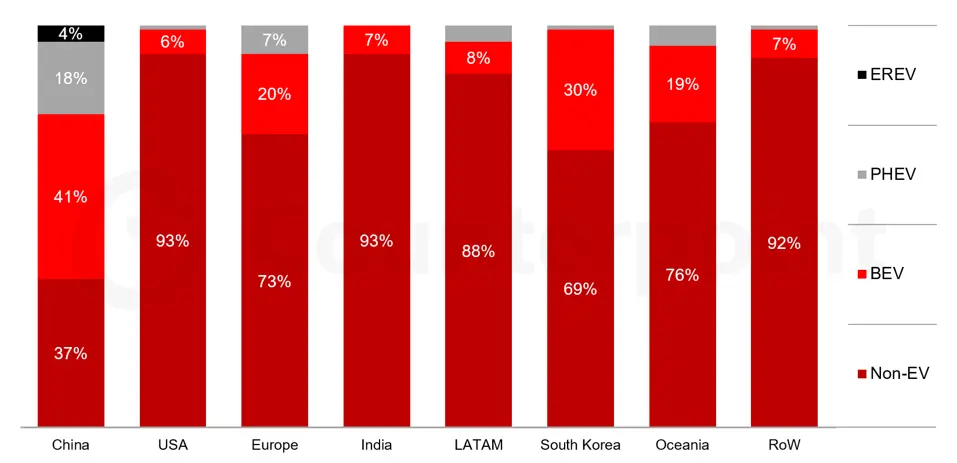
Source: Counterpoint Global Passenger Vehicle Model Sales Tracker, Q2 2026
EVs include BEVs, PHEVs & EREVs.
