- Memory prices continue to rise, prompting smartphone OEMs to pass rising costs on to consumers through price hikes on both new and legacy models.
- While such adjustments help alleviate margin compression, they are likely to weigh on shipment volumes and market share.
- Huawei appears well positioned to gain share in the China market, underpinned by its domestic supply chain advantages and relatively stable pricing strategy.
- Apple is unlikely to raise prices in the near to medium term, backed by its premium product mix and supply chain strength; instead, it is expected to absorb margin pressure, supporting further share gains.
As memory prices increase, Chinese smartphone OEMs have adopted a range of mitigation strategies, including trimming non-core hardware specifications, streamlining product portfolios, and extending refresh cycles. Despite these efforts, cost pressures have still been partially passed through to consumers. Since mid-to-late March, OPPO, vivo and HONOR have successively raised prices on selected legacy models. According to Counterpoint Research’s China weekly tracker, we observe that from the week price increases were implemented, these OEMs’ market share began to decline noticeably. This reflects a clear shift toward a “profit-first” strategy, even at the expense of market share.
China Smartphone Market Share by OEMs
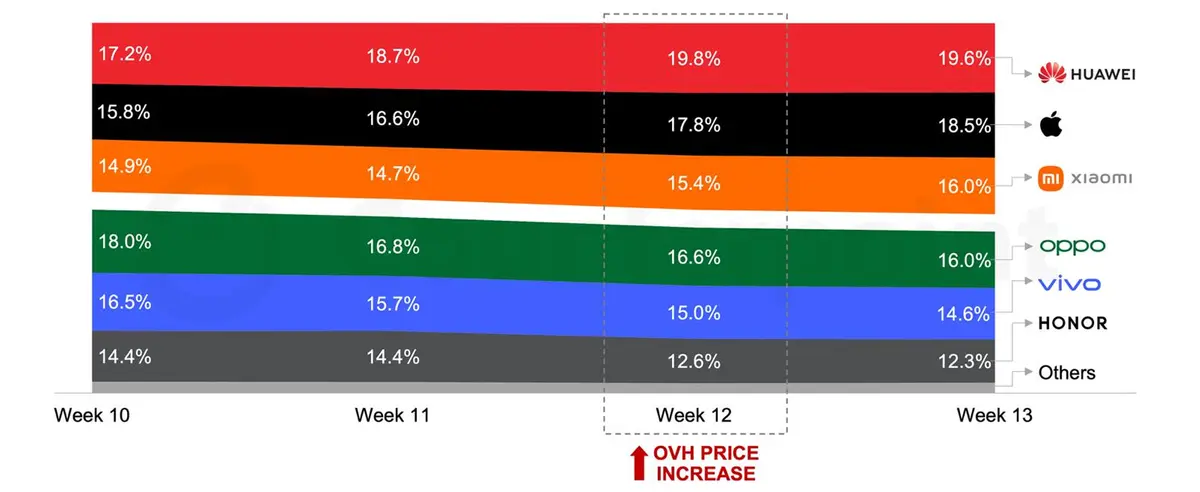
Note: OPPO includes OnePlus and realme, vivo includes iQOO.
Week 12: 20260316-20260322


