India’s Tablet Market Grows 2% YoY in 2025, Driven by Strategic Portfolio Upgrades and Localization Gains
- India tablet shipments remained largely stable in 2025, with a modest 2% YoY growth, while Q4 2025 shipments grew 14% YoY, indicating improving demand momentum.
- Samsung maintained its market leadership, driven by the Galaxy Tab A series, further reinforced by the newly launched A11 lineup, while Apple strengthened its second position with the iPad (2025) refresh.
- Cellular-enabled tablet penetration increased, surpassing Wi-Fi-only models, with 5G adoption rising to account for 43% of cellular-enabled shipments.
- Mid-premium demand accelerated, with shipments in the INR 30,000-INR 40,000 growing 7x YoY, reflecting a clear shift toward higher-spec devices.
- Exports crossed 1 million units in 2025, led by Samsung and Lenovo, while domestic manufacturing accounted for most of the shipments.
India tablet shipments rose 2% YoY in 2025, remained largely stable through the year, according to Counterpoint Research’s latest IoT Service report. The market continued shifting toward productivity led devices, indicating a gradual move from consumption-focused usage to performance and long-term utility. Although growth remained stable through the year, momentum strengthened significantly in Q4 2025, with shipments rising 14% YoY during the quarter, supported by portfolio refreshes and improving demand in the premium segments. The year reflected a gradual but clear realignment toward higher-value segments and productivity-driven usage.
India's Top 5 Tablet Brands by Shipment Share, 2024 vs 2025
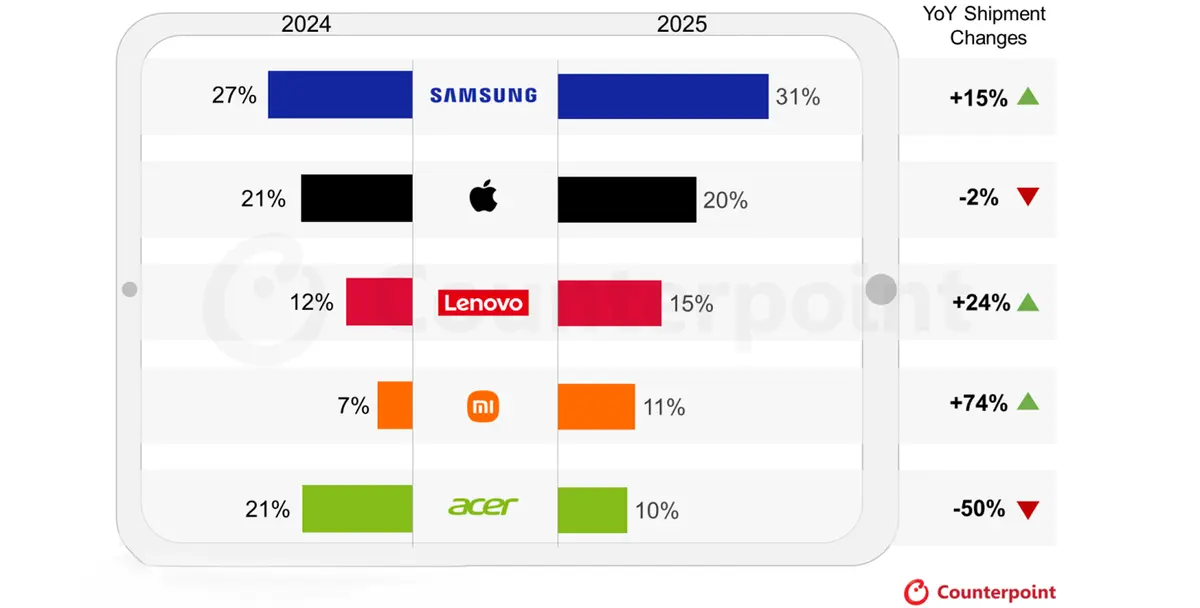
Samsung retained its market leadership in 2025, anchored by the Galaxy Tab A9 series across the first three quarters before transitioning to the successor A11 series in Q4 2025, reinforcing its stronghold in the INR 15,000-INR 30,000 segment while sustaining its premium presence through the Galaxy Tab S portfolio. Apple ranked second, with the iPad (2025) 128GB Wi-Fi variant emerging as a key driver in the INR 30,000-INR 40,000 band, significantly influencing the market’s premium mix in H2 2025. The iPad Pro series further accelerated OLED penetration, strengthening Apple’s positioning in the high-performance segment.
Lenovo secured the third position, supported by the Idea Tab series and Motorola-branded Moto Pad portfolio, as it pivoted toward larger-display, performance-oriented devices aligned with productivity use cases. Xiaomi followed in fourth place, emerging as the fastest-growing brand with 74% YoY growth in 2025, driven by its Redmi Pad Pro series, alongside expanded domestic manufacturing, competitive pricing, and a broader accessories ecosystem.
Looking at the evolving market trends, India’s tablet market saw a clear shift towards premiumisation, driven by strategic product refreshes across key brands. The INR 30,000-INR 40,000 price band emerged as the fastest-growing segment, with shipments rising nearly 7x, reflecting increasing consumer preference for higher-performance devices. This shift in the price mix, alongside deeper localization, signals a market transition towards more value-led growth. Apple played a key role in this trend, with its March 2025 iPad launches driving upgrades from lower price tiers and emerging as a major volume contributor during the year. At the same time, chipset dynamics remained competitive, with MediaTek sustaining its leadership in the tablet SoC space, supported by broad adoption across leading brand portfolios.
From a product evolution perspective, tablets continued to evolve as productivity-led devices, reflected in consistent upgrades across key specifications. Consumers increasingly preferred higher storage variants and larger batteries, aligning with more intensive and everyday usage patterns. Larger display formats also gained traction, particularly models above 12 inches, supporting both productivity and content consumption use cases. On the connectivity front, cellular-enabled tablets overtook Wi-Fi-only models, while 5G adoption continued to increase.
2025 marked a turning point for India’s tablet manufacturing landscape. Exports crossed one million units from negligible levels in prior years, led by Samsung and Lenovo, with shipments directed toward the US and key European markets. At the same time, domestic production accounted for 50% of annual shipments, reflecting accelerated localization. This dual momentum positions India not just as a growing consumption market, but increasingly as a strategic manufacturing base within the global tablet supply chain.
Looking ahead, in 2026, the Indian tablet market is expected to see robust growth, supported by the strong momentum witnessed in Q4 2025. While memory pricing will remain, a dynamic factor influencing device costs and margins, sustained demand for higher configurations and productivity-oriented devices is likely to support value growth. The export market will be particularly important to look out for in 2026, as increasing localization and supply chain diversification position India as a growing manufacturing hub beyond domestic demand. At the same time, the evolution of AI-enabled tablets and on-device AI features is expected to gradually enhance user experiences, laying the foundation for the next phase of market expansion.
Category
Industry
IoT
Service
Standard
Report Type
Report
Time Period
Other
Receive our insightful weekly newsletter and stay ahead of the competition.
Author
Srishti Jain
Srishti Jain is a Research Analyst at Counterpoint Technology Market Research, where she closely tracks the Consumer IoT domain with a focus on Laptops, Tablets, Smart Wearables, and Smart Home devices. She has prior experience as a Product Manager at Xiaomi India, where she worked across multiple categories, including Smartphones, Smart Wearables, and Smart Home products. Srishti holds an MBA from IIM Udaipur and is passionate about the intersection of technology, user-centric design, and innovation.
Anshika Jain
Anshika is a Principal Analyst at Counterpoint Research with over 13 years of experience in market research and business intelligence. She currently leads the Global Consumer IoT domain, focusing on wearables, hearables, smart home, and emerging technologies. Previously, she managed various research and consulting projects across sectors such as BFSI and Telecom. Additionally, she has significant client-handling experience with major multinational companies. Anshika holds an MBA in Finance from IMT Ghaziabad and a Bachelor’s degree in Economics from Hansraj College, Delhi University.