
ENG
Report

From T-Glass Crisis to Capacity Erosion: The Multi-Year Substrate Shortage

2
March 11, 2026
  • The ABF substrate industry is entering a structurally longer up-cycle driven by enterprise AI demand, differing from the 2020-2022 consumer-led “work from home” cycle.
  • Next-generation technologies like Embedded Passives and Intel’s EMIB-T introduce complexity. Even with a single defective passive component, the entire package must be scrapped, further straining capacity.
  • Substrate vendors are expected to implement 3%-5% QoQ price hikes in H1 2026 to pass through surging costs. Meanwhile, greenfield capacity will not arrive until 2027, leading to a 20% gap in shortage.
  • AI players should treat substrate availability as a strategic binding constraint. Securing multi-year capacity agreements and subsidies will ensure raw material priority (T-glass) and stability.


Today’s AI “brains” have become massive and far more complicated, requiring super-bridges that are much larger and have many more layers than those used for ordinary PCs (one AI chip consumes roughly 10 times more substrate material than a standard PC chip). This sudden explosion in demand has brought a major roadblock – the world is running out of T-glass, a specialized high-strength glass fiber needed to make substrates. Furthermore, because these AI-grade bridges are relatively difficult to construct, many end up being defective during manufacturing (lower yields), meaning the actual supply is likely even smaller than it appears.

Substrate remains indispensable amid surging AI demand

The substrate industry is undergoing a fundamental transformation as demand pivots from consumer-led PC markets to enterprise-driven AI infrastructure, which offers significantly higher visibility. By 2030, AI related applications, including servers, GPUs, ASICs and networking, are expected to capture over 50% of the total substrate market value, while the PC segment's share is expected to fall from above 50% in the 2010s to below 20%. This transition is straining global capacity because a single advanced AI chip consumes roughly 10 times more ABF (Ajinomoto Build‑up Film) material than a traditional PC chip. Furthermore, substrate specifications are rapidly migrating toward dimensions exceeding 100x100 mm and layer counts of 20+ to 40+, exponentially increasing manufacturing complexity.

The role of Substrates and PCBs in Advanced Packaging
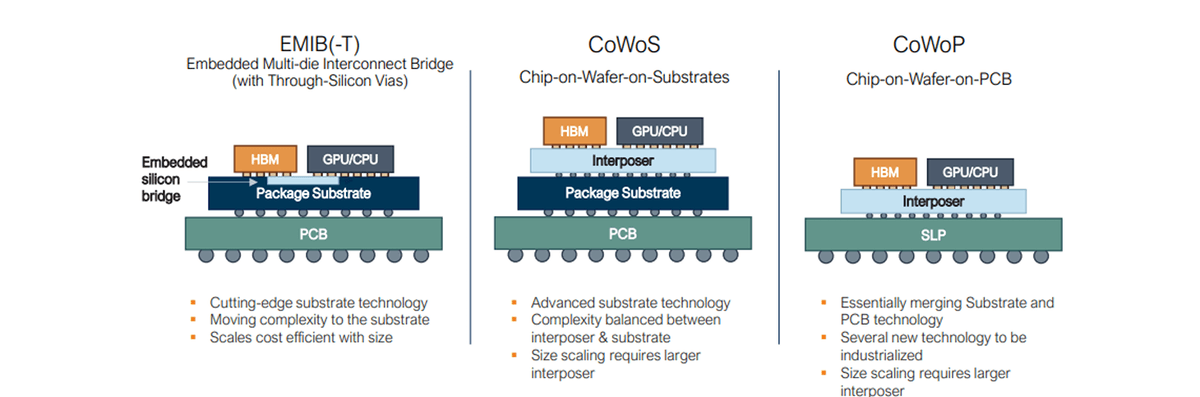
Source: AT&S

Surging demand is creating a structural undersupply

Against this backdrop of surging demand, a critical upstream bottleneck has emerged in the supply of T glass (low-CTE glass cloth). Our channel check shows there is a 10%+ supply-demand gap for T-glass in 2026, a shortage even more severe than in 2025. Besides, due to material suppliers prioritizing high-margin AI projects, BT substrates and low-to-mid-end ABF segments are being starved of supplies. Simultaneously, the industry is suffering from invisible capacity erosion due to advanced packaging architectures. Next-generation technologies like Embedded Passives and Intel’s EMIB-T introduce unprecedented complexity by embedding components directly into the substrate. This introduces multiple new failure points, because even a single defective embedded component requires the entire high-value package to be scrapped. Manufacturing yields are being suppressed, further tightening the industry’s actual output.

Substrate vendors are expanding capacity, but it takes time for the new output to materialize

To mitigate cost pressures, substrate makers have shifted from aggressive expansion to strategic pricing and capacity management. Substrate prices are expected to increase by 3%-5% each quarter in H1 2026 to pass through sharp increases in raw materials, including copper (up ~40%) and CCL (up 30%). Regarding capacity, major players are adopting a cautious approach, since greenfield expansions take over 2.5 years to reach mass production. Significant new capacity (such as Unimicron’s KF2 or Yangmei’s second plant) will not arrive until 2027. In response, major IC vendors (like NVIDIA and Broadcom) are proactively negotiating capacity reservation agreements and subsidies to prevent supply bottlenecks for their next-generation platforms.

Mitigation strategies: Alternatives to organic substrates

While expanding capacity remains the primary goal, the industry is developing several technological and material alternatives to mitigate the supply-demand imbalance:

1. Short-term alleviation: Material substitution and supplier diversification

  • E-glass substitution: Substrate makers are qualifying solutions that replace specific T-glass layers with standard “electrical grade” E-glass fiber cloth. While T-glass is superior for high-end AI, using E-glass where specs allow could significantly ease the primary material bottleneck.
  • Diversified vendor base: While currently dominated by Nittobo, new players like Taiwan Glass and Nan Ya Plastics are being qualified, with meaningful supply expected to ramp up from H1 2026.


2. Packaging architecture shifts

  • CoWoP (Chip-on-Wafer-on-PCB): This technology merges substrate and PCB functions, potentially displacing the need for high-layer ABF substrates by attaching the interposer directly to high-density PCBs.
  • InFO (Integrated Fan-Out): Already proven in consumer SoCs, InFO utilizes fine-pitched Redistribution Layers (RDLs) to bypass the traditional substrate supply chain entirely.


3. Long-term mainstream: Glass core substrates

  • Glass core: Replacing organic cores with glass sheets offers superior flatness and interconnect density through Through-Glass Vias (TGV). While the ecosystem is in its infancy, it is viewed as the definitive way to break the physical limits of organic materials for post-2027 AI chips.
  • Optical Hybrid Packaging: Looking toward 2030, integrated optical signals could reduce the complexity and material intensity of traditional copper-based substrates.

Source: ASE

Substrate industry is expected to face a severe supply-demand imbalance in H2 2026

The industry is projected to enter a period of sustained undersupply starting in H1 2026, which is likely to worsen through the upcoming years. The ABF shortage gap is estimated at 10% in H2 2026, widening dramatically to 20% in 2027 before new capacity comes online. Industry-wide utilization rates are expected to rise sequentially through 2027 as high-end AI projects ramp up, leaving little room for error in the supply chain.

For major stakeholders across the AI ecosystem, substrate availability has evolved into a strategic binding constraint for advanced node and advanced packaging development. To mitigate these impending supply risks, industry participants may:

  • Shift toward proactive procurement models: Secure multi-year capacity reservation agreements and explore strategic subsidies to guarantee priority access to limited upstream materials like T-glass and ensure manufacturing stability.
  • Implement aggressive technological hedging: Actively qualify diversified T-glass vendors and develop grades that utilize E-glass substitution to alleviate immediate material bottlenecks.
  • Accelerate architectural transitions: Prioritize the roadmap for CoWoP, glass substrates and co packaged optics (CPO) to bypass the physical and capacity limits of traditional organic ABF, ensuring that next-generation AI platforms are not stalled by a decade-long substrate shortage.

Category

Industry

Semiconductors

Service

Standard

Report Type

Report

Time Period

Other

Receive our insightful weekly newsletter and stay ahead of the competition.

Author

William Li

linkedin_icon

William is a Research Analyst in Semiconductor and Components team, based in Taiwan. He has over 8 years of experience in global PC (personal computer) and semiconductor market. Before Counterpoint, he was an equity research analyst at Credit Suisse, focused on both technology and non-technology sectors as well as supporting Taiwan equity market strategy research. Prior, he worked for a Taiwan PE fund as a research analyst covering semiconductor and downstream components sector.