Samsung Reasserts TV Leadership at CES 2026
- At CES 2026, Samsung put its new Micro RGB TV technology at the forefront of corporate presentation in its First Look press event and its exhibition.
- The 2026 emphasis on TV stood in contrast to Samsung’s message a year ago, when the company seemed to ignore its TV products to focus on AI.
- In 2026, Samsung will be offering large TVs with seven distinct display technologies – MicroLED, RGB MiniLED, White MiniLED with quantum dot films, edge-lit LCD with quantum dot films, conventional LCD, QD-OLED and White OLED.
Samsung reminded CES 2026 attendees why it has been the No. 1 TV brand for 20 years, putting its new Micro RGB TV technology at the forefront of corporate presentation in its First Look press event and its exhibition.
The 2026 emphasis on TV stood in contrast to Samsung’s message a year ago, when the company seemed to ignore its TV products to focus on AI. While Samsung was napping on TV, Chinese upstarts TCL and Hisense aggressively pushed new display technologies and cut into Samsung’s lead as the No. 1 brand. This year, Samsung let it be known that it intends to stay the champion.
In its First Look press event, Samsung’s Head of the Visual Display Business SW Yong outlined the company’s success, having sold 830 million TVs in the last 20 years, far ahead of any other vendor.
Samsung’s new flagship in the TV space is its 130” Micro RGB TV. At Counterpoint, we refer to the base technology as RGB MiniLED, but each brand has a different designation. Samsung uses the word “Micro” because the LEDs are smaller than 100µm. This technology was introduced a year ago by Samsung and Hisense but is poised to see a great expansion by these two brands and by others.
These TVs use red, green and blue LEDs arrayed in a matrix that forms the backlight of the LCD display, and like MiniLED, the LEDs light only when needed in the picture, allowing large areas of black to be truly black. Although Samsung does not disclose the number of LEDs, it is likely in the low five figures. With these LEDs, Samsung can get 100% of the BT-2020 color gamut.
Samsung 130” Micro RGB
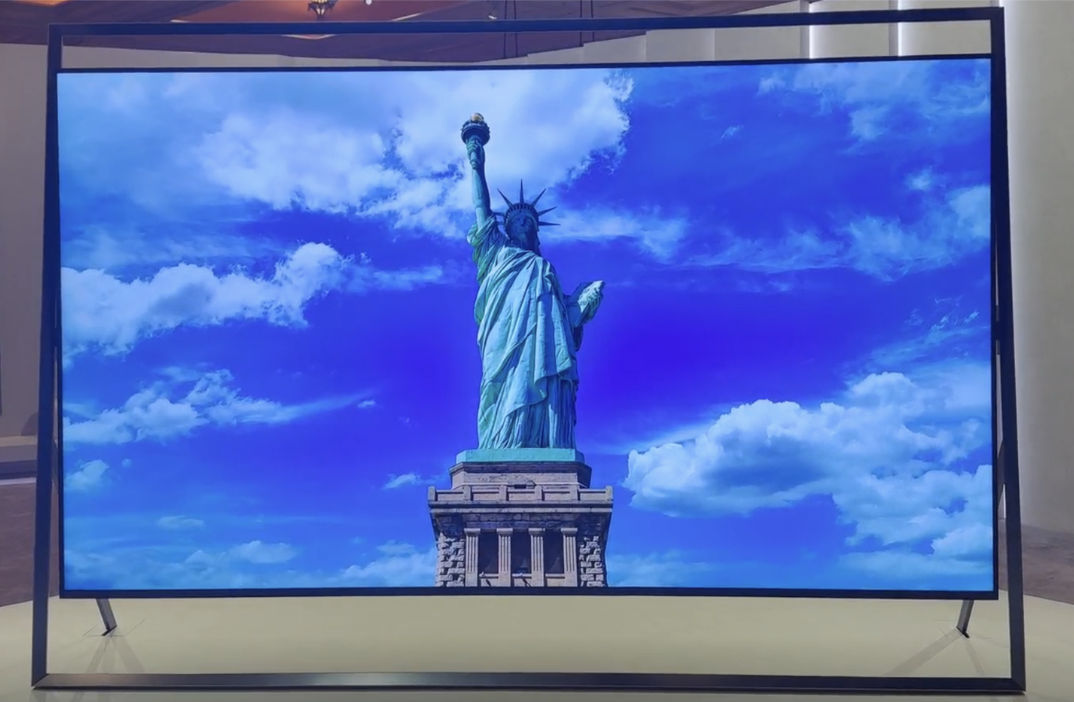
The flagship TV comes with Samsung’s best video processing features, which include Micro RGB AI Engine Pro, Micro RGB Color Booster Pro and Micro RGB HDR Pro, leveraging AI to enhance the picture. The 130-inch model also includes Samsung’s Glare Free technology, which minimizes reflections for the best viewing experience.
Yong stressed that Samsung’s TV offerings go “so much further than picture quality”, with its Vision AI Companion enabling conversational search, proactive recommendations and access to AI features and apps. The Companion also integrates with other Samsung devices in the home, which include PCs, tablets and smartphones, as well as digital appliances. Much of the rest of the First Look event addressed the AI features of refrigerators and other appliances.
In 2026, Samsung will be offering large TVs with seven distinct display technologies – MicroLED (direct-view), RGB MiniLED (called Micro RGB), White MiniLED with quantum dot films (called Neo QLED 8K and 4K), edge-lit LCD with quantum dot films (QLED), conventional LCD (Crystal UHD), QD-OLED and White OLED (both labeled Samsung OLED). In 2025, the Micro RGB was available only in 115”, and priced far above all the other flat panel technologies at $24,999 (though this was still below the direct-view MicroLED).
Samsung did not disclose how Micro RGB would be positioned with respect to the other technologies, but it will have a product range in six sizes, going from 55” to 130”.
Samsung will be the first TV vendor to introduce a 130” flat panel TV; this size represents the endpoint of larger screen sizes for flat panels. It is an efficient cut on a Gen 10.5 LCD fab with two panels per substrate. In order to efficiently make a larger flat panel, there would need to be a fab larger than Gen 10.5, and at Counterpoint Display, we think that is extremely unlikely because it would involve a massive capital investment to tackle a market that is already being served (although at high prices) by MicroLED.
Receive our insightful weekly newsletter and stay ahead of the competition.
Author
Bob Obrien
Robert J (Bob) O’Brien joined Counterpoint Research as part of its acquisition of DSCC, where he was Co-Founder, Principal and CFO of DSCC. Bob has decades of experience turning market and business analysis into strategic insights in the display and electronics industries. At DSCC, Bob takes the lead role in analysis of display materials, including glass and AMOLED materials, and covers developments in TV and other large-screen display applications. He is the principal author of DSCC’s AMOLED Material Report, the Advanced TV Shipment Report, and the Display Glass Report, and Bob contributes regularly to the DSCC Weekly Review.