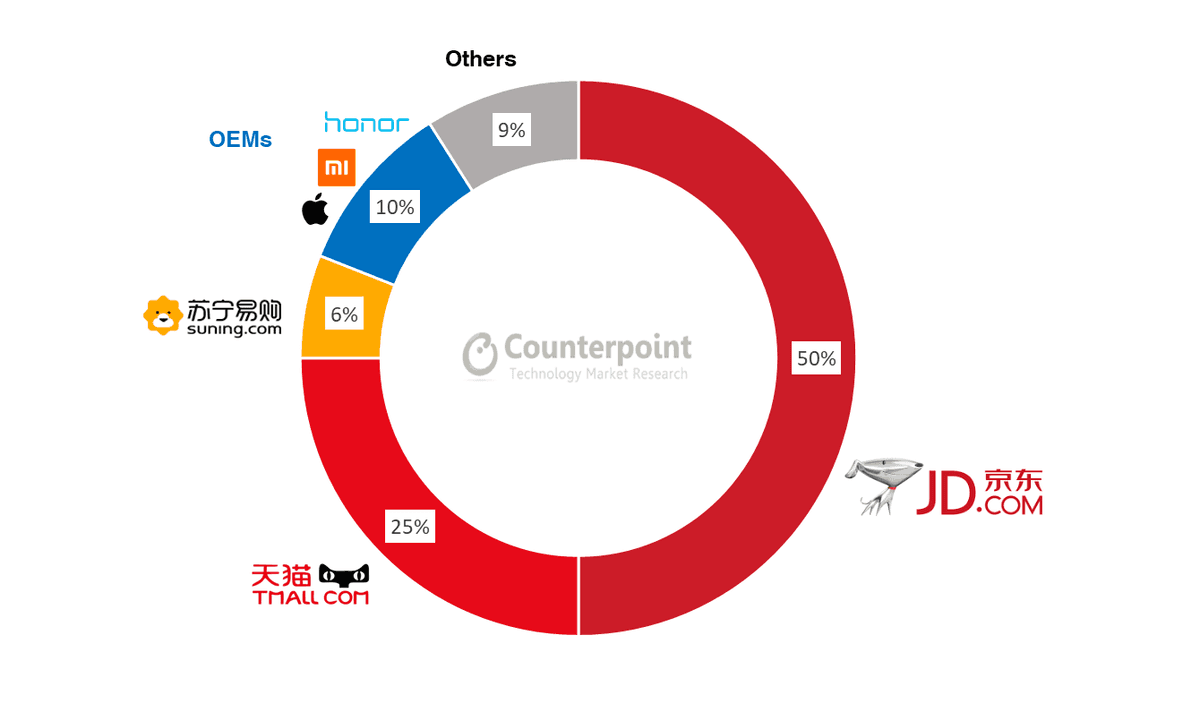
JD is the top online platform for smartphone sales with 50% channel share
Honor overtakes Xiaomi to become the leading brand by sales volume in the online channel.
New Delhi, Hong Kong, Seoul, London, Beijing, San Diego, Buenos Aires
Mar 17th, 2019
China’s online channel contribution to total smartphone sales in China increased to 28% in Q4 2018 from 25% in Q3 2018, according to the latest research from Counterpoint’s Smartphone Channel Share Tracker. JD.com, Alibaba’s Tmall, Suning continued to be the preferred channels for online smartphone purchases. The three portals together accounted for more than 80% of the total smartphones sold in online channels.
Commenting on the growing role of e-tailers for smartphone sales in China, James Yan, Research Director at Counterpoint Research commented, “Smartphone sales in online channels in China are dominated by Jingdong (JD) and Tmall. JD has become a de-facto platform to purchase smartphones online. JD’s greater focus on consumer electronics, computers, and communications, which is dubbed as its 3C strategy, has helped it gain mindshare compared to rivals. JD.com is also known to work very closely with different smartphone OEMs to launch, promote and service the products selling on its platform. This has helped JD to dominate the online smartphone sales, which is one of the biggest GMV contributors with a 50% market share.”
Yan, added, “Tmall remained the second largest platform followed by Suning. Tmall gained from the Singles Day (11.11) sale which bumped up its market share in online channels during the quarter.”
Exhibit 1: Q4 2018 - China’s Smartphone Sales Share Through Online Channel by Platforms
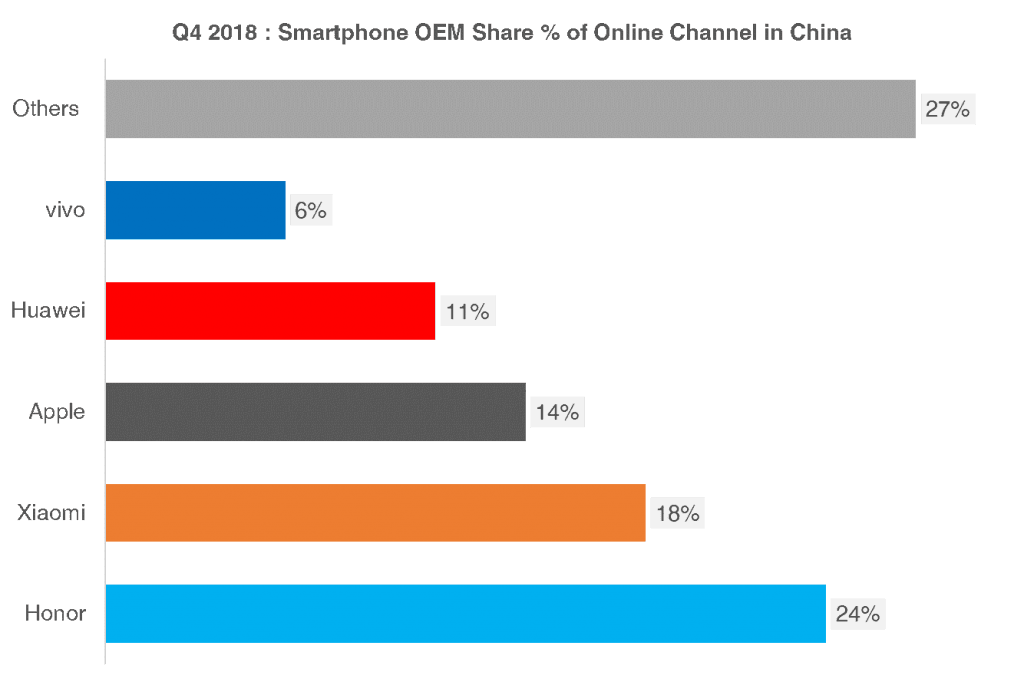
While the traditional e-tailers continue to dominate, OEMs have been holding steady share selling through their own e-commerce portals. Counterpoint’s Research Analyst, MengMeng Zhang, noted, “Xiaomi, Honor, and Apple remain the most successful brands to attract consumers to buy from their own portals and own that direct relationship which is key to cross-sell accessories, services, and other products. For example, this is the key go-to-market strategy for Xiaomi to drive its hardware ecosystem mode. It prefers selling online to help maintain the tighter margins.” In terms of OEMs share of the total sales in online channels, Honor topped the rankings with 24% of all smartphones sold online in China in Q4 2018 surpassing Xiaomi.
Exhibit 2: Q4 2018: China’s Smartphone OEM Market Share by Brand in Online Channel
The Chinese e-commerce business is constantly evolving with companies developing new business models for selling smartphones. Commenting on the new business models of Chinese e-commerce portals, Zhang said, “Interestingly, we are seeing a new type of e-commerce platform called Pinduoduo becoming popular through a social selling model. Consumers can get healthy discounts on products leveraging Pinduoduo’s team purchasing model where users can invite others through a social network and team-up to buy the products and obtain a bulk purchase discount. This is becoming popular especially for low-end models.”
While we believe that China has become one of the largest mobile e-commerce markets in terms of volumes, smartphone sales contribution through the online channel is still low compared to countries like India where 41% of smartphones are sold online. Flora Tang, Research Analyst at Counterpoint Research said, “The lack of infrastructure development and logistics network in rural parts of China makes ordering and delivering goods through e-commerce portals in certain regions difficult. E-commerce giants such as JD are seeking to counter this problem through developing drone delivery networks in rural areas.”
Tang added, “Another major reason for lower penetration rate for online smartphone sales in China, compared to India, is bigger discounts being offered in India. Further, platforms in India also attract buyers with online exclusive models. Nonetheless, we think that China’s online smartphone market has yet to realize its full potential and has great growth potential in the coming years.”
Despite heavy promotions during Singles’ Day and 12.12 e-commerce festival which led to growth in smartphones sold online during the quarter, the online channel growth failed to offset the overall decline in China’s smartphone market. During Q4 2018, the smartphone demand in China fell 14% year-on-year.
Market analysis:
- In Q4 2018, the top four brands (Honor, Xiaomi, Apple and Huawei) account for 67% of the market share.
- Honor became the leading online smartphone brand in China, capturing 24% of the market compared to Xiaomi a year ago which led this segment.
- With the most aggressive promotions amongst all OEMs, Honor’s sales during Singles’ Day was especially strong, ranking first in terms of volume on both Tmall and JD and it even replaced Apple from the top spot in terms of value on JD.com for the first time.
- Xiaomi ranked second in terms of market share. Nearly 20% of Xiaomi’s smartphones are sold on its own platform, higher than any other OEM. Building on a smartphone and IoT ecosystem strategy with a diversified portfolio of smartphones and IoT products, Xiaomi Mall serves as a convenient one-stop shop to purchase all Xiaomi products.
- Traditionally offline brands, OPPO and Vivo, are also gaining more interest in the online space to develop new areas of growth amidst a weak market. Both Vivo and OPPO have launched their own online models, such as Vivo Z series and OPPO K1, and have done fairly well.
This analysis is extracted from our in-depth smartphone channel share tracker by OEM by model for China and available for subscribing clients at http://report.counterpointresearch.com/
Analyst Contacts:
Mengmeng Zhang
+86 18611804269
mengmeng@counterpointresearch.com
James Yan闫占孟
+86 15810182576
[email protected]
@james_a3
Tarun Pathak
+91 9971213665
[email protected]
Flora Tang
+852 5545 2529
flora@counterpointresearch.com
Counterpoint Research


