
India's premium flagship smartphone segment is seeing a forced shift in its price threshold, moving from ₹50,000–70,000 towards ₹1 lakh and above. Rising DRAM and NAND costs, driven by AI data centre demand, have pushed memory's share of smartphone BOM from ~13% in early 2025 to over 40%, prompting smartphone manufacturers to reassess specifications, components and product strategies to manage costs. A few years ago, a ₹1 lakh smartphone was a rarity in India. Today, as flagship prices keep rising, this price point is becoming increasingly common. Prices of premium flagship devices are expected to rise by more than 30% by the end of 2026 compared with 2025.
Premium Smartphone BoM Cost Share Trend
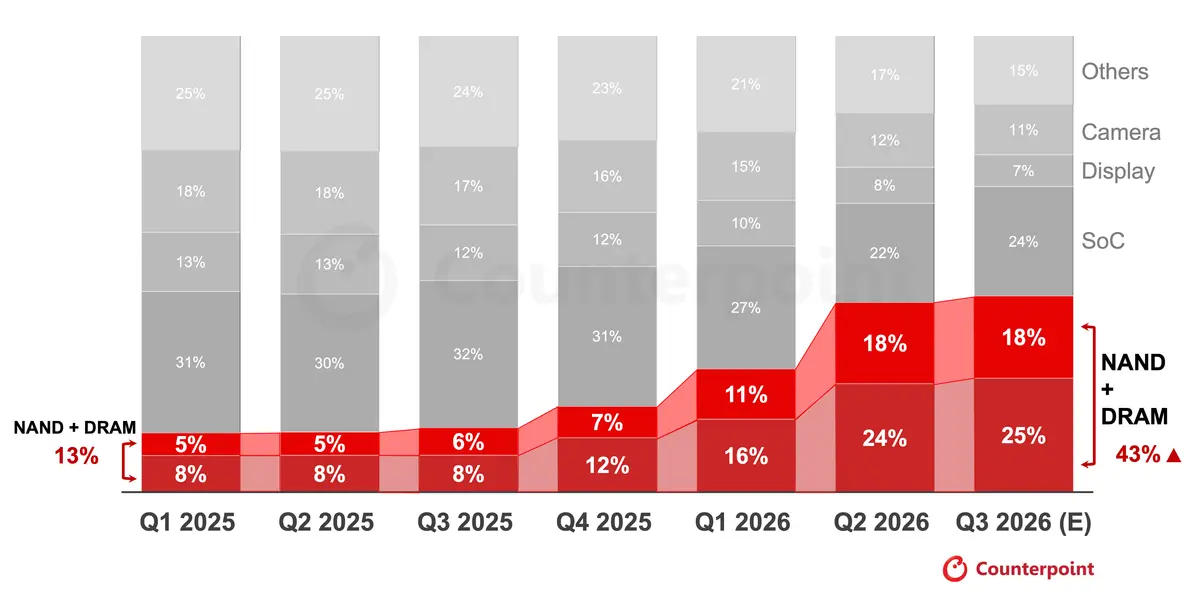
Source: Counterpoint Teardown & BoM Service, Memory Price Tracker The DRAM is selected as LPDDR5X 16GB, and the NAND is chosen as UFS4.1 512GB. SoC is selected as Qualcomm Snapdragon 8 Elite series or MediaTek D9000 series. Display is selected as a flagship QHD+ LTPO OLED screen. Cameras are selected as premium triple-camera configurations.
Note: Premium refers to >$600 price segment.
As flagship device prices rise above the ₹1 lakh-plus price point, brand reputation alone is no longer enough. Consumers are looking beyond the logo, expecting meaningful advancements in performance, camera, battery, software and overall user experience to justify the higher investment. This shift can be seen as tech-focused brands like iQOO and Google are launching well-rounded flagships that can not only last a good number of years but also give users experiences that are at par with devices being launched at almost INR 2 lakh price points. For example, the upcoming iQOO 16, which was first glimpsed at the India Mobile Congress, showed a strong reflection of this long-term approach, focusing on camera, OS, top-tier hardware and the world’s fastest chipset, designed to deliver a reliable experience over several years.
Flagship Model Increasing Prices Across Brands
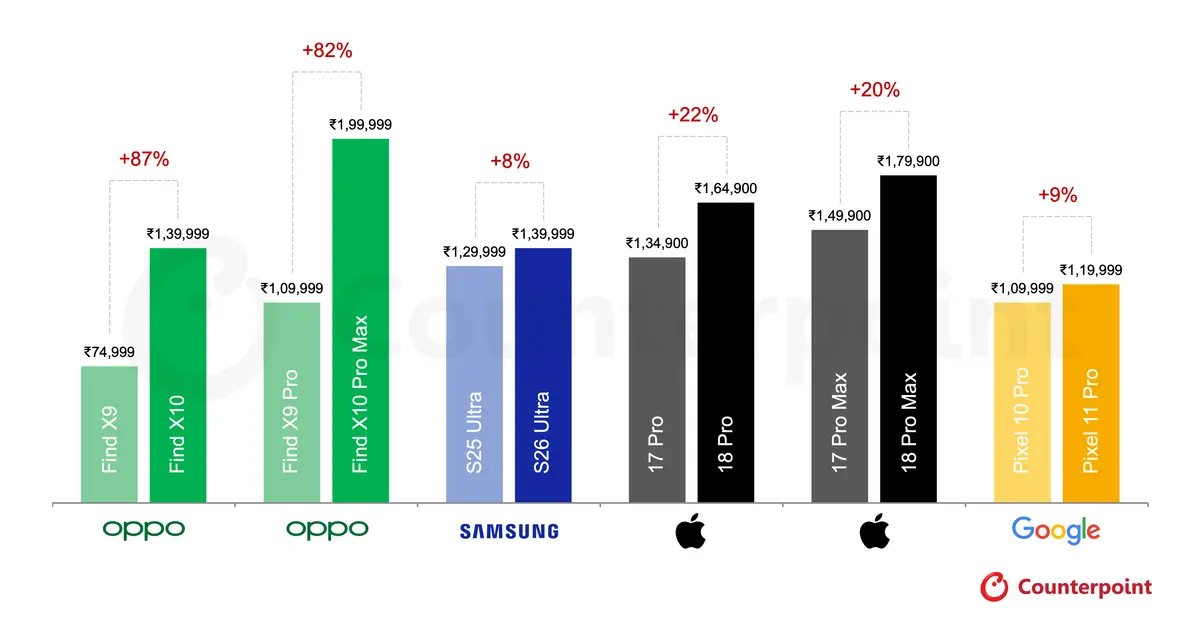
Source: Counterpoint Research Monthly Smartphone Pricing Tracker
What Should Consumers Expect from a Premium Flagship Smartphone?
At ₹1 lakh and above, consumers expect more than brand appeal. Performance, innovation, and long-term ownership value become critical to justifying the premium. Seven aspects stand out:
- Processor and performance: Beyond benchmark scores, sustained performance and seamless multitasking matter. Samsung and iQOO leverage the world’s best flagship processors to deliver powerful everyday experiences.
- Display: Sharp resolution, high refresh rates, brightness, and color accuracy define the viewing experience. For example, the upcoming iQOO 16 features Samsung's next-generation M16 OLED material, which is the world's first 2K 165Hz display.
- Camera: Versatile telephoto and ultra-wide lenses, low-light photography and advanced image processing matter more than megapixel counts alone. iQOO, vivo and Oppo are ensuring a best-in-class camera set-up for a complete flagship experience.
- Battery and charging: Strong battery endurance and fast charging are essential to support demanding usage throughout the day.
- Software and longevity: A refined interface, useful AI features, and long-term support are key. Samsung's One UI and iQOO's Origin OS 7 focus on delivering smoother, smarter experiences. iQOO's previous flagship also offered five OS upgrades and seven years of security updates.
- Build quality and durability: Premium materials, water and dust resistance, and hardware reliability help ensure devices remain relevant over several years.
- After-sales service: Extensive service networks, genuine spare parts and reliable repair support strengthen consumer trust. Brands like vivo/iQOO have invested in these aspects to improve the long-term ownership experience.
Different consumers, different priorities
There is no single best premium flagship, as consumer priorities vary.
As Apple and Samsung flagship prices move towards ₹2 lakh, tech-focused brands like iQOO and Google are attracting consumers with specifications that are at par but at more competitive prices.
Beyond hardware, ecosystem flexibility is becoming an important differentiator, especially for working professionals who tend to carry more than one smartphone in addition to a laptop. With Origin OS 7, iQOO aims to bridge Android and Apple ecosystems through easier file sharing, photo transfers and seamless cross-device connectivity. This can help consumers using MacBooks, iPads, and Microsoft Windows to enjoy a more seamless experience without being restricted to a single brand's ecosystem.
Beyond Brand: The New Premium Equation
Does investing ₹1 lakh+ in a flagship from a relatively premium brand make sense? When it comes to a head-to-head comparison, tech-first brands like Google and iQOO are delivering hardware and software experiences at par with, and in some areas even ahead of, established premium players. The upcoming iQOO 16 reflects this shift, bringing advanced hardware, meaningful innovation and flagship-grade features at a competitive price point. As smartphone prices rise, consumers are increasingly valuing technology and overall experience over brand name alone, creating a significant opportunity for these brands in the premium segment.


