

The BoM cost of Samsung Galaxy S25 Ultra with a 12GB + 512GB memory variant is estimated to be 3.4% higher than that of the S24 Ultra.
The SoC cost continues to increase due to the process node and hardware architecture upgrades over the past two years.
Memory cost fluctuates because of the dynamic supply and demand relationship, while the casing cost varies due to a new middle frame material.
The costs of other functional parts, such as RF parts and cameras, have declined.
The estimated BoM costs for Samsung Galaxy S23 Ultra, Galaxy S24 Ultra, and Galaxy S25 Ultra (all 12GB + 512GB memory variants) saw a slight cost increase from the S23 Ultra to the S24 Ultra, while the cost increase from the S24 Ultra to the S25 Ultra is somewhat larger.
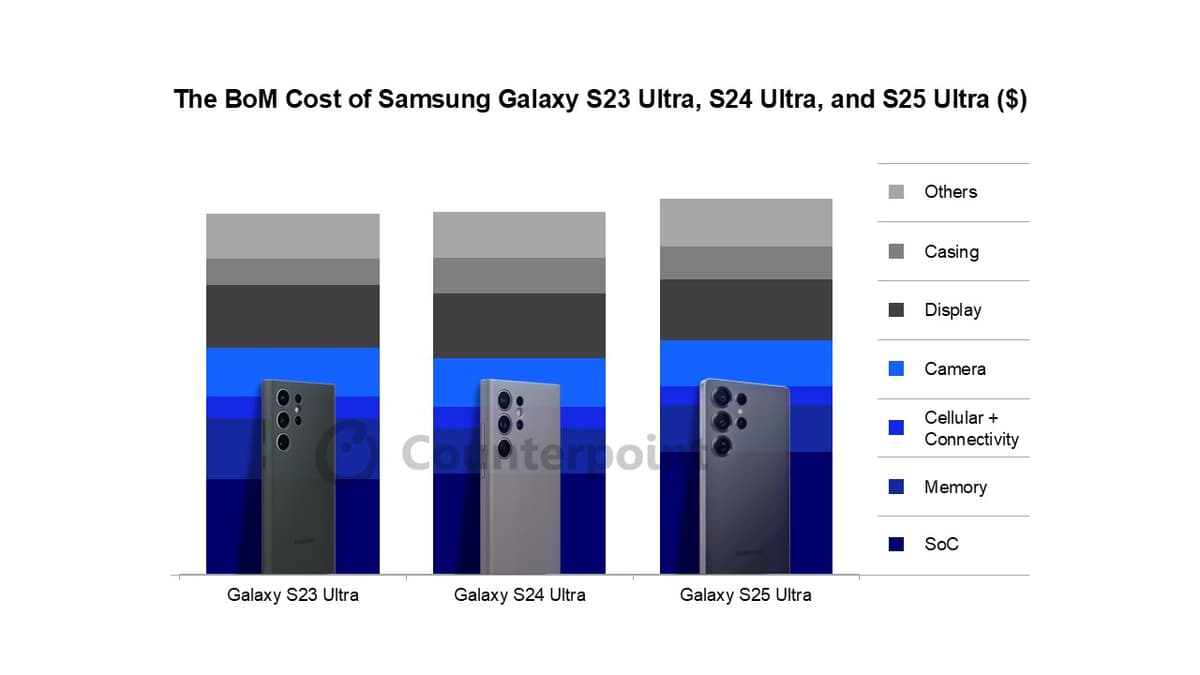
All three models see a significant rise in SoC costs, with the Galaxy S25 Ultra experiencing the largest increase. The trend is driven by two main factors: First, the SoC’s fabrication process evolves from Qualcomm Snapdragon 8 Gen 2’s TSMC N4 to 8 Elite’s TSMC N3E. The more advanced process enables a faster operating speed and a higher transistor integration level (~16 billion in 8 Elite), allowing it to handle more complex functions while maintaining low power consumption. Second, the Snapdragon 8 Elite’s CPU features ‘Oryon’, Qualcomm’s first in-house CPU architecture. This innovation creates a state-of-the-art framework to unlock the CPU’s performance potential. The factors outlined above, together with similar upgrades of other SoC subsystems, contribute to a 21% increase in SoC cost from the Galaxy S24 Ultra to the S25 Ultra.
Memory prices have fluctuated over the past two years due to the dynamic interplay between supply and demand. This is reflected in BoM analyses, with a notable decline from the Galaxy S23 Ultra to the S24 Ultra, followed by a slight rise in the S25 Ultra.
To reduce weight without sacrificing too much strength, the Galaxy S24 Ultra utilizes titanium alloy for the middle frame instead of aluminum alloy. This change hikes the casing cost by about 32%. Meanwhile, the S25 Ultra is estimated to experience a ~8% cost decline as the production technology for titanium alloy middle frames matures.
The display cost also varies by generation. The Galaxy S24 Ultra’s display is 4% more expensive than that of the S23 Ultra. This is a result of two main upgrades: higher peak brightness (2600 nits vs 1750 nits) and an anti-reflection coating on the cover glass. Although the curved glass has been replaced with a flat one, the added features outweigh the savings. Since the Galaxy S25 Ultra offers only minor upgrades in display, its cost reflects the downward trend in OLED panel price over recent years, resulting in a single-digit percentage reduction.
Other functional parts, such as the RF (cellular + connectivity), exhibit a cost-declining trend from the Galaxy S23 Ultra to the S25 Ultra. The decline in the cost of RF parts is primarily due to the iteration and maturation of 5G solutions. For instance, the S23 Ultra uses two SDR735 transceivers for 5G FR1. However, in the S24 Ultra, a single SDR875 replaces both, resulting in a double-digit percentage cost reduction. As the technical solutions for key RF components continue to mature, the S25 Ultra’s RF costs decline by over 10%.
Camera costs also continue to decline despite the CIS spec improving with each generation. The Galaxy S24 Ultra features an upgraded periscope CIS, compared to the S23 Ultra’s 10MP and 1/3.52" one, with a 50MP and 1/2.52" sensor. However, since the optical zoom range has been decreased to 5x from 10x and the cost of other shared components has also been reduced, the total camera cost remains stable. The Galaxy S25 Ultra features a new ultrawide CIS with 50MP and a 1/2.4" size, replacing the previous 12MP and 1/2.55" one. Since other unmentioned CISs have remained unchanged across three generations, and as lens and module costs decline, the total camera cost is about 8% lower.
About Counterpoint Research
Counterpoint Research is a global market research firm specializing in products across the technology ecosystem. We advise a diverse range of clients – from smartphone OEMs to chipmakers and channel players to Big Tech – through our offices located in the world's major innovation hubs, manufacturing clusters and commercial centers. Our analyst team, led by seasoned experts, engages with stakeholders across the enterprise – from the C-suite to professionals in strategy, analyst relations (AR), market intelligence (MI), business intelligence (BI), product and marketing – to deliver services spanning market data, industry thought leadership and consulting. Our core areas of coverage include AI, Automotive, Consumer Electronics, Displays, eSIM, IoT, Location Platforms, Macroeconomics, Manufacturing, Networks and Infrastructure, Semiconductors, Smartphones and Wearables. Visit our Insights page to explore our publicly available market data, insights and thought leadership, and to understand our focus, meet our analysts and start a conversation.
Insight

