- Impinj has rebranded around ‘Physical Intelligence,’ positioning its RAIN RFID technology as an essential data layer for physical AI systems and item-level tracking.
- The RAIN RFID market is experiencing robust growth, driven by retail inventory accuracy, supply chain automation, regulations, and the need for real-time data to power AI systems.
- Less than 1% of taggable products are currently connected via RAIN RFID, highlighting a massive growth opportunity given the multi-trillion-unit addressable market.
- Impinj aims to move up the value chain by focusing on reader intelligence and ML software, differentiating itself from competitors that focus on commoditised tag silicon.
For decades, retailers have depended on people to manually count and track items. It is a slow, repetitive process, and there is always room for human error. Radio Frequency Identification (RFID) technology is changing that. With RFID tags, retailers can identify, count and track items automatically without needing a direct line of sight or scanning each product by hand. This has made inventory checks faster and more accurate, while recent innovations have expanded RFID adoption into new product categories, including items traditionally difficult to tag.
Now, retailers and large enterprises want to go a step further, and many are investing in AI to automate and improve their operations.
But as they started to bring AI into their existing systems, they realised that AI is only as good as the data it gets. It can process massive amounts of data, but it still struggles to understand what is happening in the physical world. Currently, most AI systems are trained on digital information such as transaction records, software logs, and images. But that does not tell them where a physical object is, what is happening to it, or how it is moving in real time.
Impinj, a Seattle-based RAdio IdentificatioN (RAIN) RFID solutions provider, is addressing this data challenge by rebranding around ‘Physical Intelligence.’ The vision is to take RAIN RFID technology beyond its traditional inventory tracking function and use it as a reliable digital identity and traceability layer for all items in the physical world.
In simple terms, RAIN RFID can help AI move from guessing what is happening based on a limited amount of real-world data to knowing which physical objects are actually around it, and where they are moving.
RAIN RFID has long operated behind the scenes, tracking inventory and managing supply chains for businesses. As retailers and enterprises adopt AI, it is becoming the source of the real-time data that AI needs to understand what is happening in stores, warehouses and across the supply chain.
The RAIN RFID Market: A Decade of Compounding
RFID technology has been around for years, powering everything from access cards to contactless identification. RFID is the broad, overarching category for any technology using radio waves to identify objects. However, RAIN RFID is a specific type of passive UHF RFID (operating at 860-960 MHz) that follows a unified global standard and is finding a bigger role in tracking the physical world.
While access cards identify a person or grant entry, small, battery-free RAIN RFID tags are used to identify and track individual products, cartons, and pallets. RAIN RFID readers can read multiple items at once without a direct line of sight, speeding up inventory checks.
A decade ago, RAIN RFID was an emerging technology, with deployments focused on pilot projects such as tagging clothing and pallets. Today, it is widely used in retail and logistics, helping businesses such as UPS, Inditex, Fast Retailing, and Chipotle improve inventory accuracy and supply chain visibility.
Yet this is only the beginning. According to the RAIN Alliance, less than 1% of the items worldwide that could be tagged were connected through RAIN RFID in 2025, leaving a massive opportunity for growth. Despite the chip shortages from 2021 to 2023, the broader RFID industry entered 2026 with stronger momentum than expected.
Global RAIN Opportunity
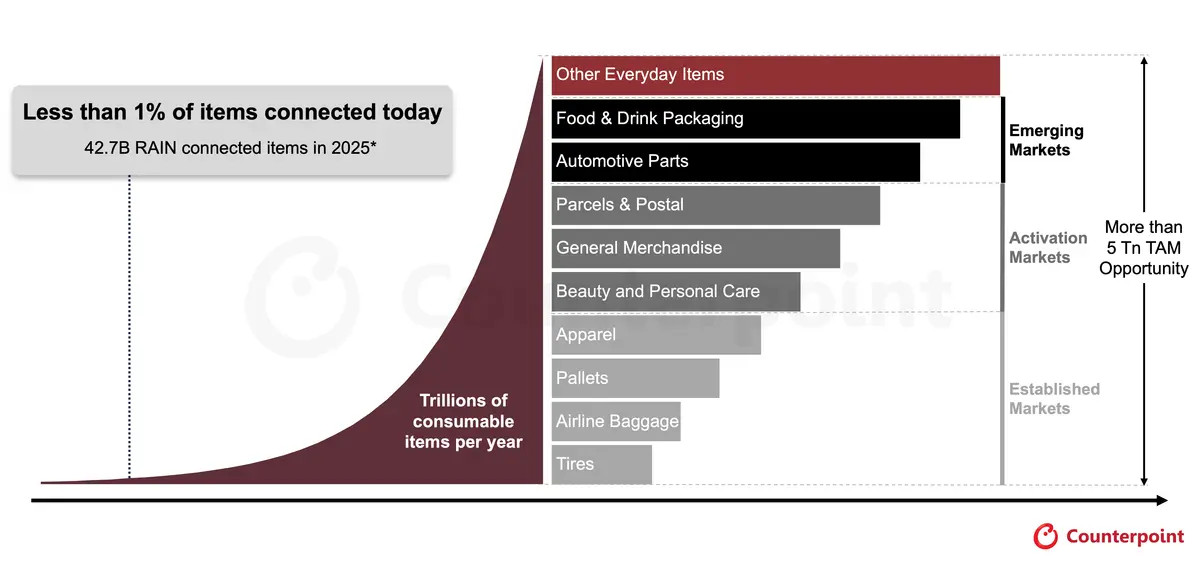
Source: Impinj, Counterpoint Research
*RAIN Alliance, RAIN Alliance reports shipments of 42.7Bn RAIN Tag Chips Globally in 2025


