

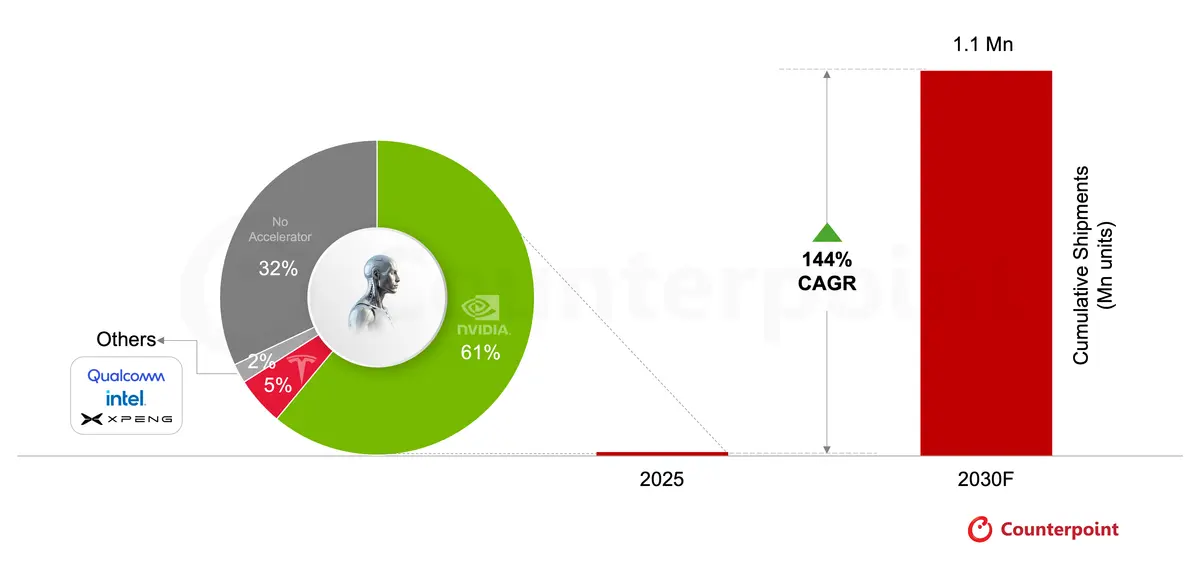
- Global humanoid robot AI accelerator cumulative shipments are expected to surpass one million units by 2030, growing at a CAGR of 144% between 2026 and 2030.
- GPUs will remain the dominant near-term compute architecture, but AI ASICs will evolve with the mass adoption of humanoid robots.
- NVIDIA currently leads the humanoid robot AI accelerator market, while Qualcomm and Intel are securing design wins.
- Tesla and Xpeng are poised to reshape the humanoid robot AI accelerator landscape by leveraging automotive expertise, custom silicon and vertical integration, while D-Robotics is strengthening China’s domestic ecosystem.
- AI accelerator competition is expected to intensify beyond 2027 as heterogeneous architectures gain momentum and next-generation accelerators enter mass production.
Beijing, Berlin, Buenos Aires, Fort Collins, Hong Kong, London, New Delhi, Seoul, Taipei, Tokyo – October 26, 2026
Global humanoid robot AI accelerator cumulative shipments are expected to exceed one million units by 2030, with a CAGR of 144% between 2026 and 2030, according to the latest Counterpoint Research’s Global Humanoid Robotics Tracker. GPUs are expected to remain the dominant compute architecture as vision-language-action (VLA) and world models combine to create artificial general intelligence (AGI) in the future. AI ASICs are similarly gaining traction, with vertically integrated humanoid robot makers such as Tesla and Xpeng transitioning technologies from automotive to humanoids.
As humanoid robots move toward general-purpose physical AI applications, compute architecture will evolve alongside brain model advances. NVIDIA currently dominates the humanoid robot GPU segment with a complete stack, from compute to models to simulation. In contrast, Qualcomm has entered this market to challenge NVIDIA’s position by offering heterogeneous compute architecture, delivering power efficiency and lower bill-of-materials (BoM) costs.
Commenting on market dynamics, Principal Analyst Soumen Mandal said, “The humanoid brain compute ecosystem is shifting from GPU dominance towards coexistence of multiple AI compute architectures. As humanoid robot models are moving from VLA to world action model (WAM) and emerging routes, dedicated AI compute is becoming more important for delivering higher performance with lower thermal constraints and improved power efficiency.”
Global Humanoid AI Accelerator Shipments Forecast, 2025-2030
Source: Counterpoint Research Global Humanoid Robot Tracker
NVIDIA currently leads the humanoid robot AI accelerator market, supported by its early entry and strong collaborations with leading robot makers such as AGIBOT, Unitree, UBTech, Galbot, Figure AI, Neura Robotics, and Noetix Robotics. Qualcomm is building momentum through partnerships with Neura Robotics, VinMotion, Booster Robotics, and Figure AI, but its shipment scale remains significantly lower than NVIDIA’s. The competition is expected to further intensify beyond 2027 as AI accelerators capable of supporting AGI workloads are set to enter mass production by then.
Commenting on the market outlook, Associate Director Ethan Qi said, “Humanoid brain compute architecture serves the advancement of embodied foundation models; GPUs remain the preferred option for on‑device deployment of state‑of‑the‑art models, while EV firms represented by Tesla will act as primary drivers of ASIC architectures. Additionally, GPT‑6 Astra has sparked a technical debate between the LLM‑first and VLA paradigms; the resulting cloud infrastructure will help drive the adoption of hybrid solutions such as SoCs.”
Tesla and Xpeng Motors are well positioned, leveraging their automotive expertise along with custom silicon, proprietary AI models, and vertical integration across hardware and software. Meanwhile, China’s D-Robotics, a spin-out of Horizon Robotics, has already partnered with Leju Robotics and LIMX Dynamics, positioning itself to play a larger role in humanoid robot compute and software as the market scales.
About Counterpoint Research
Counterpoint Research is a global market research firm specializing in products across the technology ecosystem. We advise a diverse range of clients – from smartphone OEMs to chipmakers and channel players to Big Tech – through our offices located in the world's major innovation hubs, manufacturing clusters and commercial centers. Our analyst team, led by seasoned experts, engages with stakeholders across the enterprise – from the C-suite to professionals in strategy, analyst relations (AR), market intelligence (MI), business intelligence (BI), product and marketing – to deliver services spanning market data, industry thought leadership and consulting. Our core areas of coverage include AI, Automotive, Consumer Electronics, Displays, eSIM, IoT, Location Platforms, Macroeconomics, Manufacturing, Networks and Infrastructure, Semiconductors, Smartphones and Wearables. Visit our Insights page to explore our publicly available market data, insights and thought leadership, and to understand our focus, meet our analysts and start a conversation.
Follow Counterpoint Research

