

Europe moves from pilots to production
It was great to attend my third GTC of 2026, this time in Berlin. It builds on the main event in San Jose in March, which set the base for this year (our take: NVIDIA GTC 2026, Groq, Tokenomics, CMX).At the Tempodrom on 21 October, Jensen Huang laid the foundation for Europe’s next AI phase. The focus is now on execution at industrial scale. NVIDIA wants to make it easier to build gigawatt-scale, secure AI factories in Europe. There was no new GPU. The keynote was about platforms, partners and reference designs.
The numbers show how big the push is. NVIDIA has invested nearly $10 billion in Europe over the past 12 months and works with more than 12,000 partners. Jensen’s Europe tour through Paris, London, Stockholm and Dublin added 14 startup investments in the last week alone. This is a playbook for building the full ecosystem around the NVIDIA stack.

Jensen’s main message was that Europe should produce AI and not just consume it. He described AI as a five-layer cake of energy, chips, AI factories, models and applications. The infrastructure has to come first.
My key takeaways:
- Time to token is now a competitive advantage. The Vera Rubin DSX POD makes the container the AI factory. Onsite deployment drops from about six months to 14 days.
- Agent safety is built into the hardware. The OpenShell Reference Architecture runs governance on BlueField-4, with sandboxing and policy controls enforced in silicon.
- Sovereign AI is getting practical. Companies can take open models like Nemotron, train them on their own data and run them on their own infrastructure.
- Physical AI suits Europe’s strengths. In automotive, Mercedes-Benz, Volkswagen, Volvo and JLR are on NVIDIA Hyperion and Alpamayo, and there is a new reference humanoid built on Isaac GR00T to scale humanoid adoption in the region.
- Telco networks become AI infrastructure. NVIDIA put the opportunity at around 100 GW across 100,000 sites, pushing for distributed telco-driven AI infrastructure.
AI Factory in a Container
The Vera Rubin DSX POD was one of the most practical announcements of the day. It is a reference design for a complete Vera Rubin AI factory, built by partners inside modular containers and tested before delivery. Once a site is ready, onsite deployment can drop from around six months to as little as 14 days.
The idea is to move the hard work into the factory. Compute, networking, cabling, rack power and liquid cooling are put together and tested before shipping. The site is prepared at the same time. NVIDIA already did this at rack level with NVL72, and DSX POD takes it to the whole cluster.

Source: NVIDIA
Seventeen partners will deliver DSX POD from early 2027: Anduril, Armada, Bull, Crusoe, DayOne, Dell, Delta, Eaton, Foxconn (Ingrasys), GIGABYTE, HPE, Lenovo, Pegatron, QCT, Schneider Electric, Vertiv and Wistron. The list covers server OEMs, Taiwanese ODMs, power and cooling suppliers, and defence and edge players.
Time to token is a revenue lever. Jensen said a 1 GW AI factory can bring in about $40 billion in revenue per year. Using that figure, each month of delay at 1 GW costs roughly $3.3 billion (our calculation). With DSX POD, building a $50 billion AI factory gets a lot simpler.
One caveat. The 14 days start only after power, cooling and networking are in place at the site. In Europe, grid connections and permits take the longest. DSX POD speeds up the last step but does not solve the first one, which will be worked upon, but overall time to market can be pulled back significantly.
NVIDIA also addressed power, water and grid access through the wider DSX AI Factory Platform:
- Water: closed-loop liquid cooling with dry coolers and coolant up to 45°C. NVIDIA says this brings cooling water use close to zero, saving 54 million litres a day at 2 GW.
- Power: DSX MaxLPS shifts power within a fixed budget and can deliver the same tokens with up to 30% less power. Nscale saw 49% more inference throughput on four GB300 NVL72 racks in Iceland on the same 264 kW budget.
- Grid: DSX Flex lets an AI factory act as a flexible load. In a trial with Emerald AI, EPRI, Nebius and the UK National Grid, cluster power draw fell by up to 40% during simulated grid events.
- Operations: new open source DSX OS tools for network setup, rack management and cluster checks.
The direction makes sense, though, and the numbers will change based on geographic conditions and scale to be deployed. In Europe, the limit is megawatts and permits, and NVIDIA now has software to get more out of each megawatt.
Sovereign AI gets more practical
Sovereign AI is made simpler by NVIDIA with an open model like Nemotron, post-train it on your own data, and enterprises can get sovereign intelligence. NVIDIA provides the models, the data and the training recipes.
The open model lineup keeps growing. It now includes Nemotron 3.5 Super VL and Bolt, Nemotron Retriever for search and document parsing, a new Kumo family for structured business data, Cosmos 3.5 world models, Alpamayo 2 Edge for cars, BioNeMo for protein design and Ising for quantum calibration. European labs Mistral, Black Forest Labs and H Company are part of the Nemotron Coalition that helps build these models.
The keynote showed three customer examples. In each, a post-trained Nemotron model was compared with an OpenAI model on the customer’s own task.

Source: NVIDIA
For European companies, that is what sovereignty really means: control over data, cost and where the model runs. The new Agent Knowledge Foundation, with retrieval, reranking and Kumo prediction models, connects these models to company data.
Germany adds a policy push. Chancellor Friedrich Merz and two federal ministries signed a Joint Declaration of Intent with NVIDIA on physical AI models for German industry. Local control, open tools and industrial use cases all point in the same direction.
Safe agents, built into the stack
Another big announcement was the OpenShell Reference Architecture for Safe AI Agents. It brings agent security into the infrastructure itself. NVIDIA believes agent safety is an engineering problem, so it has to be solved in the system and not left to the model alone.
The agent can be divided into five parts: a model, a harness that runs its work and memory, a sandbox around the harness, knowledge and tools. Once an agent can reach files, networks and tools, it should get only the access it needs and be watched all the time. Every time an agent starts, its privileges are different.
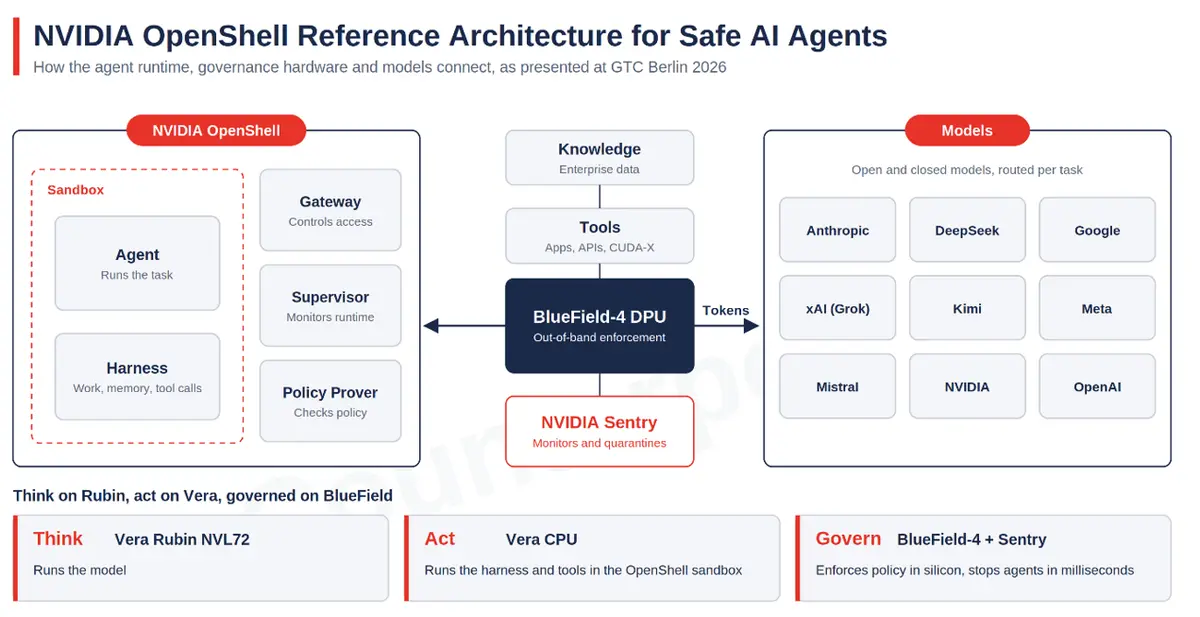
OpenShell combines sandboxing, controlled access, credential protection and verified policies, enforced outside the agent workload. OpenShell governs how agents interact with enterprise systems, data and services.
Agent-native: OpenShell separates agent logic and every action sees thorough policy enforcement.
Governance: Defined access and pre-defined access controls, guardrails. OpenShell enforces policy outside the agent process.
NVIDIA summed up the design as agents that think on Rubin, act on Vera and are governed on BlueField.
Sentry on BlueField-4 sits outside the host, so an agent that goes wrong cannot turn it off. If an agent steps outside its limits, NVIDIA says Sentry stops it within milliseconds. NVIDIA also says this offload adds up to 20% more agent capacity.
More than 100 partners are on board, including Anthropic, Google, Meta, OpenAI, Cohere and Perplexity on the model side. Security vendors CrowdStrike, Palo Alto Networks, Check Point, Zscaler and Cisco are integrating it. SAP and ServiceNow are building it into their agent platforms, and BBVA and Santander are testing it. The architecture is available now and also runs at the edge on RTX Spark, DGX Spark and DGX Station.
Our view: Every governed agent deployment is a reason to buy a BlueField-4 DPU next to the GPU and CPU. It also puts NVIDIA in the position of a neutral safety layer across competing model providers, which is hard for any single AI lab to offer.
The open question is mixed environments. Companies run agents across clouds, SaaS tools and non-NVIDIA hardware. OpenShell is open source, but in-silicon enforcement only works where BlueField is installed.
Physical AI from Healthcare to Mobility
Physical AI is picking up pace across Europe, from healthcare to mobility. This is where Europe’s industrial base and NVIDIA’s stack fit together well. Jensen called it the next frontier, and the robotics news in Berlin focused on making it easier for developers to get started.
The main robotics announcement was Agile ONE SN, a reference humanoid from Munich-based Agile Robots built on Isaac GR00T. It is aimed at researchers, with Stanford and ETH Zurich already interested, and is due in Q1 2027.


The goal is to save setup time. Today, researchers have to connect separate tools for simulation, training and deployment. Agile ONE SN comes with the full workflow preloaded, which NVIDIA says cuts setup from weeks to days. NVIDIA also released Isaac Lab 3.0, the Isaac OS runtime, more than 2,000 simulation-ready assets and a Human 1M dataset of human activity video.
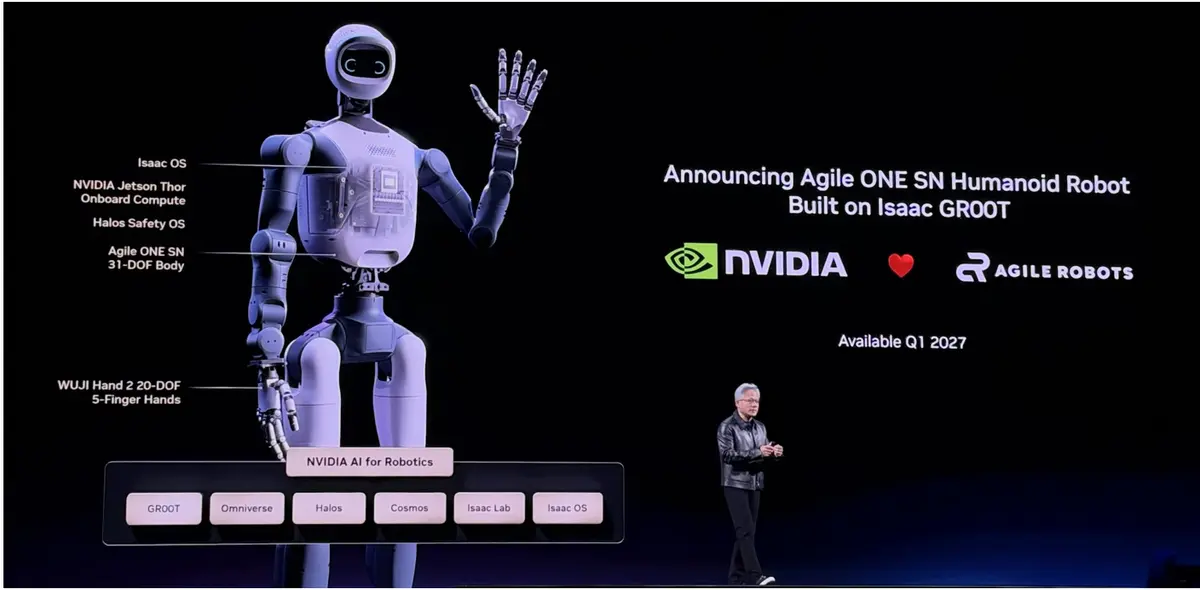
The ecosystem slide shows how wide the platform has become. NVIDIA listed eight model builders (Black Forest Labs, Flexion, Generalist, Genesis, Physical Intelligence, Runway, Sereact, Skild AI) and 20 robot platforms, including 1X, ABB Robotics, Agility, Boston Dynamics, FANUC, Figure, KUKA, NEURA, Siemens and Yaskawa. Many are European, including ABB, KUKA, NEURA, Sereact, Humanoid and Hexagon. Schaeffler is also supplying actuators for the Newton physics engine.
In healthcare, NVIDIA and Siemens Healthineers are working on robotic radiotherapy that adjusts as the patient moves. Nemotron agents plan the treatment, Omniverse creates a digital twin of the machine and the patient, and Holoscan on IGX Thor feeds live images so the beam can be adjusted in real time. As Jensen explained, the tumour changes shape during therapy, so the system has to keep up.

All of this follows NVIDIA’s three-computer model. Train in the data centre, simulate in Omniverse and run on Jetson or IGX Thor at the edge. Every new robot or medical device is another Thor design win.
During the GTC keynote, NVIDIA founder and CEO Jensen Huang showed off how AI agents running on RTX Spark can be used to train Hugging Face’s Microduck robot using NVIDIA Isaac Lab, Hermes Agent and Nemotron 3.5 Bolt 74B.
Fantastic showcasing the power of NVIDIA RTX & DGX Spark-based PCs leveraging Agentic AI to build, program, simulate and control workflows for robots to thrive in the physical world. Agentic AI accelerating Physical AI deployments, in short. Rolling out in a big way across Europe.
Europe’s automakers build on Hyperion
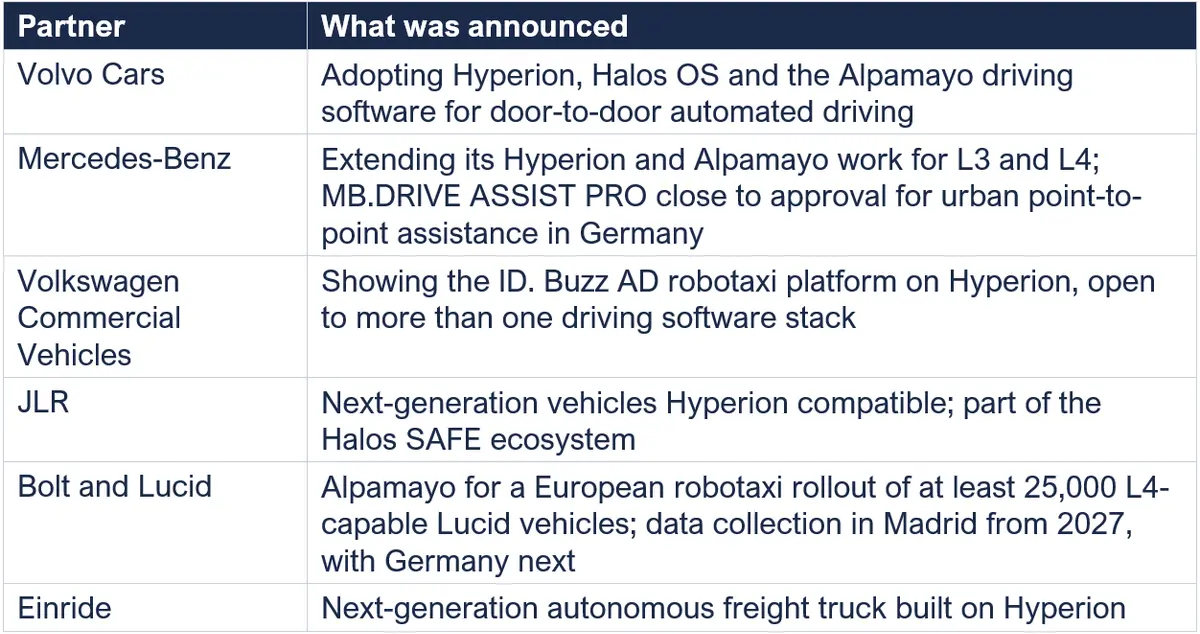
Mercedes-Benz, Volkswagen, Volvo and JLR all announced next-generation vehicles that will be compatible with NVIDIA Hyperion. German and European industrial strengths are now being combined with NVIDIA’s stack.

Source: NVIDIA
The global Hyperion ecosystem is now wide. It covers mobility ridesharing platforms Bolt, Grab, Lyft and Uber, AV software companies such as Wayve, Nuro, Pony.ai, WeRide, Momenta, Motional and Waabi, and carmakers from BYD, Geely and Zeekr to Hyundai, Nissan, Stellantis and Lucid. Suppliers Aptiv, Valeo and Schaeffler are building Hyperion compute boards that any carmaker can use.
Safety certification is the key part of the stack here. NVIDIA announced the new Halos SAFE framework, built with dSPACE, IVEX and TÜV Rheinland, which links simulation, lab tests, road tests and fleet monitoring into one safety record. European carmakers face strict approval rules, so a ready path to safety evidence is as valuable to them as the DRIVE AGX Thor chip.
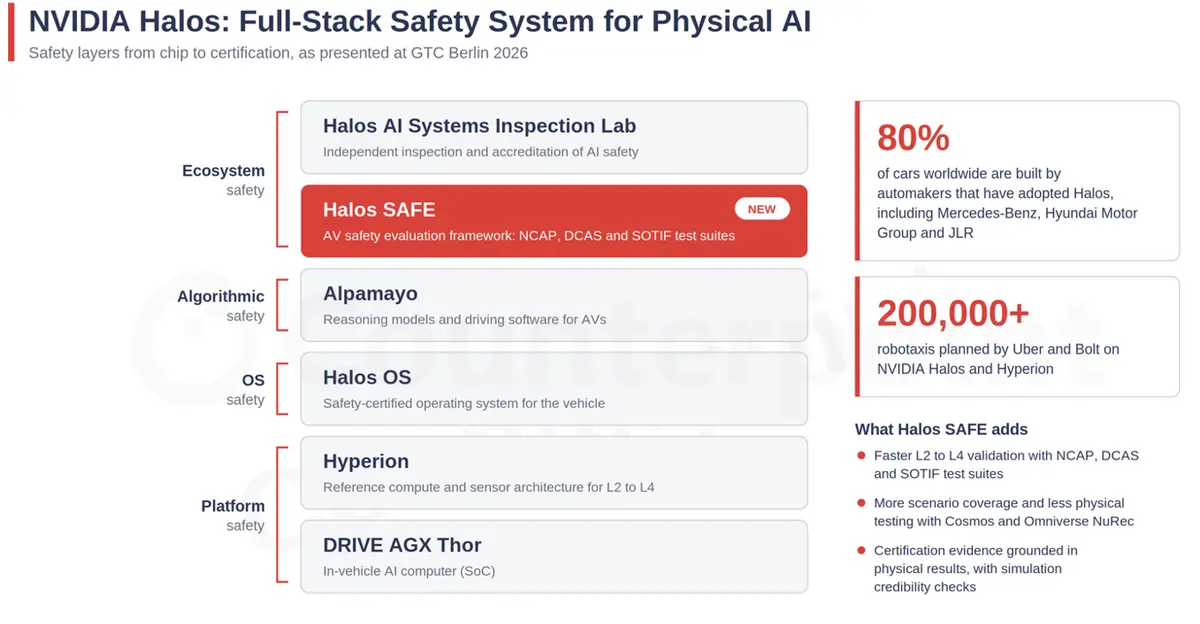
Source: Counterpoint Research, NVIDIA
On software, Alpamayo 2 Edge is a 2-billion-parameter reasoning model that runs at 10 Hz on DRIVE Thor. Porsche, which is leading a data workflow across Volkswagen Group brands, expects Cosmos-based simulation to cut repeated physical test drives by up to 90%.
Our view: Hyperion is becoming a common compute and sensor base for cars, much like Android for phones. Carmakers can run their own software or NVIDIA’s. The risk for them is the same one phone makers faced, where value moves to whoever owns the software and the data.
Europe’s ecosystem, Telcos and one CUDA
NVIDIA is building the European ecosystem that buys its platform. The closing slide put it in three numbers: about $10 billion invested over the last year, 14 new startup investments this week, and more than 12,000 companies in its European ecosystem.
Investing in the ecosystem. At the Invest in Germany Summit, Jensen announced planned investments in Agile Robots, Avelios Medical, Mirelo and Reflex Aerospace. These add to earlier stakes in n8n, NEURA Robotics and Black Forest Labs. In Paris, NVIDIA backed Doctolib, Genesis AI, Pigment and Entalpic. Agile Robots is now an NVIDIA investee and also the partner behind the new reference humanoid, so investment and platform go hand in hand.
Telcos as distributed AI infrastructure. Jensen put the telco opportunity at about 100 GW of distributed capacity across 100,000 sites. This is the “Telcoscaler” opportunity. Operators already own the land, power, fibre and spectrum, which is the base of the five-layer cake. The telecom announcements included:
- T-Mobile and Nokia completed the first AI-RAN call on a commercial network. As Jensen said, “Now CUDA makes phone calls.
- BT, Deutsche Telekom, Elisa and Orange are testing Nokia’s anyRAN software on NVIDIA’s Aerial RAN Computer, with field trials and commercial services planned for 2027.
- Nine operators in Europe, the Middle East and Africa, including Deutsche Telekom, TIM and Fastweb + Vodafone, are building or expanding NVIDIA-powered infrastructure.
- Deutsche Telekom’s Industrial AI Cloud already serves robotics companies such as Agile Robots.
This gives operators a way to sell compute and inference on top of connectivity. Combined with the agent safety tools, it also supports wider adoption by enterprises and the public sector. The challenge is economics. Edge sites are small and spread out, so usage and payback will decide how fast this scales.
One CUDA, many markets. Jensen’s “productive, fungible and durable” slide explains NVIDIA’s moat. The same CUDA architecture serves six customer groups: cloud providers, AI labs, more than 10,000 AI startups, neoclouds, server makers, and enterprise and industrial buyers. Each segment balances the others, and the 11 million developers on CUDA make switching harder. CUDA remains the crown jewel for NVIDIA.
Counterpoint Key Takeaways
GTC Berlin was all about platforms, partnerships and reference architectures to help speed up AI across Europe. Europe does not need to outspend the US or Asia on model scale. It needs to lead on industrial AI, sovereign deployment and safer physical systems, and Berlin gave it the tools for all three.
What NVIDIA got right
- It addressed the real constraints. Power, water, grid access, deployment speed and agent safety all now have an NVIDIA answer as part of the platform.
- Reference designs help the whole ecosystem. DSX POD, OpenShell, Hyperion and Agile ONE SN give partners a tested starting point. That shortens sales cycles for OEMs, ODMs, carmakers and robot makers. It accelerates Cloud AI and Physical AI deployments.
- Safety is now part of the hardware plan. Running agent governance on BlueField-4 gives CISOs something concrete to approve.
What to watch
- 2027 timelines. DSX POD, Agile ONE SN, Alpamayo Agentic Factory and most AI-RAN services arrive in 2027. Execution is the story for next year.
- Sovereignty and dependency. Open models and local data centres give Europe control of data and deployment. The stack underneath, from CUDA and NVLink to BlueField and Thor, still comes from one vendor. European buyers will need to weigh that.
- Grid timelines. A 14-day install does not help much if the grid connection takes three years. DSX Flex helps, but permitting and grid investment will decide how fast Europe’s AI factories come online. The Go-to-Market execution into days, if there is an added premium for this (I bet), SLAs around this from NVIDIA or customers paying premium for the Pods?
- Vendor numbers. The 30% power savings, accuracy gains and 20% agent capacity uplift are NVIDIA or partner figures. We will look for independent results as deployments go live.
Jensen asked Europe to produce AI and not just consume it. With modular AI factories, telco edge build-outs, agent safety and full-stack software, NVIDIA has made itself the easiest way to do that. The next question is how Europe uses it on its own terms.

