

- NVIDIA is expanding its GeForce NOW cloud gaming service and India is the latest pivotal market to join the list, with open beta coming soon.
- The service supports over 4,500 titles, including most AAA and 100+ free-to-play games.
- Powered by NVIDIA RTX 5080 (Blackwell)-class servers, users can now stream up to 4K 120fps, and up to 1080p 360fps for competitive games.
The wait is finally over! After initially announcing it at CES 2025, NVIDIA is set to bring its GeForce NOW (GFN) cloud gaming service to India soon. This marks a major milestone, launching in one of the world’s fastest-growing and high-scale gaming markets, India. Steam, one of the leading digital distribution platforms for PC gaming, has seen over 2x growth in PC gamers in India over the last five years. Timing is ripe, as average broadband download speeds in India are now touching 50Mbps, and networks are capable of delivering 4K 60fps gameplay, key tailwinds for the adoption of premium cloud gaming. With GPU and memory prices skyrocketing, a cloud gaming subscription makes more sense in the near- to mid-term instead of an upfront investment in a high-end gaming PC.
GFN is already present in over 100 countries and has over 30 data centers, with India the latest to join. GFN servers are already live in Mumbai, and an Open Beta is expected sometime in Q1 2026.
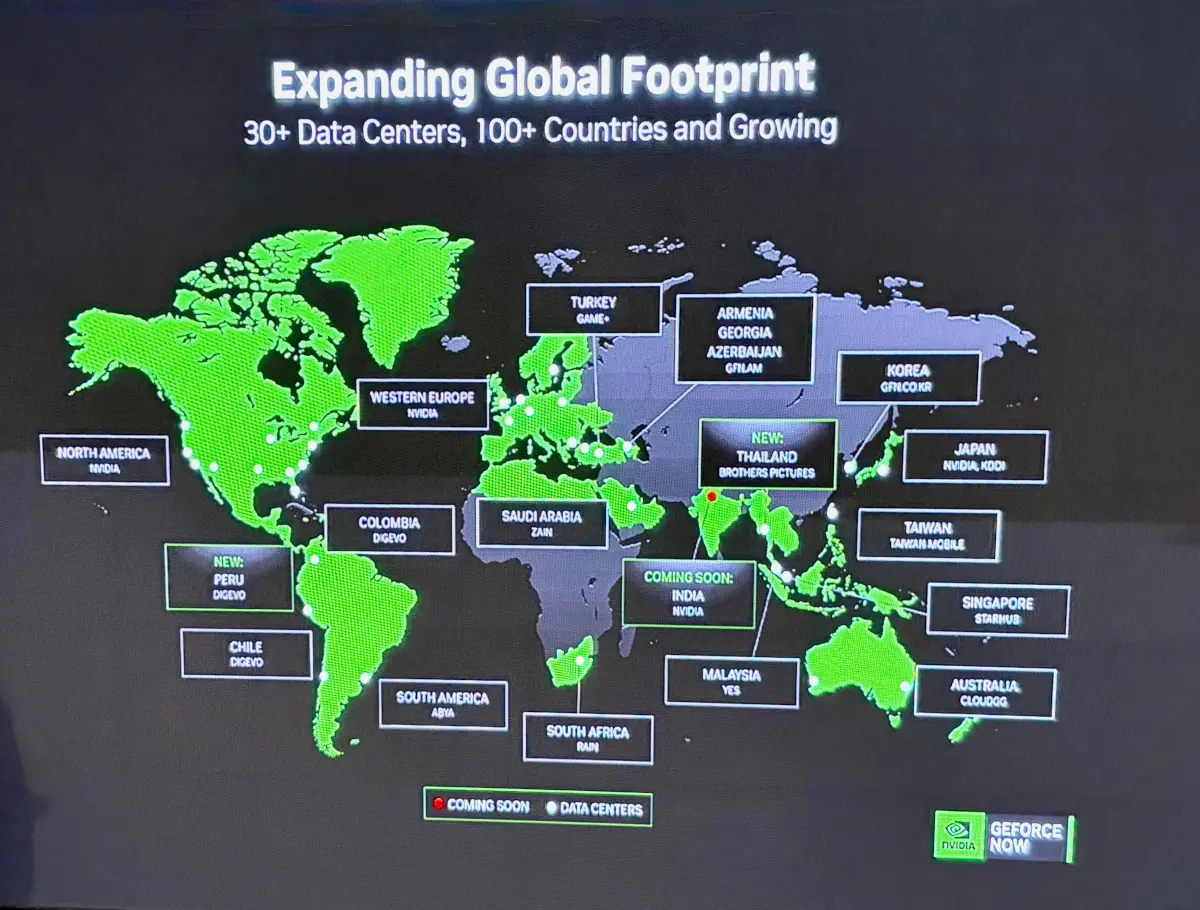
At an exclusive preview event in Mumbai, NVIDIA offered Counterpoint a sneak peek of its latest cloud gaming service, showcasing some stimulating gaming demos possible across a range of devices.
NVIDIA RTX 5080 Blackwell-powered gaming — Without the PC
At its core, GFN is powered by NVIDIA’s flagship Blackwell GPU-based RTX 5080 SuperPODs. NVIDIA has also updated servers with AMD CPUs clocked at 4.4GHz, featuring 8 cores and 16 threads.
As latency is the make-or-break factor for cloud gaming, NVIDIA is leaning heavily on its software and networking stack to address it. There is upgraded support for ConnectX-7 adapters, hardware pacing technology RiverMax, and NVIDIA Reflex to reduce click-to-photon latency (the delay between your input and action on the screen), thus offering ultra-fast data speeds and low-latency gaming.
The Blackwell architecture also unlocks advanced features such as DLSS 4, AI frame generation, ray tracing and cinematic streaming.
Simply put, GFN is a cloud gaming service where you get a high-end gaming PC in the cloud. NVIDIA’s goal is to deliver high-quality PC-level gaming visuals and experience with minimal compromise. So, unlike traditional gaming, where you need a laptop or desktop with a powerful GPU at home, GeForce NOW streams games from NVIDIA’s data centers to your device, whether it is a smartphone, a basic laptop like a Chromebook, a tablet, or even an affordable Android smart TV.
WATCH: Counterpoint Conversations: NVIDIA RTX 5080 Blackwell Powered GeForce NOW to Deliver Low-Latency Cloud Gaming to Every Screen
How is NVIDIA GeForce NOW different from Microsoft’s Xbox Cloud Gaming?
The idea of cloud gaming is the same for both NVIDIA and Microsoft offerings – it eliminates the need for expensive hardware or gaming rigs. However, they work on different philosophies.
GeForce NOW streams the game from NVIDIA's data centers to your device, allowing you to play demanding titles on a standard laptop, smartphone, or smart TV. Basically, it lets users connect and play their existing PC games from libraries such as Steam, Epic Games, Ubisoft, and Xbox Game Pass. In short, if you own a game, you can stream it — no downloads, no installations, and no expensive hardware upgrades. There are over 100 free-to-play games that come with GFN. Overall, with over 300 publishers, one has access to a library of more than 4,500 games, including popular AAA titles such as Cyberpunk 2077, Gears 5, Assassin’s Creed, Far Cry and Diablo IV, that you can play with GFN. But the game developer needs to enable cloud gaming by clicking on the checkbox.
In terms of resolution support, with GFN, you can get up to 4K 120fps, 1440p at 240fps and 1080p at 360fps for competitive games, provided your screen supports up to 360Hz refresh rate. But the experience will depend on your internet bandwidth. A 25 Mbps connection can get you 1080p, whereas a 100 Mbps connection can get cinematic quality streaming.
Microsoft’s Xbox Cloud Gaming subscription, on the other hand, gives you access to hundreds of games in the Xbox Game Pass library that you can stream and play on your smartphone, PC or console, without downloading them. You don’t necessarily need to own the games, and you can play them as long as the subscription is active. Microsoft’s cloud gaming is capped at 60fps and a maximum resolution of 1080p. These are also Xbox version games, and not PC versions, which also means they are not as visually rich and lack many of the features that RTX enables. This is where the NVIDIA GeForce Now differentiates and shines.
Hands-on and first impressions: Power of Blackwell on every screen
NVIDIA did a great job of demonstrating the cloud gaming capability on any device. There were two things that instantly stood out – the range of devices on which you can play, and the low-latency gaming.
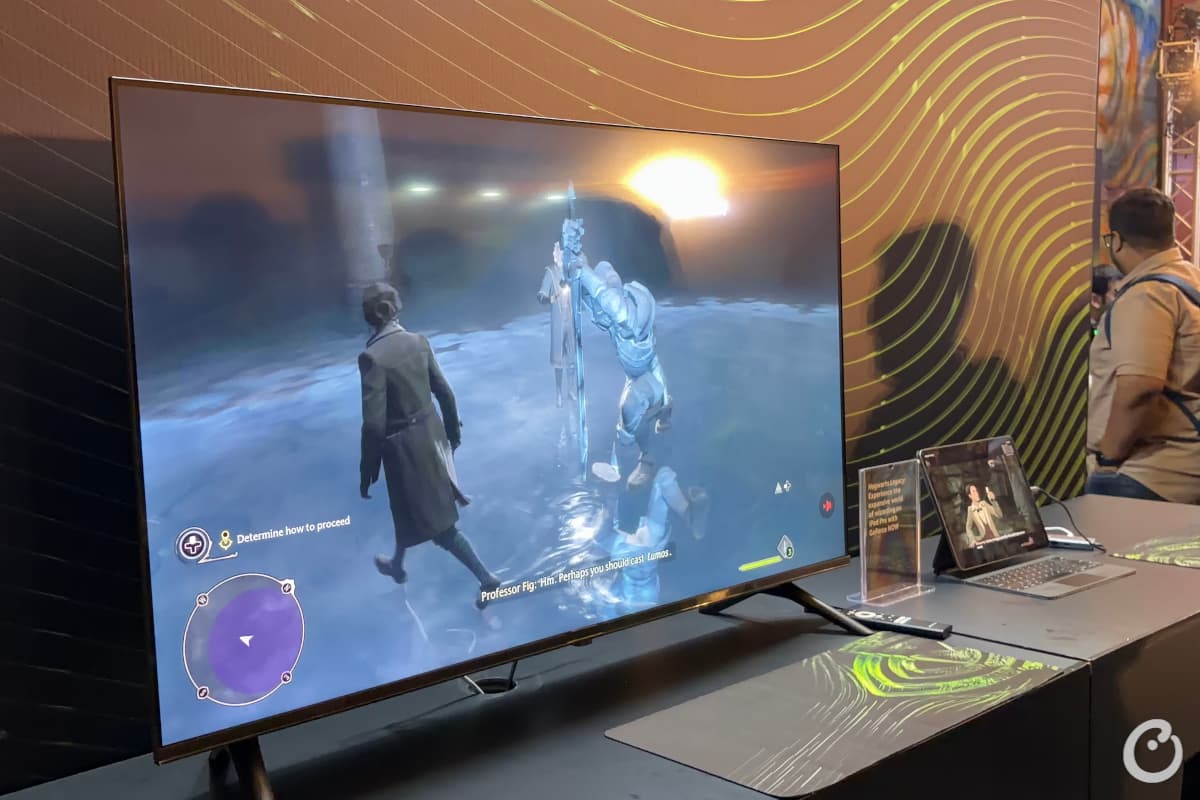
The demo zone had everything from an iPhone 13 to a three-year-old OnePlus 10T, an average ChromeBook laptop to a basic Android TV, a MacBook Air to a six-year iPad Pro with the A12z Bionic SoC, a thin-and-light Intel-powered Ultrabook to a high-end gaming PC, and handheld gaming consoles like Steam Deck and Lenovo Legion Go. All these devices were running different games – from Forza Horizon 5 to Hogwarts Legacy to Arc Raiders and more.

Below are some of the impressive stats from our hands-on experience:
· Battlefield 6 on an Acer Chromebook Plus Spin got around 60fps with a ping of 2ms.
· Black Myth: Wukong Experience on a MacBook Air logged around 87-90fps with a ping of 2ms.
· Forza Horizon 5 on a OnePlus 10 Pro logged around 118fps with a ping between 4ms and 7ms.
· Arc Raiders on a high-end gaming PC logged around 379fps with 2ms ping.
· Cyberpunk 2077 on a Dell Latitude 7420 logged 134fps and a ping of 2ms.
· Doom: The Dark Ages on a thin-and-light Ultrabook logged 100fps, and 2ms ping.
· Hogwarts Legacy on an iPad Pro logged 60fps with 2ms ping.
· Indiana Jones: The Great Circle on a Lenovo Legion Go logged 200fps and 3ms of ping.
Clearly, these numbers are impressive across all these device types and showcase the true capabilities of what cloud gaming can deliver.
More ways to play
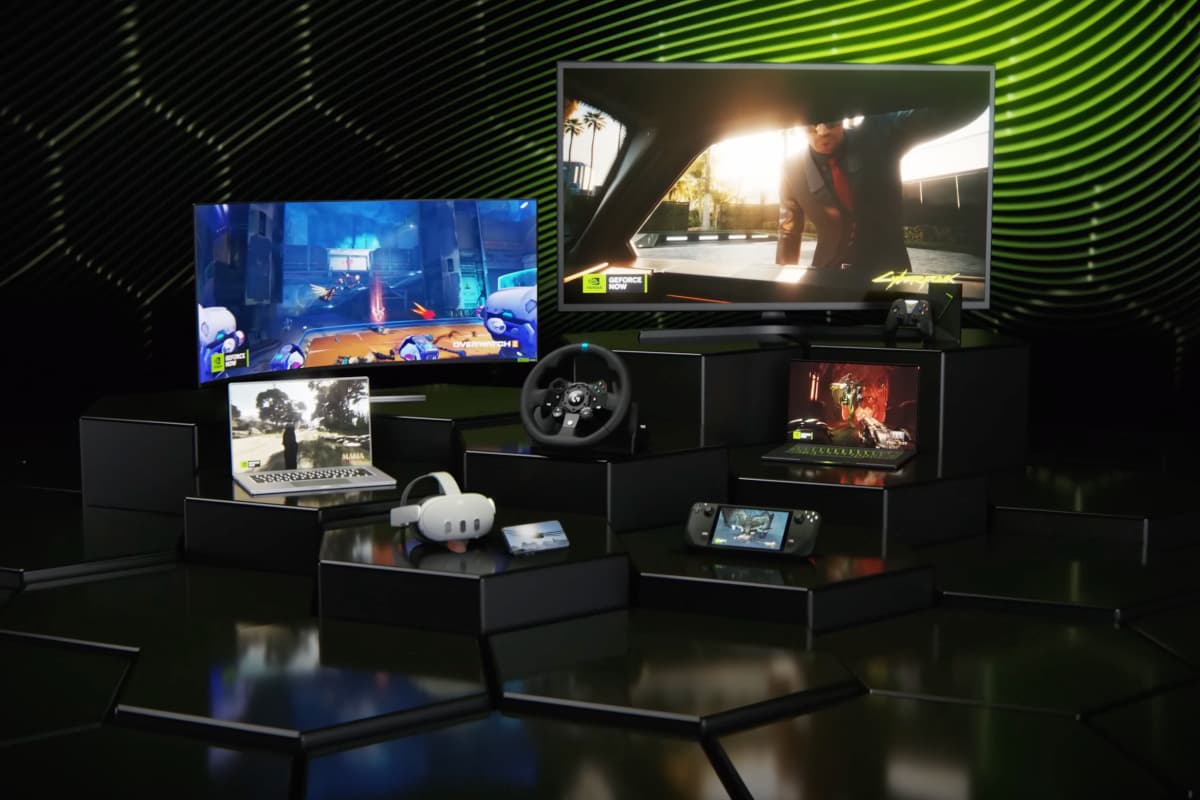
GeForce NOW isn’t just limited to keyboard and mouse. NVIDIA is positioning the platform as device-agnostic, which means it supports controllers and joysticks, steering wheels for racing titles, and VR display compatibility on devices like Meta Quest. NVIDIA also announced a native Linux client, expanding access beyond Windows and macOS.
India pricing, telco partnership opportunity
NVIDIA hasn’t announced the pricing for India, nor hinted at the gaming tiers it will have in the country. But an open beta is expected soon, with pricing to follow later. Given that India is a competitive market, we expect the pricing to be reasonable. It needs to be seen if it can undercut Microsoft or will be slightly expensive.
While the local data center in Mumbai is a vital first step, NVIDIA must seek deep partnerships with telcos like Jio and Airtel to solve the “last mile” problem. By leveraging their native CDN/CDSN solutions, compute can be pushed to the very edge of the network, ensuring the sub-20ms latency required for competitive play. This could be a new tier for some pro gamers and also a monetisation opportunity.
Deeper telco partnerships are key to mass-market accessibility, especially in a huge country like India. Recent high-impact tie-ups, such as Airtel-Perplexity/Adobe and Jio-Google Gemini, prove that bundling premium services with monthly recharges is the most effective way to scale in India. By bundling a base tier of AAA cloud gaming, NVIDIA can further create a clear upgrade path to high-paying tiers with additional lower latency. In a mobile-first market like India, telcos can further enhance this by using 5G network slicing to prioritize gaming traffic over standard browsing, ensuring a lag-free experience even on the move.

