
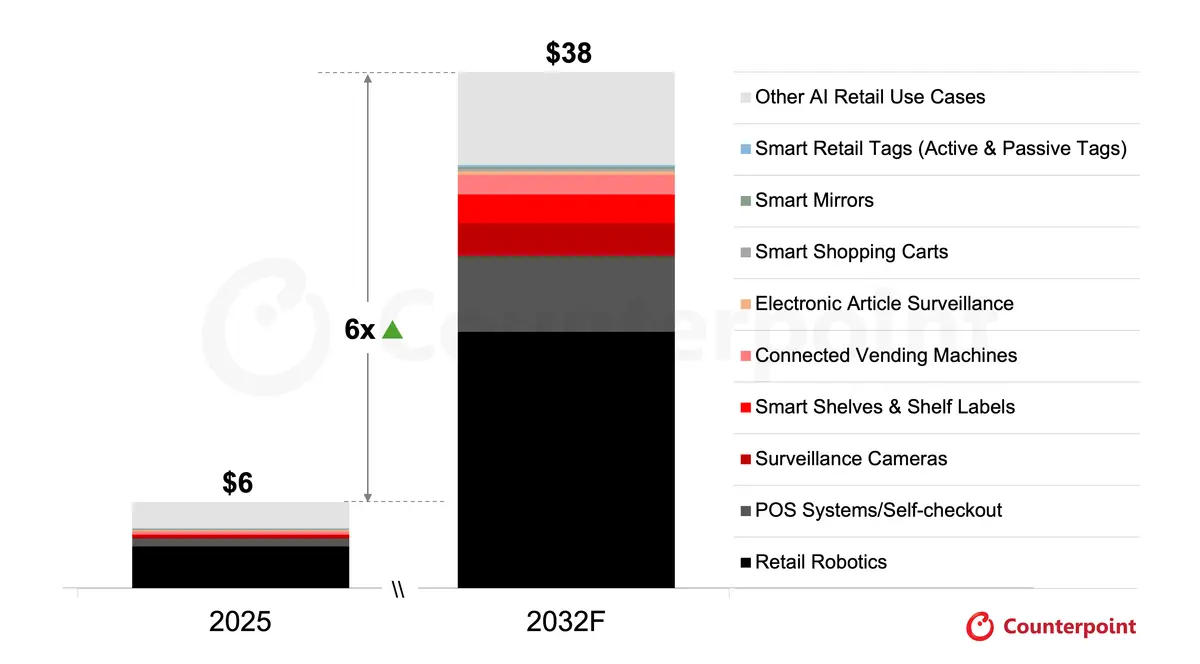
- Edge AI revenue in the retail industry is projected to reach $38 billion by 2032.
- Edge AI penetration in in-store retail device shipments is projected to reach nearly 50% by 2032.
- Advancements in processors and AI models are driving the shift from cloud-based to hybrid edge-cloud architectures, allowing latency-sensitive tasks to be processed locally for greater privacy and efficiency.
- Smart shelves (including electronic shelf labels) and smart retail tags are expected to be the fastest-growing categories, with a combined CAGR of 77% between 2025 and 2032, while retail robotics is projected to generate nearly half of the total Edge AI revenue in the retail industry by 2032.
Beijing, Berlin, Buenos Aires, Fort Collins, Hong Kong, London, New Delhi, Seoul, Taipei, Tokyo – November 19, 2026
Artificial intelligence (AI) is reshaping the retail landscape, as connected devices evolve into intelligent systems capable of processing information and making decisions locally. The retail industry has been slower to adopt advanced automation and intelligence technologies, largely due to its thin profit margins. However, the industry has significant growth potential. According to Counterpoint Research’s latest Edge AI in Retail Industry: Global Market Outlook 2023-2032F report, Edge AI revenue in the retail industry is projected to reach $38 billion by 2032, up from around $6 billion in 2025.
The growing penetration of Edge AI-capable devices reflects a broader transition in retail technology. Retailers have traditionally relied on store staff and conventional devices to process transactions, monitor stores, and collect operational data, while more advanced analysis has taken place in the cloud or on centralized servers. Edge AI is changing this model by enabling devices to analyze data where it is generated and automate tasks once handled manually. This gives retailers the real-time insight they need for checkout automation, inventory management, loss prevention and customer engagement, while cutting response times and reducing the need to send large amounts of raw data to remote systems.
Edge AI penetration in in-store retail device shipments is projected to reach nearly 50% by 2032, driven by advancements in processors, rapid NPU miniaturization, and smaller, more efficient AI models. Together, these make it possible to run AI inference locally on embedded SoCs, microcontrollers, and microprocessors using models trained in the cloud. Latency-sensitive tasks that need immediate responses, such as detecting suspicious activity on security cameras or flagging unusual transactions, can run directly on devices, while more demanding activities, such as demand forecasting, multi-store analysis and AI model training, remain in the cloud.
Commenting on retail industry trends, Principal Analyst Tina Lu said, “Edge AI in retail is no longer limited by what the chip can do. With NPUs moving into everyday SoCs and microcontrollers, and models shrinking to fit them, intelligence is spreading from cameras and robots to the smallest devices on the shop floor, right down to shelf labels and tags. Processing data on the device cuts latency and keeps sensitive customer data local instead of sending it to the cloud, which strengthens privacy and security.”
Edge AI in Retail Revenue (in Billion USD), 2025 vs 2032F
Source: Counterpoint Research, Edge AI in Retail Industry: Global Market Outlook 2023-2032F Report
Edge AI adoption will vary across retail device categories depending on computing needs, deployment scale, cost constraints and measurable operational benefits. Smart retail tags, POS systems, and surveillance cameras are expected to remain the leading categories by unit volume, while retail robotics, POS systems, and surveillance cameras are projected to lead in Edge AI revenue by 2032, with retail robotics alone accounting for nearly half of the total. Smart shelves, including electronic shelf labels, and smart retail tags are expected to be the fastest-growing categories.
Today, the main use case for robots in retail is autonomous floor cleaning, but new use cases are emerging, such as navigating aisles, identifying shelf-level issues in real time and automating repetitive tasks such as shelf scanning and inventory checks. AI-capable POS terminals are evolving beyond payment and can help detect unusual transactions, support biometric authentication, and enable smarter, faster checkout experiences. Surveillance is well suited to Edge AI as processing video locally reduces the need to send continuous footage to the cloud, reduces bandwidth requirements, and helps protect sensitive data. AI-enabled cameras can detect suspicious activity, identify selected objects and alert staff to potential security issues.
Commenting on the market outlook, Research Director Mohit Agrawal said, “Retail runs on thin margins, so every AI investment has to pay for itself quickly. That is why Edge AI is taking off first where the return is easiest to measure: reducing shrinkage, keeping shelves stocked and automating repetitive store work. Retail robotics shows this most clearly, as robots depend on on-device AI to see, navigate and act in real time. As those use cases prove themselves, we expect Edge AI revenue in retail to grow six-fold by 2032, and AI to become a standard feature of in-store retail devices rather than a premium option.”
With AI moving into a growing share of in-store devices, we expect Edge AI to become one of the main growth engines in retail technology this decade. Counterpoint’s Edge AI in Retail Industry: Global Market Outlook 2023-2032F report provides detailed shipment and revenue forecasts for Edge AI across major retail device categories.
For detailed research, refer to the following report available for subscribers:
Edge AI in Retail Industry: Global Market Outlook 2023-2032F
About Counterpoint Research
Counterpoint Research is a global market research firm specializing in products across the technology ecosystem. We advise a diverse range of clients – from smartphone OEMs to chipmakers and channel players to Big Tech – through our offices located in the world's major innovation hubs, manufacturing clusters and commercial centers. Our analyst team, led by seasoned experts, engages with stakeholders across the enterprise – from the C-suite to professionals in strategy, analyst relations (AR), market intelligence (MI), business intelligence (BI), product and marketing – to deliver services spanning market data, industry thought leadership and consulting. Our core areas of coverage include AI, Automotive, Consumer Electronics, Displays, eSIM, IoT, Location Platforms, Macroeconomics, Manufacturing, Networks and Infrastructure, Semiconductors, Smartphones and Wearables. Visit our Insights page to explore our publicly available market data, insights and thought leadership, and to understand our focus, meet our analysts and start a conversation.
Follow Counterpoint Research


