

- Infineon’s acquisition of Marvell’s Ethernet business cements its leadership in SDV in-vehicle networking, adding high-speed connectivity solutions to its product lineup.
- The acquisition underscores the non-negotiable role of secure, high-bandwidth Ethernet as the backbone for ADAS, digital cockpits, zonal architectures, and the overall connected car experience.
- This deal significantly strengthens Infineon against rivals like NXP, Broadcom, and TI, likely intensifying competition and potentially triggering further strategic moves within the automotive semiconductor market.
Infineon Technologies AG has announced its plan to acquire Marvell Technology’s Automotive Ethernet business for USD $2.5 billion in cash, with the deal expected to close by the end of 2025, pending regulatory approvals. This deal adds Marvell’s Brightlane portfolio to Infineon’s automotive product lineup, featuring high-speed Ethernet solutions up to 10 Gbps. This complements Infineon’s leading automotive microcontroller lineup, specifically the AURIX family. The acquired business is projected to generate $225–$250 million in revenue in 2025 with a gross margin of around 60%, backed by a $4 billion design-win pipeline through 2030.
This announcement is pivotal as it positions Infineon at the forefront of in-vehicle networking. Ethernet is a critical enabling technology for software-defined vehicles (SDVs), supporting low-latency, high-bandwidth, and secure in-vehicle communication essential for advanced driver-assistance systems (ADAS), autonomous driving, and software updates to vehicle systems.
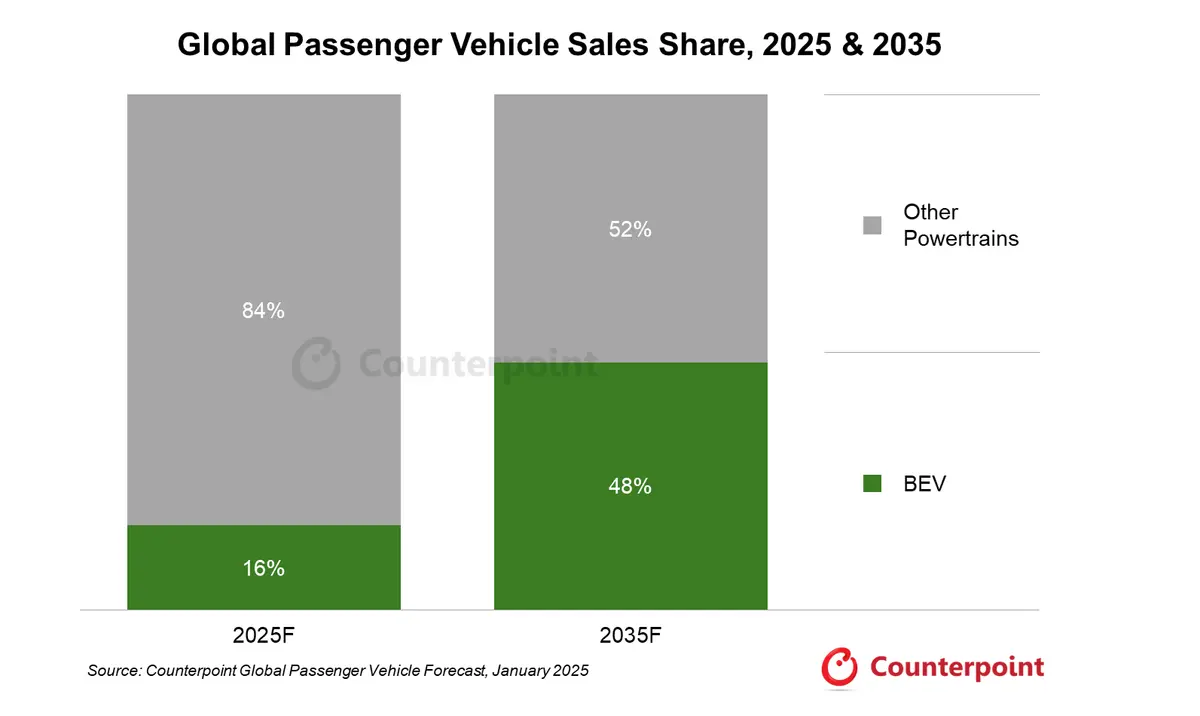
The growing adoption of Battery Electric Vehicles (BEVs) is a good indicator of the increasing importance of Ethernet, since most EVs have next-gen E/E architectures with Ethernet backbones. According to Counterpoint’s Global Passenger Vehicle Forecast by Powertrain, 2035, BEVs will make up 48% of vehicles sold in 2035.
Competitors like NXP, Broadcom, and Texas Instruments face intensified rivalry, prompting potential innovation or M&A responses, while OEMs and Tier 1 suppliers may see benefits from integrated solutions, but risk reduced supplier diversity. The move highlights the shift to systems that consolidate previously separate functions and the semiconductor solutions critical for supporting the next-generation vehicle architectures that use these new systems, with broader implications for connected mobility.
Access our full 4-pager report here
If you are not a client, reach out to us at [email protected]

