

- India's XR market is forecast to grow at an 18% CAGR between 2025 and 2030, supported by expanding enterprise applications across manufacturing, education and other sectors.
- Enterprise applications form the core of India's XR ecosystem value in 2025, with manufacturing and education together contributing nearly 78% of enterprise spending.
- XR headset shipments are projected to grow at a 27% CAGR through 2030, while wholesale hardware market value is expected to increase from INR 2 billion to INR 9 billion.
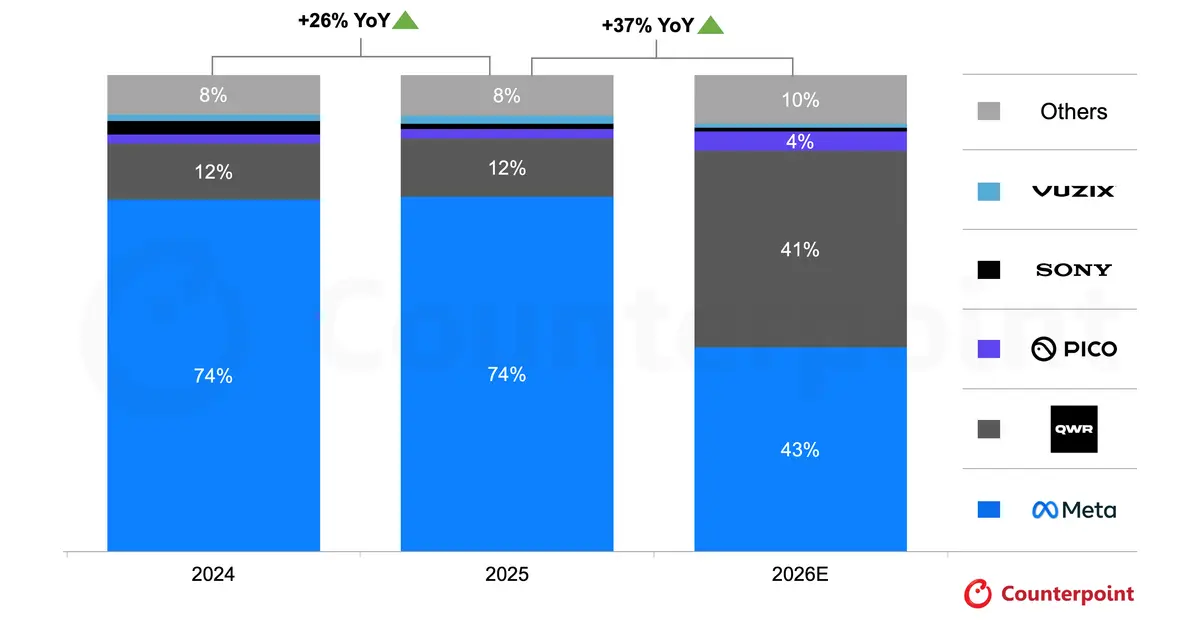
- Meta led India’s XR headset market with a 74.4% shipment share in 2025, while domestic OEM QWR is gaining ground through enterprise orders.
New Delhi, Beijing, Berlin, Buenos Aires, Fort Collins, Hong Kong, London, Seoul, Taipei, Tokyo – October 28, 2026
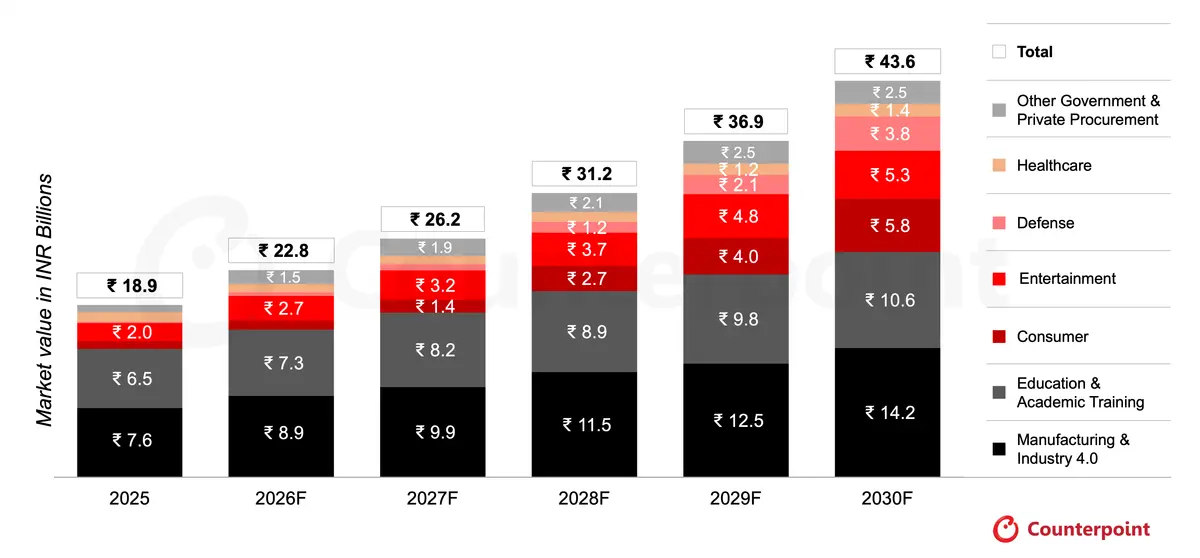
India's extended reality (XR) market is projected to grow from INR 18.9 billion in 2025 to INR 43.6 billion by 2030, registering a compound annual growth rate (CAGR) of 18%, according to Counterpoint Research's latest India's XR Landscape: Present Dynamics and Future Opportunities report. Demand for safer training and practical learning is driving India’s XR growth, with local suppliers combining headsets, software and content into complete solutions for customers seeking a single deployment partner.
Enterprises accounted for 95% of India’s XR market value in 2025 and are projected to represent around 87% by 2030 as consumer adoption expands. Manufacturing and education together contributed nearly 78% of enterprise spending in 2025. The sectors were valued at INR 7.6 billion and INR 6.5 billion, respectively, and are forecast to reach INR 14.2 billion and INR 10.6 billion by 2030. Much of this spending goes beyond devices, with hardware accounting for less than one-tenth of manufacturing XR spending and content and software making up nearly 88% of education sector value in 2025.
India XR Market Value (INR Billions) by Category
Source: Counterpoint Research India XR Landscape Report
Note: XR (Extended reality) is used as an umbrella term covering virtual reality, mixed reality and augmented reality devices and applications. Estimates cover XR hardware, accessories, software, content and associated services. Display-less glasses are excluded from the core XR hardware estimates
Commenting on the market dynamics, Research VP, Peter Richardson said, “Many industries need XR solutions tailored to their training and operational requirements, creating opportunities for suppliers that combine sector expertise, specialized content and systems integration. Suppliers that can turn customised projects into repeatable solutions across multiple locations will be better placed to scale. India’s strengths in software, immersive content, AI and systems integration make enterprise solutions its clearest near-term export opportunity.”
Beyond developments in the enterprise XR segment, India’s consumer XR market is projected to grow nearly sevenfold, from INR 0.85 billion in 2025 to INR 5.8 billion by 2030, increasing its share of the overall market from 4.5% to around 13%. Adoption is expected to broaden as lighter augmented reality (AR) glasses, gaming and immersive entertainment experiences attract new users. However, high upfront costs and limited locally relevant content will keep demand selective, making affordability and compelling use cases critical to sustained growth.
India’s XR Hardware Market Gains Momentum
India’s XR headset shipments are forecast to grow at a 27% CAGR during 2025–2030, while wholesale hardware value is projected to expand at approximately 35% CAGR, reaching INR 9 billion by 2030. Virtual reality (VR) and mixed-reality headsets will remain the larger shipment category, supported by immersive training and simulation, while display-enabled AR glasses are forecast to approach 42% of shipments by 2030. Faster value growth reflects a changing device mix, higher specifications and component-cost pressures. Rising memory prices and currency fluctuations could also prompt institutions to phase purchases to manage budgets.
India XR Device Shipments by Brand, 2024 vs 2025 vs 2026E
Source: Counterpoint Research India XR Landscape Report
Commenting on the hardware market, Research Analyst Akshay RS said, " While global VR headset demand remains under pressure, India has an opportunity to build stronger capabilities in device design, firmware, testing and manufacturing. However, dependence on imported processors, memory, displays and advanced optics remains a challenge. A stronger local component supply chain, deeper engineering expertise and greater scale through domestic demand and exports will be essential for India to move beyond assembly and compete in the global XR hardware industry.”
QWR is emerging as a strong player in India’s XR market, with its shipment share expected to reach 41% in 2026. Its gains are supported by education and enterprise orders for certified headsets, with QWR designing its own devices in India alongside customised deployment and local support. Meta’s headsets are sold in India mainly through third-party imports, with its shipment share estimated at around 43% in 2026, compared with 74% in 2025. Other brands face barriers such as high device prices, limited local availability and gaps in after-sales support. PICO and HTC have limited local distribution and service networks, and AR-focused brands serve a category that still accounts for a small share of India’s headset shipments.
Looking ahead, wider distribution, software that works across devices and a stronger developer ecosystem will help bring XR to more organisations. Making deployments easier to expand and support can strengthen India’s position as an enterprise XR market and a potential export base for immersive technologies and services.
About Counterpoint Research
Counterpoint Research is a global market research firm specializing in products across the technology ecosystem. We advise a diverse range of clients – from smartphone OEMs to chipmakers and channel players to Big Tech – through our offices located in the world's major innovation hubs, manufacturing clusters and commercial centers. Our analyst team, led by seasoned experts, engages with stakeholders across the enterprise – from the C-suite to professionals in strategy, analyst relations (AR), market intelligence (MI), business intelligence (BI), product and marketing – to deliver services spanning market data, industry thought leadership and consulting. Our core areas of coverage include AI, Automotive, Consumer Electronics, Displays, eSIM, IoT, Location Platforms, Macroeconomics, Manufacturing, Networks and Infrastructure, Semiconductors, Smartphones and Wearables. Visit our Insights page to explore our publicly available market data, insights and thought leadership, and to understand our focus, meet our analysts and start a conversation.
Follow Counterpoint Research


