
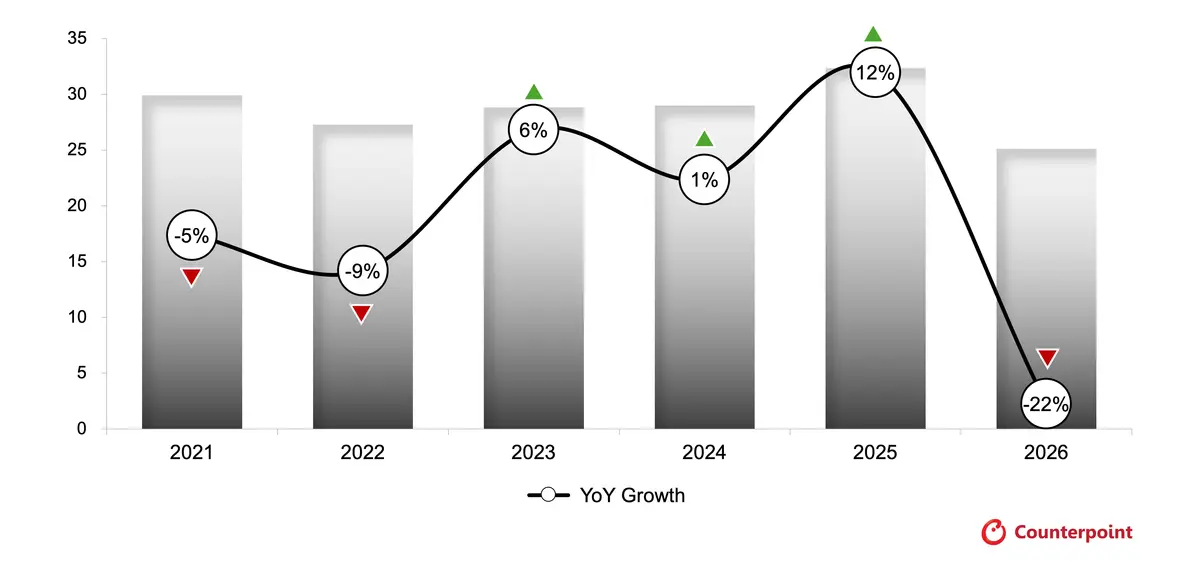
- India's 2026 festive season smartphone sales declined 22% YoY as price hikes dampened consumer demand.
- Market value remained broadly flat YoY despite the volume decline, as average selling prices (ASPs) grew 28% YoY.
- Festive discounts narrowed to 10–25%, from 35–40% in 2025, as rising memory costs limited brands’ room to cut prices.
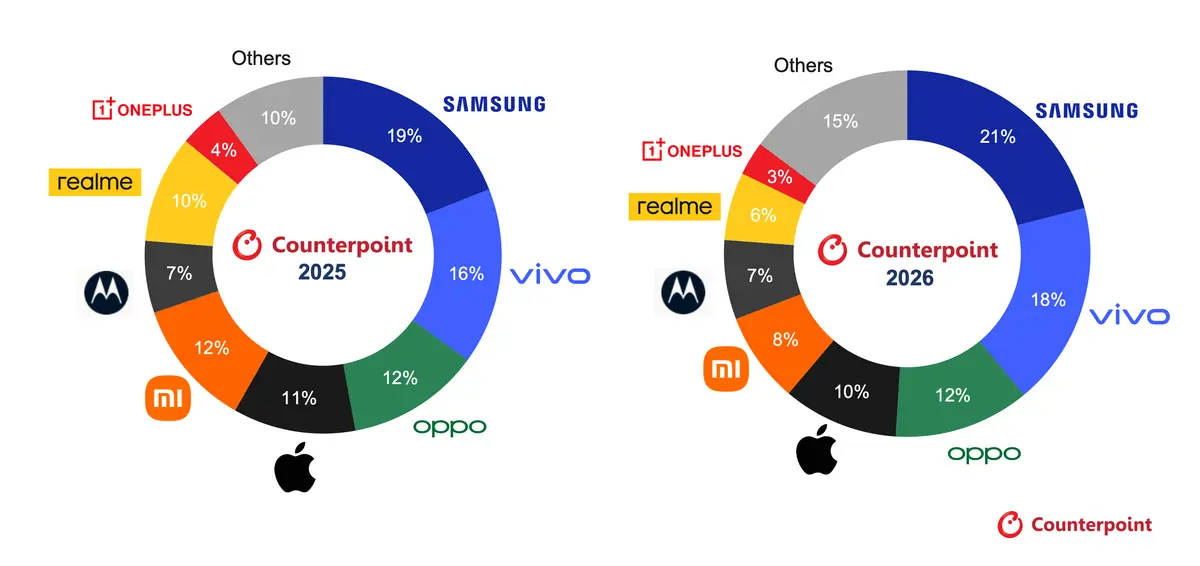
- Samsung led the festive season with a 21% share, while brands focused on the budget segment saw the sharpest declines.
New Delhi, Beijing, Berlin, Buenos Aires, Fort Collins, Hong Kong, London, Seoul, Taipei, Tokyo – November 19, 2026
India’s smartphone sales during the 2026 festive season (October 8–November 10) declined an estimated 22% YoY as rising device prices and weaker consumer demand weighed on purchases, according to Counterpoint Research’s preliminary post-festive checks. The decline was much steeper than the pre-festive forecast of 12%. Market value, however, stayed broadly flat YoY, as ASPs grew 28% YoY, largely offsetting the fall in unit sales.
Festive Season Smartphone Sales (in Mn Units)
Source: Counterpoint Research
Note: - India festive season in 2026 = October 8 to November 10
Rising DRAM and NAND prices pushed device prices up and left brands with less room for discounts. Festive discounts narrowed to 10–25%, from 35–40% in 2025. Even discounted entry-level models were generally priced higher than a year ago, putting upgrades out of reach for many price-sensitive buyers. Brands instead leaned on no-cost EMIs, bank offers and trade-ins, with 48% of smartphone sales being finance-led.
During the first wave (October 8–18), volumes fell 19% YoY, with online sales falling short of the performance seen during earlier sale events. Online sales, which account for a significant share of smartphone purchases, declined as higher consumer traffic failed to translate into actual conversions. Mainline retail was initially slow, and consumers held back purchases in anticipation of better festive offers, with footfalls recovering during Navratri but conversions remaining weak.
India Festive Season Smartphone Volume Market Share by Brand (%)
Source: Counterpoint Research India Smartphone Service
Note: vivo excludes iQOO; Xiaomi includes Poco
Samsung led the festive season with a 21% share, overtaking vivo, as its sales fell just 8% YoY against a 22% market decline. Premium models such as the Galaxy S25 Ultra and Galaxy S25 drew strong demand, while Samsung delayed price hikes until after the sales and managed inventory better than rivals. vivo and OPPO declined 21% and 24%, respectively, holding up better in mainline retail through retailer incentives and bundled offers, but were weaker online. Apple's sales declined by double digits YoY despite strong feedback for the new iPhone 18 Pro series and continued consumer interest in the iPhone 17. However, refurbished iPhones saw strong demand as consumers sought more affordable options, which hurt demand for new iPhones, especially the n-1 and n-2 series. Retailers saw stronger sales where pre-price-hike inventory was available. Xiaomi declined sharply, though its sales picked up around Diwali, driven by the Redmi Note 15 and Note 17 series. Google was the fastest-growing brand in the ultra-premium segment (>INR 45,000) as Google sold its highest-ever Pixel devices during the festive season. Brands with exposure to the sub-INR 20,000 segment were hit hardest, declining by close to 50%. Meanwhile, emerging brands such as Ai+ Smartphone saw strong demand in the online channel, with Ai+ Smartphone the fastest-growing brand, selling over 1 million units in the festive period. New entrants like Mivi and Boltt performed better than expected as well.
Research Analyst Shubham Singh said, “This festive season proved that discounts can’t do the heavy lifting when device prices keep climbing. Buyers who needed a phone still bought one, often on EMI, but many others simply held on to what they had. Brands with depth across price bands weathered it well, while those leaning on the entry-level segment took the full force of the price hikes. Overall, smartphone sales this festive season were driven more by need than by festive sentiment.”
Overall, the 2026 festive season was value-led rather than volume-led. Premium demand and financing supported market value, while entry-level buyers deferred purchases. Brands with balanced portfolios, strong mainline engagement and disciplined pricing held up best, showing that affordability options, rather than deep discounts, decided festive performance this year.
Notes: Preliminary estimates; subject to revision
About Counterpoint Research
Counterpoint Research is a global market research firm specializing in products across the technology ecosystem. We advise a diverse range of clients – from smartphone OEMs to chipmakers and channel players to Big Tech – through our offices located in the world's major innovation hubs, manufacturing clusters and commercial centers. Our analyst team, led by seasoned experts, engages with stakeholders across the enterprise – from the C-suite to professionals in strategy, analyst relations (AR), market intelligence (MI), business intelligence (BI), product and marketing – to deliver services spanning market data, industry thought leadership and consulting. Our core areas of coverage include AI, Automotive, Consumer Electronics, Displays, eSIM, IoT, Location Platforms, Macroeconomics, Manufacturing, Networks and Infrastructure, Semiconductors, Smartphones and Wearables. Visit our Insights page to explore our publicly available market data, insights and thought leadership, and to understand our focus, meet our analysts and start a conversation.
Follow Counterpoint Research


