
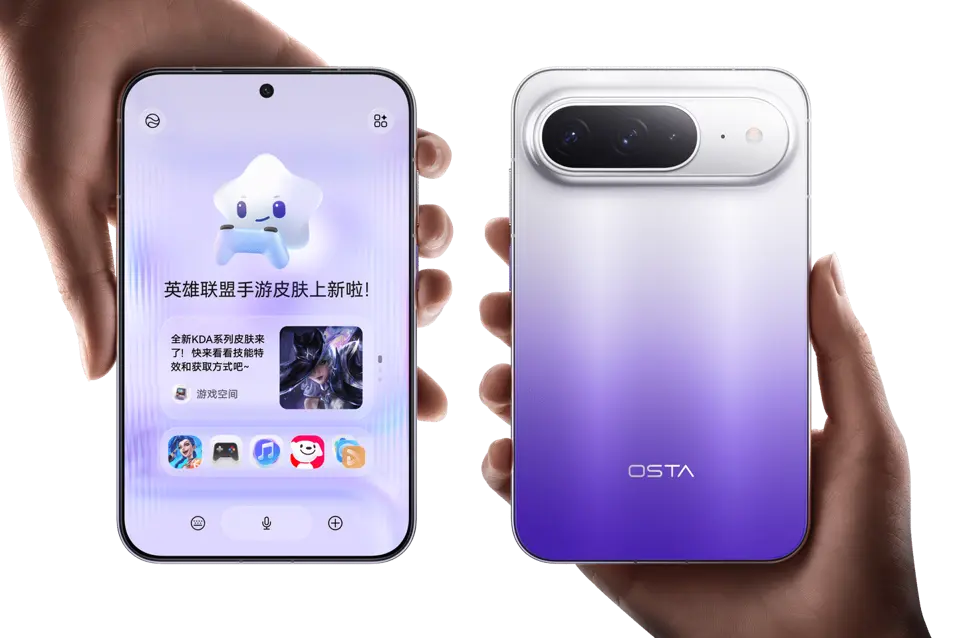
Huawei's first smartphone under its new OSTA (Xingmang) brand, the O1 Pro, officially launched on November 20. Sales began at 18:08 on the same day, with the 12GB + 256GB variant priced at RMB 5,699 (RMB 5,499 during the launch promotion), while the top-end version is priced at RMB 8,999. The starting price is significantly higher than the previously rumoured RMB 4,199.
The OSTA O1 Pro is powered by the Kirin 9030S chipset and features a 6.39-inch wide-screen display, a 200MP main camera and a 7,000mAh battery. It is also the first smartphone to come pre-installed with HarmonyOS 7 AI Pioneer Edition.
Source: Huawei OSTA
OSTA stands for Original, Smart, Technology and Accessible. Huawei positions the brand as an AI-driven technology brand for pioneers, with "Pioneer, Technology and AI" as its core themes. Its tagline, "OSTA Xingmang, Shine with Your Own Light," is about encouraging users to explore themselves and express their individuality.
So, how should we look at OSTA?
First, pricing is likely to be one of the main points of discussion. With a starting price of RMB 5,699, the O1 Pro is clearly positioned outside the mass market. From a hardware perspective, much of its configuration and product positioning overlaps with the Pura X View, making the price point relatively unsurprising. However, Huawei is not positioning the O1 Pro simply as another smartphone with upgraded hardware. Instead, it is seeking to establish it as an AI-first smartphone.
The O1 Pro introduces what Huawei describes as an industry-first system-level AI screen, essentially a personalized dashboard designed to place AI at the center of the smartphone experience. By combining Kirin 9030S, HarmonyOS 7 AI Pioneer Edition and a system-level personal AI companion, Huawei aims to move beyond conventional AI features and make AI an integral part of how the smartphone perceives user needs, retains context, understands intent and executes tasks.
One of the key differentiators of Xiaoyi, Huawei's personal AI companion, is its long-term memory. Rather than simply waiting for users to give commands, Xiaoyi is designed to gradually build an understanding of their interests, habits and preferences through interactions and contextual information. For example, restaurants, travel destinations or movies that users save or interact with over time can become part of their personal memory. When users revisit similar topics or make related requests, Xiaoyi can draw on that information to provide suggestions without requiring them to repeatedly explain their preferences. This is quite different from simply adding AI features to a smartphone. Huawei is trying to move AI closer to the OS level, where it can become part of the overall user experience rather than another feature users need to access separately.
That also explains why the O1 Pro is unlikely to target the mass market. The experience Huawei is trying to deliver relies on hybrid AI capabilities and deeper integration between hardware, the operating system and AI services. This is probably a product for a relatively selective group of consumers who are interested in new technologies, willing to experiment with AI and looking for something different from mainstream smartphones. In terms of brand positioning, OSTA could play a role somewhat similar to that of OnePlus within the OPPO ecosystem: a brand targeting younger consumers and technology enthusiasts who want something a little different from the mainstream.
The bigger question, however, is why Huawei would introduce another sub-brand when the O1 Pro could potentially overlap with its existing Pura, Mate and even nova product lines.
Strengthening its position in China will remain Huawei's mid-term priority. Although overseas expansion is still part of the broader strategy, rebuilding and expanding its ecosystem in international markets will be more challenging. HarmonyOS has already surpassed 100 million users in China, but Huawei is also facing a more mature smartphone market, rising memory costs and increasingly challenging growth conditions for its Pura and Mate lineups.
Rather than waiting for its existing product lines to gradually run out of room for innovation, Huawei is trying to explore a new direction from within its own ecosystem. As Kirin and HarmonyOS continue to mature, the company has more room to experiment with new smartphone experiences. Meanwhile, AI is becoming increasingly integrated into everyday digital life, with a growing segment of consumers expecting their devices to understand their habits and preferences rather than simply respond to individual commands. OSTA is Huawei's attempt to capture that group.
The brand also has a relatively solid foundation to build on. As part of Huawei's dual-brand strategy, OSTA shares Huawei's technological foundation and quality standards, including Kirin chips, HarmonyOS, Red Maple imaging and Kunlun Glass. It also benefits from Huawei's established service infrastructure, which spans more than 2,600 service outlets across China. On the distribution front, the O1 Pro is sold online through Huawei's VMall and JD.com, with OSTA and JD.com having signed a strategic cooperation agreement targeting RMB 70 billion in sales over the next three years.
Establishing a new sub-brand is certainly not without challenges, especially given the potential overlap with Huawei's existing product lines. If OSTA can attract younger consumers and technology enthusiasts, this does not necessarily have to come at the expense of Huawei's main brand. Instead, it could give Huawei greater flexibility to experiment with new product experiences and target different consumer segments.
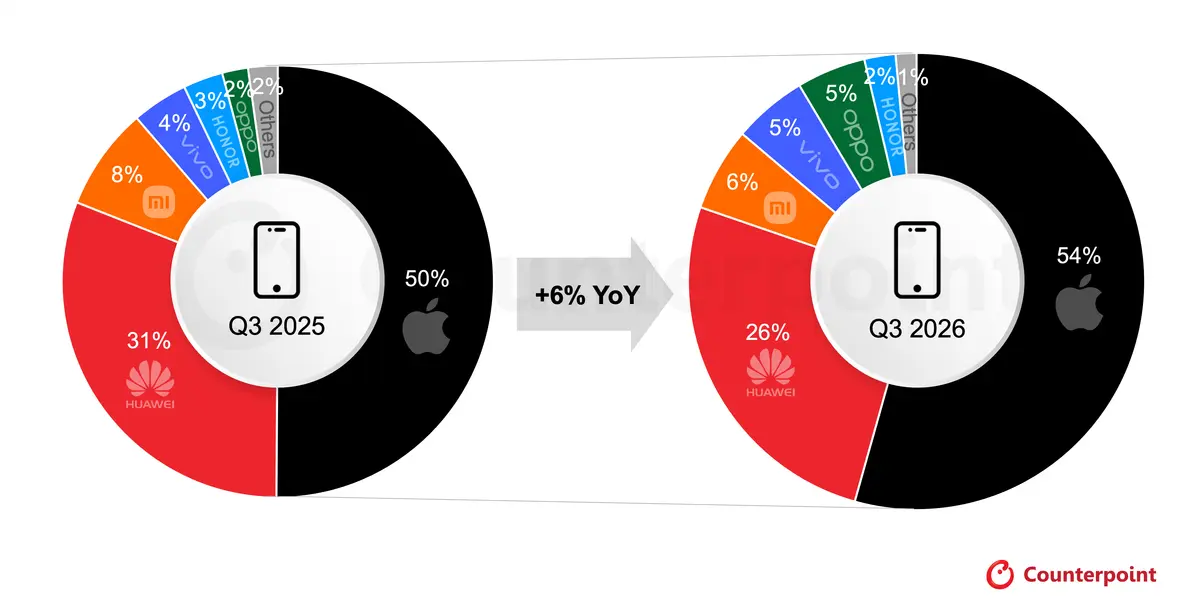
The broader market environment is also worth considering. China's smartphone market is expected to decline by double digits this year, with a meaningful recovery unlikely next year. This is increasingly a mature replacement market, where consumers are more rational about upgrading and less willing to replace their devices simply for the sake of buying a new phone. At the same time, consumers remain reluctant to compromise on hardware specifications when upgrading, providing continued support for premiumization in China.
China Smartphone Sales Above $600 by OEM
Source: Counterpoint Research Global Handset Model Sales Tracker
Notes: OPPO includes OnePlus and realme. Pricing based on wholesale price. Percentage totals may not add up to 100% due to rounding
Huawei is facing continued pressure from Apple, while other Chinese smartphone manufacturers are also pushing further into the premium segment. Against this backdrop, OSTA gives Huawei another avenue for growth and differentiation. It provides more flexibility in product positioning and innovation, while allowing the company to experiment with AI-first smartphone experiences at a time when AI is becoming the next major narrative in the industry.
The OSTA O1 Pro may not be aimed primarily at chasing volume in the short term. But it is an interesting move by Huawei, particularly as the smartphone market becomes less about volume growth and more about differentiation, ecosystem capabilities and the next wave of user experience innovation.


