

The Pixel 4a now flaunts an OLED display with HDR10 support.
The smartphone features a single 12MP rear camera and an 8MP front snapper.
Under the hood is a Snapdragon 730G SoC with 6GB RAM and 128GB storage.
Google launched three new Pixel smartphones in 2020 – the Pixel 4a, Pixel 4a 5G and Pixel 5. Out of the three devices, the Pixel 4a 5G and Pixel 5 support 5G connectivity (Sub-6GHz and mmWave). The Google Pixel 4a, on the other hand, is an LTE capable smartphone offered as an affordable alternative. With the new Pixel smartphones, Google has managed to make decent upgrades on the hardware, right from the chipset to display, on-board storage, and RAM, among others.
Unlike last year, when there were multiple SKUs, this time around, Google is offering just one variant, and the storage is now bumped up from 64GB to 128GB. The Pixel 4a devices come with 6GB of RAM, whereas the Pixel 5 comes with 8GB of RAM, a good upgrade over the 4GB RAM in last year’s models.
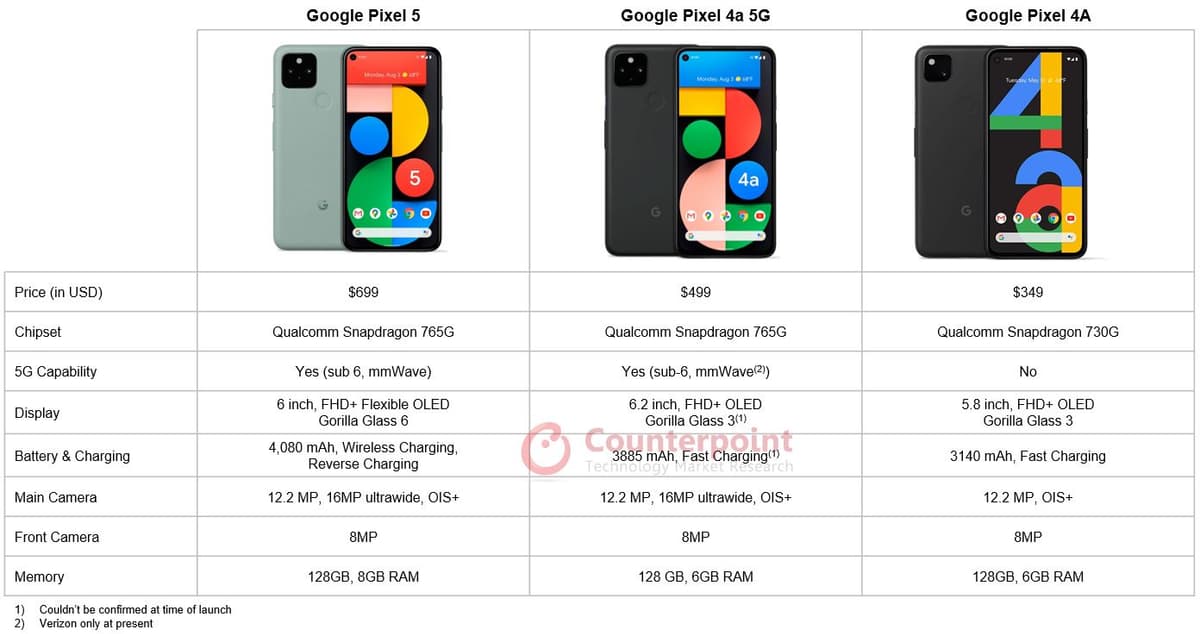
The new Pixel phones are priced between $349 and $699, depending on the model you choose. However, the pricing differs from region to region. For instance, in Canada, the Pixel 4a is available for $479.
Commenting on Google’s strategy for the Pixel series, Research Analyst Ankit Malhotra said, “The Pixel 4A is an interesting proposition from Google. It fulfils the niche demand for a compact Android experience while appealing to Android purists as well. The camera has been a strength of the Pixel series since its inception, which is also a standout point for the Pixel 4A. With the Pixel line, Google can showcase its advancements in AI, such as in image processing. Google has also introduced a 5G version of the Pixel 4A which makes its portfolio more complete and more competitive at a global level. The higher-end 5G model will do better in regions like Europe and North America where Google has performed comparatively well.”
We have been using the Pixel 4a for a few weeks now. While it does not feature dual rear cameras or a high-refresh-rate display, it has still managed to impress us. With its compact form factor, crisp and vibrant display and, of course, the single front and rear cameras, the Google Pixel 4a has a lot more to offer. Here is our review.
Design: Compact, Lightweight
Over the years, the smartphone screen size has been getting bigger and bigger. Even a budget smartphone comes with a display that is over six inches. But that is what the consumer wants as content consumption has increased. You need a bigger screen to enjoy OTT content, web surfing, and gaming. Yet, the demand for compact phones is still there, and it is good to see the likes of Google and Apple releasing smartphones with a smaller footprint.

The Pixel 4a flaunts a 5.8-inch FHD+ OLED panel with support for HDR10. The screen gets bright enough for good legibility under direct sunlight. The color reproduction is punchy and the text appears sharp. Sadly, the screen refresh rate is still 60Hz while competitors in this price range offer 90Hz or even 120Hz panels.
Unlike the Pixel 3a that had thick bezels on the top and bottom, the Pixel 4a comes with thin bezels. The front camera sits in a hole-punch cut out on the top left, and it does not intrude much. Overall, the phone has a compact and lightweight profile where the thumb can easily reach all four corners of the screen for one-handed use. The circular fingerprint scanner at the back has good placement, making it easier for your fingers to reach. It is quick at recognizing fingerprints and unlocks the phone in under a second.

The sides have smooth, rounded edges. The polycarbonate back with a smooth matte finish not only offers a perfect grip but also keeps smudges away. The volume rocker is on the right, and a power/sleep button sits right above it. They are easily accessible and offer good tactile feedback. The USB Type-C port is at the bottom and the SIM card slot is on the left. There is also a legacy 3.5mm audio jack on the top which is a welcome addition.

Software: No Frills, Vanilla Android
Being a Google smartphone, the Pixel 4a features vanilla Android 11 without any over-the-top customizations. Those who have used a stock Android phone before will know what to expect from it. The interface is clean, there are no bloatware apps, and just a handful of essential Google apps that come pre-installed. Besides, there are a couple of apps such as Pixel Tips to help you get started with Pixel devices and a Personal Safety app that lets you add your emergency contacts and share with them your real-time location in case of emergencies.

The UI is easy to use with gesture controls. When using an app, a swipe up from the bottom of the screen takes you to the home screen. Swiping up and holding opens the multitasking menu. Swiping to the left or right from the sides works as a back gesture. Google has optimized the UI well to offer smooth performance. With the Pixel phone, you also get three assured Android OS upgrades and monthly security updates.

However, features like a gaming mode are missing from the stock Android OS. It would have been a nice addition, at least including features where you can silence the notification while playing a game.
Cameras: Photographer’s Delight
Since the first Pixel smartphone, cameras have been a key highlight of the series. It is good to see Google offering a consistent camera experience on the affordable as well as top-end Pixel devices. The Pixel 4a, like the Pixel 3a, continues to be a great compact still camera. It comes with a 12MP f/1.7 aperture, 27mm wide lens, which is a minor improvement over the 12MP f/1.7 aperture, 28mm lens on the Pixel 3a. The sensor size is 1/2.55 inch, with 1.4µm pixels, and it comes with OIS (Optical Image Stabilization) and dual pixel PDAF (Phase Detection Auto Focus) support.

The camera app has a simple interface, with Google making some UI changes more recently. It brings better zoom controls, wide-angle portrait mode on supported phones, and other smaller changes like standard stabilization and cinematic pan-in video modes. There is also a drop-down menu from the top that brings up settings to change ratio, add a timer, turn flash on or off, and more. Then there are subtle additions, where the AI will prompt to move slightly backward to improve the focus. But sadly, I was disappointed to see Google dropping support for AR Playground.

Coming to still camera quality, the Pixel 4a delivers excellent results in daylight and low-light scenarios. The camera captures great photos with plenty of details. The photos offer a great dynamic range, even on shots that were taken against the sun. This is where the Pixel 4a, and Pixel series in general, manage to impress.
Daylight Shots: Great Point-and-shoot Camera
Starting with daylight shots, the photo below shows how the camera can capture great details, right from colors to structure, contrast and focus.

Moving on, the next couple of photos were taken against the sunlight. You can see how the Pixel 4a has managed to preserve the details and colors while lifting the highlights and reducing the shadows. This is all thanks to the live HDR+ mode.


The photo below is another example of how Google’s algorithms work on every part of the screen. You can see the details in color and texture of the steering wheel, and even the idol which is a bit away, yet the color and structure are retained. This photo was clicked in the afternoon when the sunlight was a bit harsh.

Close-up Shots: Eye for Detail
When taking close-up shots, on most smartphones, the sensor is not able to capture a great number of details. But that is where the Pixel 4a excels, offering sharp, crisp and detailed photos. Below are two photos that show the camera’s prowess. Look at the eye’s cornea, the details on eyebrows, and even on the eyelashes.

Even in the photo below, which appears to be the buds of powder-puff flowers, you can see that the details and colors are very well preserved.

Portrait Shots: Good Edge Detection for Professional-looking Bokeh Effects
In most competitor smartphones, a combination of AI and secondary telephoto/ultra-wide lens is used for creating a shallow depth of field around the subject. And this is the area where Google excels with its AI (artificial Intelligence) and ML (machine Learning) prowess. The processing algorithms work well in separating the background from the foreground to create nice bokeh effects without making it look artificial. Google also lets you adjust the blur intensity from the Photos app after the photo is taken. Unlike other smartphones, the Google Pixel’s portrait mode and edge detection work well on human as well as non-human subjects. Below are some samples.


Notice the colors, texture and depth of field in the two photos above. They are as good as you can click using a professional DSLR camera.
RAW Mode: More Editing Controls at Your Fingertips
The Google camera app does not include a Pro Mode like in other Android smartphones, but you do get the RAW+JPEG option. After enabling this, the camera app will click two sets of photos in both formats, thus giving you greater editing control. Below is an example of a default JPEG vs edited RAW file on the SnapSeed app.
Color Pop Mode: Add Fun Effects to Your Photos
The Photos app also includes a “Color Pop” mode that uses AI and ML to make the colors pop out while keeping the rest black and white. It is not perfect but works the best on portrait or close-up shots. What is interesting is that Google’s edge detection algorithms work well here. Some samples below.
Low-light Photos: Good, But Could be Better
The low-light mode, Night Sight, on Pixel devices has received a lot of praise over the years. It continues to capture good photos in the dark, even where your naked eyes cannot see things. But sadly, the Pixel 4a’s night mode leaves a few things to be desired.
As you can see in the above sample shot, the Pixel’s camera and computational photography enhance the photo quality to a great extent. But they lift the contrast, brightness and ambiance a little too much, giving a bit of an artificial feel to the photos. Slight graininess is also visible. While the quality is not close to the flagship sibling, Pixel 5, the 4a still does a better job compared to the competitor.
There is an astrophotography mode too. I tried to click a photo in this mode, but it turns out to be too bright and grainy.

Selfies: Good for Instagrammers and Snapchatters
The 8MP front camera is the same as we have seen on the Pixel 3a. It clicks good selfies in broad daylight. Right from the skin tone and details to the color of the shirt and the trees in the background, the camera does a great job. There is also a portrait mode, and it works well in separating the background from the foreground. Sadly, the quality goes a bit dull in low light.
Videos: Improved but Far From Being Perfect
Over the years, the Pixel phones have been great at still photography, but Google is yet to crack the video side of things. Not that the video recording experience is bad, but there is still a lot of catching up to do. The sample footage I shot delivered average results. Full HD videos shot at 60fps and with stabilization on look good, but the smoothness is not great at 4K resolution, which maxes out at 30fps.
Performance: Smooth Sailor with Good Battery Life
Google, with its Pixel and Nexus series smartphones, has always gone with the “recommended” configuration. And while things go smooth initially, the struggle is noticed a few weeks later. Google seems to have finally taken this into account and bumped the hardware on the Pixel 4a.
Under the hood, the smartphone is powered by an 8nm Qualcomm Snapdragon 730G SoC, paired with 6GB of LPDDR4x RAM. There is also 128GB of UFS 2.1 onboard storage, which is a good upgrade over eMMC on the previous gen. It helps in offering good read and write speeds, as well as making sure that apps open fast.

During my usage, I did not come across any lag, but I did miss the high-refresh-rate display. My usage included clicking photos and social media apps like Facebook, Twitter and WhatsApp. On the gaming side, I was able to play the likes of Asphalt 9: Legends, PUBG Mobile and COD: Mobile without any hiccups. On PUBG Mobile, I could only set graphics to HD, and the frame rate to high. Probably, this is the best configuration to ensure smooth running, and there was no issue at all. However, having a game accelerator or a similar mode to keep those annoying notifications away would have been a good option, especially considering mobile gaming is getting good traction.
Finally, we come to battery endurance, which had been a pain point in previous generation Pixels. The Google Pixel 4a comes with a 3,140mAh battery with 18W fast-charging support. It can charge half the battery capacity in 30 minutes, whereas full charging takes about 80 minutes.

With moderate to heavy usage, the Pixel 4a easily holds up through a working day, but you will need to charge around the evening if you are a heavy user. With some gaming for an hour, some photography, and extensive social media usage, the 4a offers a screen time of close to four-and-a-half hours. On days when I did not play games, the screen time increased by 30 minutes, which is good enough for a compact phone.
Conclusion: The Best of Google’s Offerings in an Affordable Package
With the Pixel 4a, Google has once again showcased its power of computational photography. OEMs can do a lot more even with a lower resolution sensor and single camera setup if they get the software and processing right. The Pixel 4a’s camera offers stunning results in daylight and good to above average results in low light. However, quality can be improved further with better software tuning. With more RAM, better chipset and faster storage, the performance has improved over the previous generations. There is physical as well as eSIM support which is a good addition.

There are some areas where Google can do better with the next affordable Pixel smartphone. Adding an ultra-wide-angle camera could allow more versatility. A high refresh rate display will make the UI experience even smoother. Google could also offer a slightly bigger battery and even faster charging to the max. Lastly, the search giant also needs to make improvements to enable better video-capturing. An experience similar to the iPhone would make it a perfect camera phone.
Also Read: Strategic Reviews and Insights on The Latest Smartphones
- Samsung Galaxy Note 20 Ultra 5G Review: Pinnacle of Android Flagships
- Vivo X50 Pro: A Camera Disguised as a Smartphone
- Asus ROG Phone 3 Review: Gold Standard for Gaming Smartphones
- Vivo V19: Good Cameras, Appealing Design & Long Battery Life
- Xiaomi Mi Notebook 14 Review: A Solid Performer in Work-From-Home Era

