- The new Pixel 10 lineup is powered by TSMC’s 3nm Tensor G5 SoC.
- Each device features important hardware upgrades – Pixel 10 gets a third camera lens and 5x optical zoom; Pixel 10 Pro Fold gets an IP68 rating, and the whole range supports Qi2 wireless charging.
- New AI features like Magic Cue and Camera Coach bring personalized intelligence and effortless camera capture capabilities to the new Pixel series.
Google has launched its latest Pixel 10-series smartphones, consisting of four new devices – the Pixel 10, Pixel 10 Pro, Pixel 10 Pro XL and the Pixel 10 Pro Fold. Google also introduced the new and more affordable Pixel Buds 2a earbuds along with the Pixel Watch 4 smartwatch at its launch event. The new Pixel 10 series runs on the all-new, more powerful and efficient Tensor G5 SoC made by TSMC, helping unlock new AI features. We tested the new devices and experienced some of the AI features at the launch. Here is our quick take and analysis:
Tensor G5: Faster, Efficient On-device AI Performance
The all-new Tensor G5 SoC, made on TSMC’s 3nm process, brings over 30% performance improvement over the previous generation, and up to 60% jump in TPU compute performance for on-device AI tasks, according to Google. It supports over 20 Gemini Nano features for on-device processing at launch.
Unlike previous Tensor processors that were tweaked, Exynos processors are made in Samsung’s foundry. Google says the latest ones from TSMC offer better overall performance and efficiency. Google did not reveal any specific details of the CPU cores or the GPU, but it is likely that the new Tensor G5 may not have the same raw performance as the Qualcomm and MediaTek flagship SoCs. However, Google is not chasing test scores but looking to offer an optimized experience across its device ecosystem, including Pixel phones.
More AI in More Places
Google introduced new AI features. First is Magic Cue, which uses on-device AI to proactively offer relevant information and actions based on what the user is doing. It connects information from various apps like Gmail, Calendar, and Messages, to bring up an address or hotel/restaurant reservation details when a friend asks for it in a chat. Similarly, it can suggest a flight number or PNR during a phone call with airline customer care. Magic Cue is the next step on Google’s journey to bring Agentic AI capabilities to users, first to those buying the Pixel 10 series. Critically, Google mentioned that it will soon support third-party apps like WhatsApp, Messenger and others. Integrating third-party apps quickly will help Google showcase the usefulness of its AI innovations.
Next is Camera Coach, which uses Gemini AI models to analyze the scene and offer suggestions like framing, zooming, changing angle, and much more, to help you take better photos. We tried this at the demo zone, and there is a small learning curve, but it is a great implementation that can help novice photographers learn a few photography tips and tricks from Gemini.
The next AI feature will let users edit photos with voice or text in the Google Photos app. Powered by Gemini, it uses natural language processing to describe the changes you want to make in your photos – with commands like remove reflections or fix the lighting, remove the car in the background, to name a few. The feature eliminates the need to use complex tools and apps to make simple edits. While the feature will initially be only for Pixel 10 users, Google will be rolling out the capabilities to Android and iOS users, but there is no release timeline on the same.
Thanks to Tensor G5, Voice Translation during calls on the Pixel 10 devices is now faster, with real-time on-device processing. But it gets even more interesting, as the feature can preserve the user’s original voice and respond to the caller by mimicking your tone – definitely better than robotic sounding translation.
Lastly, Google has also improved AI-powered Pro Res Zoom, which uses a diffusion model to add generative fill when you zoom in and offer high-quality photos. The Pixel 10 supports up to 20x Pro Res Zoom, whereas the 10 Pro and 10 Pro XL supports up to 100x zooming capabilities.
Pixel 10 Series: Subtle Refinements with Notable Improvements
The base Pixel 10 model is more attractive than ever. It now features a triple camera system, including a dedicated 5x telephoto lens. The rear camera configuration has changed a bit – it now comes with a 48MP main camera (compared to 50MP on Pixel 9), and a 13MP ultrawide camera (compared to 48MP on Pixel 9). Google has also bumped up the battery capacity, now packing a 4,970mAh capacity with 30W wired (up from 27W) and 15W wireless charging support.
In case of the Pixel 10 Pro and Pixel 10 Pro XL, the camera configuration and screen size, resolution, and refresh rate all remain the same vs the Pixel 9 series, except the screen on new devices can hit peak brightness of 3,300nits (compared to 3,000nits on the Pixel 9 Pro series). The key changes come in a bigger battery capacity, 4,870mAh on Pixel 10 Pro (compared to 4,700mAh on the Pixel 9 Pro). The Pixel 10 Pro XL, on the other hand, comes with a 5,200mAh battery (compared to 5,060mAh on the Pixel 9 Pro XL). Wireless charging speeds have also been bumped slightly, with the Pixel 10 Pro supporting 30W (27W on 9 Pro) and 10 Pro XL supporting 45W (37W on 9 Pro XL).
Coming to foldables, Google is not chasing the slimmest design and or biggest battery claims with the Pixel 10 Pro Fold, instead focusing on durability, which matters the most for that form factor. The Pixel 10 Pro Fold is the only foldable with an IP68 rating for dust and water resistance on the market, meaning you can take the smartphone to a beach or in dusty environments without worries (but we would not recommend that). It also comes with a redesigned, gearless hinge, which Google claims adds to its durability. Besides, the cover screen is now slightly bigger at 6.4 inches (compared to 6.3 inches on the previous generation). Google has also packed a bigger capacity 5,015mAh battery on the new Fold, up from 4,650mAh, along with 30W wired and 15W wireless charging support.
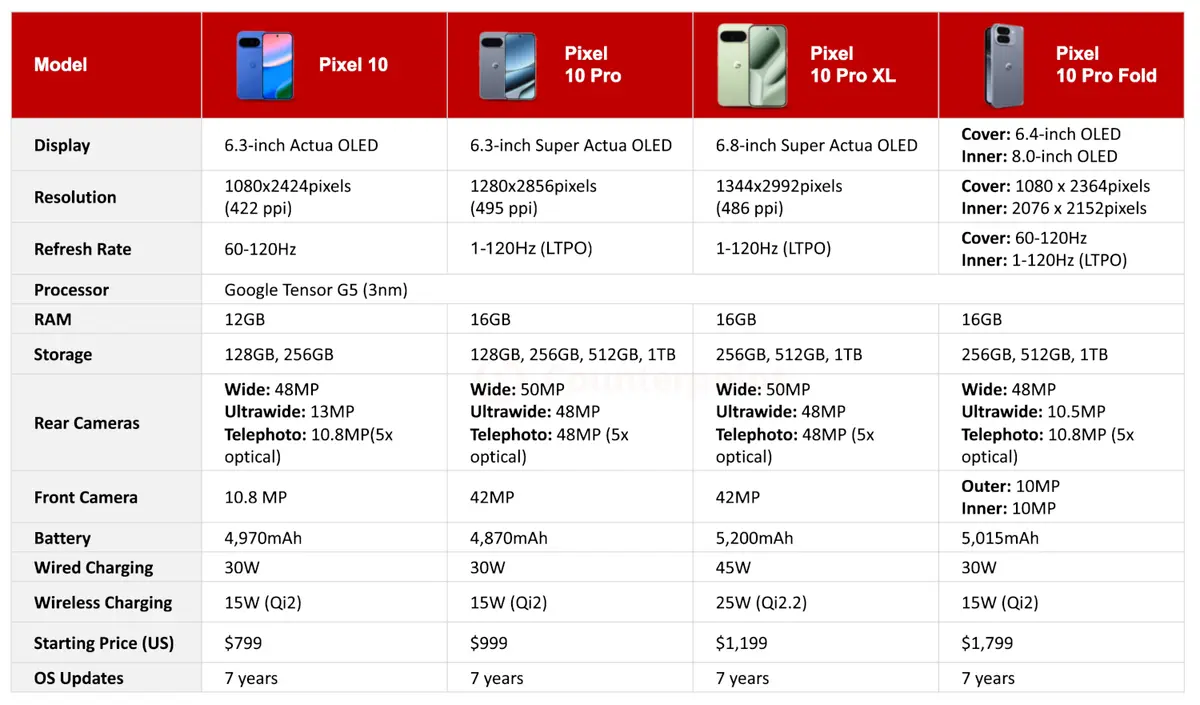
Google has also added support for Qi 2 wireless charging on the Pixel 10 series, and Qi 2.2 on the Pixel 10 Pro XL, enabling Google to release Pixelsnap, a MagSafe competitor brand that allows for accessories to be attached to the device back via magnets. Critically, Pixelsnap will also support all existing MagSafe accessories like power banks, phone holders and more that you would have bought for the iPhone, creating a large ecosystem of accessories right at launch.
Lastly, in terms of pricing, the Pixel 10 starts at $799 for the 128GB storage model, while the 256GB model is priced at $899. The Pixel 10 Pro starts at $999 for the 128GB model and goes up to $1,449 for the 1TB model. Similarly, the Pixel 10 Pro XL starts at $1,199 for the base model and goes up to $1,549 for the 1TB model – without providing a 128GB version like last year. Instead, the entry memory configuration starts at 256GB. Lastly, the Pixel 10 Pro Fold starts at $1,799 for the 256GB model and goes all the way up to $2,149 for the 1TB model. In markets like India, the Pixel 10 devices will be offered in 256GB storage as the base model, and prices start at INR 79,999. There are some interesting finance and buyback offers too, making the pricing even more attractive, and thus making the Pixel series more affordable.
Analyst Take
· With the Made by Google 2025 event, Google is further pushing its AI strategy deeper into its expanding hardware ecosystem. Enabling Gemini-powered AI features across device form factors is now at the core of everything Google does with its hardware developments.
· The Pixel 10 series has refined last year’s premium design language but does not change meaningfully. However, the company did add some important hardware improvements, like a telephoto lens for the base variant Pixel 10. Faster charging, especially wireless via Qi2, and the ecosystem enabled by the integrated magnets should help pique interest from users not currently using a Pixel device – with an expansive array of accessories readily available.
· Google also refined the Pixel Watch form factor by adding a curved display and a unique health feature with pulse tracking and satellite connectivity. However, the company could have taken the platform further by introducing an Ultra version, to tie into the enhanced tracking features and capabilities the new Health Coach (as part of the Fitbit platform) provides, positioning it as a direct competitor to Apple’s and Samsung’s top-of-the-line smartwatches.
· Lastly, with the introduction of the Pixel Buds 2a, Google is taking an important step in bringing Gemini to a broader hearable audience. For the company to succeed in its mission of enabling as many devices and form factors with Gemini capabilities, it is imperative to meet users where they are – this includes ear buds priced below Pro versions.
· Overall, Google continues to find its space as a hardware provider with a growing device ecosystem, which is now increasingly optimized to deliver personalized, helpful AI experiences wherever a user might need them.


