

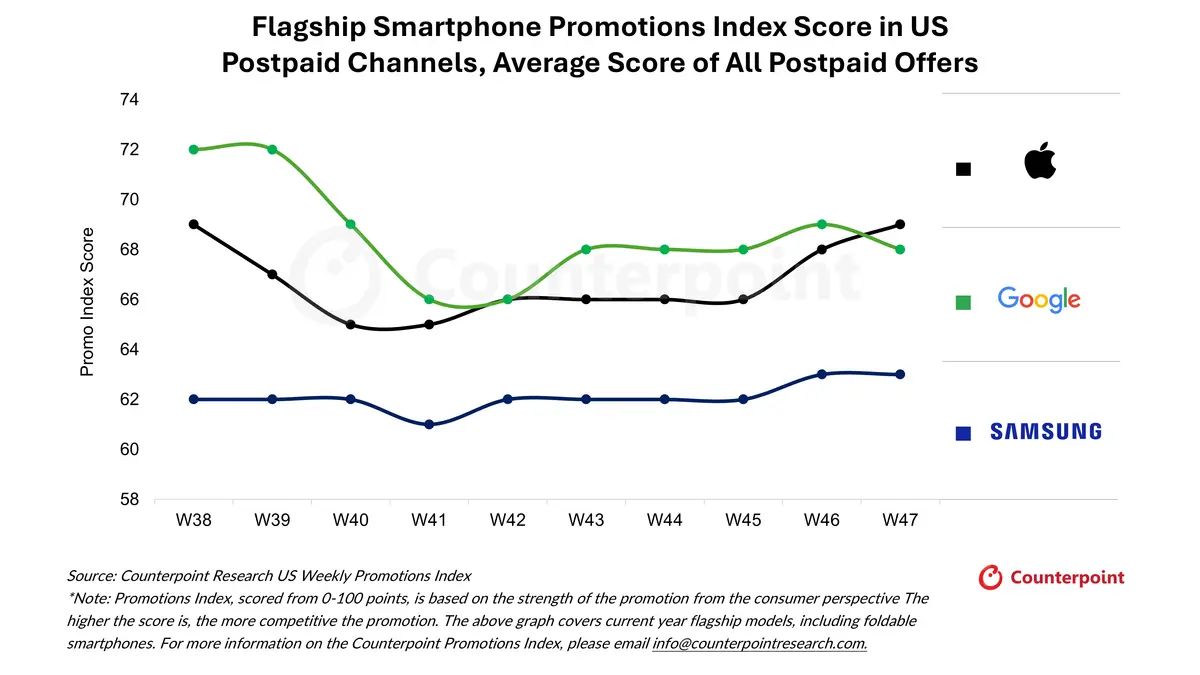
- Google led in terms of promotional value to the consumer in postpaid in the weeks leading up to Black Friday but fell slightly behind Apple in terms of promotional power during Black Friday itself.
- Samsung trailed in postpaid in terms of promotional value to the consumer simply due to more devices requiring trade-in and not meeting as strong of total discounts as Google and Apple.
- Motorola and Samsung both continue to remain strong in prepaid across multiple price bands, with Metro leading in terms of promotional power.
- Total Wireless signaled that more bundled offers may be on the horizon, offering a compelling TCL offer for $99 including a tablet, phone and service for 1 year.
Postpaid promotional landscape remained dynamic and heated
Black Friday deals continue to creep further towards October each year. This year, that rang true for smartphone promotions. Google launched some early Pixel campaigns this year to get in front of holiday promotional noise. It hoped to capitalize on early Pixel 10 series sales momentum. Google led the early holiday season promotional power race, according to Counterpoint Research’s US Weekly Smartphone Promotions Index, in both postpaid as well as at various national retail and MVNO channels. Verizon led Google’s postpaid promotional campaign with upwards of $1,260 off the Pixel 10 Pro Fold with no trade-in required. Verizon is also offering the Pixel 10 Pro XL for free with no trade-required on its mid-tier and above plan. Meanwhile, MVNOs such as US Mobile began to run steep discounts on the Pixel 10 where it sold for just $349 in the first week of November.
However,
Applemade a final push to match Google’s high ad spend ahead of Black Friday. Apple debuted aggressive promotions on the iPhone 17 series at T-Mobile and Verizon. T-Mobile featured a promotion for switchers offering four free iPhone 17’s on the Essentials plan, no trade-in required. Samsung promotions remained strong in a generally aggressive promotional US postpaid space. However, more offers required trade-ins or more aggressive plan stipulations. All three OEMs were featured in bundled offers with tablets and smart watches. Nonetheless, T-Mobile’s bundled offers just became a little less attractive as it switched wearable and tablet EIPs to 36 months, up from 24 months in a move that will keep customers locked into the carrier longer.
Samsung and Motorola led prepaid promotions
In stacked ranked order, Motorola and Samsung tied for first in terms of average promotional value. TCL took third and Apple claimed the fourth spot amongst major prepaid OEMs in terms of promotional value to the consumer. Metro led in terms of promotional scores across each major OEM. It offered a wide variety of deals across its plan range. It was offering the moto razr for free on its $60/month plan and the Moto G 2026 for free on its $40/month plan. The Galaxy A16 continues to be free on the $40 plan matching the Moto G offer. Metro is even pushing into flagship style offers discounting the Galaxy S25 to $250 after instant discount on the $60/month plan. Additionally, the iPhone 16e was free on the mid-tier $50/month plan.
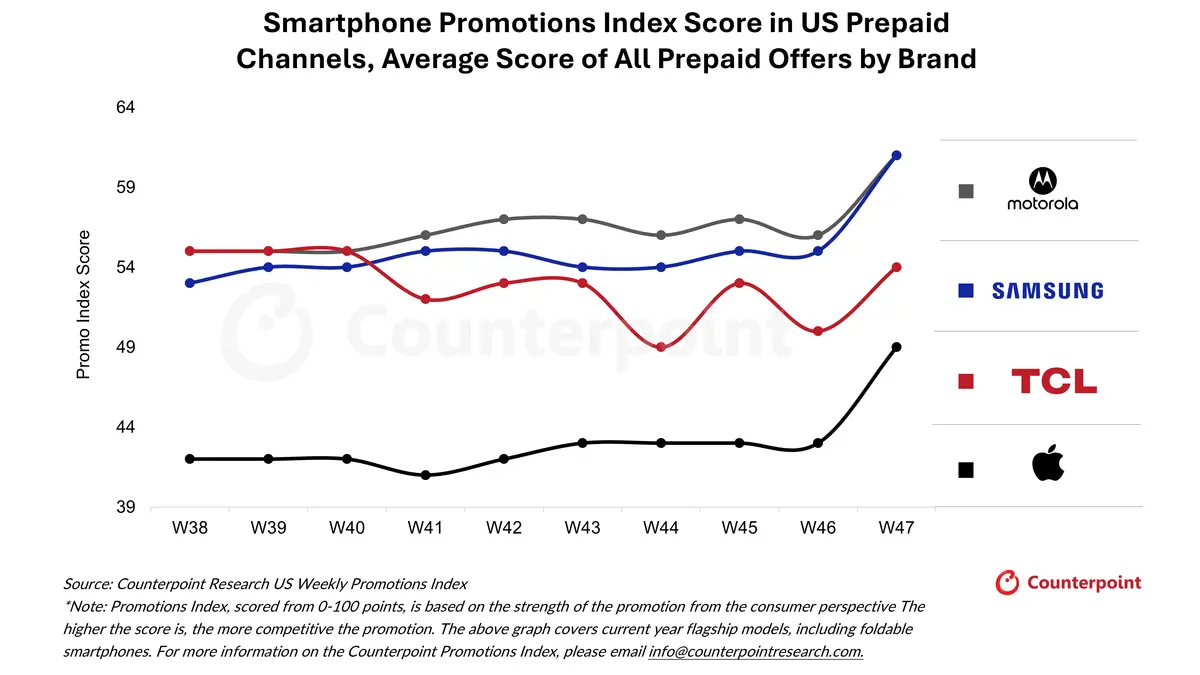
Total Wireless also stepped up its promotions, coming in second place. Its iPhone promotions for Black Friday alternated between steep discounts on the iPhone 13, 14, and 16e. It led the other channels in terms of promotions for Samsung, Motorola and Apple. TCL was the main brand left out from strong Black Friday promotions. However, there was one compelling bundled promotion at Total, which offered the TCL 50XL, TCL Tab 10 and a year of service for $99 on the base unlimited plan, a possible sign to come of further prepaid bundled offers in December.
Store traffic and macroeconomic implications
Black Friday 2026 presented some key indicators on the state of the economy but revealed some insights as to how shielded the US Smartphone market is from some macroeconomic pressure given the high percentage of devices purchased on equipment installment plans. Sirini Gopalan, newly appointed CEO of T-Mobile, said as much when he noted that carriers are not the canary in the coal mine when it comes to macroeconomic indicators. Store visits on Black Friday indicated that foot traffic was lighter than in past years for carrier channels. It certainly was for national retail. Then again, the carriers have been pushing for a higher percentage of purchases through their respective apps and have been relying on brick-and-mortar less. Additionally, tariffs did not impact smartphone pricing due to negotiated deals with India, Vietnam and China. Therefore, consumers have yet to feel material impacts on their smartphone purchases, especially given that the majority of them purchase on 24-to-36-month equipment installment plans with heavy operator subsidies. We expect this strong demand to carry through Q4 2025.
Our newest report, the US Weekly Promotions Index, derives from our US Smartphone Promotions Tracker. The foundational report examines trends in smartphone promotions across major carriers, highlighting changes in strategies, key device launches, and the most impactful discounts. The Promotions Index, scored from 0-100 points, is based on the strength of the promotion from the consumer perspective. To learn more, contact [email protected].