
- Global smartphone shipments are forecast to decline 14% year-on-year in 2026 and a further 6% in 2027.
- Mobile memory remains the principal constraint, as supplier allocation continues to favour AI and server applications, keeping handset costs and retail price floors elevated through 2027.
- The market is forecast to rebound 6% in 2028 as memory conditions improve, pricing begins to stabilize and replacement demand returns from a depressed base.
- Apple is forecast to retain a narrow shipment lead over Samsung in 2026 and 2027, while Chinese OEMs remain more exposed to the contraction in lower priced segments and emerging markets.
- The 2028-2030 recovery will be uneven and will not restore the market to its 2025 level; some demand is expected to be permanently displaced by longer replacement cycles and refurbished devices.
Beijing, Berlin, Buenos Aires, Hong Kong, London, Los Angeles, New Delhi, Seoul, Taipei, Tokyo - November 25, 2026
The global smartphone market is forecast to decline 13.9% year-on-year in 2026, according to Counterpoint Research's latest Smartphone Market Outlook Tracker. The downturn is now expected to deepen in 2027, with shipments falling a further 6%.
The 2026 outlook remains shaped by the sharp rise in component costs, reduced availability of economically viable lower-priced devices and deterioration in consumer affordability. Vendors have responded by raising prices, reducing memory configurations, withdrawing lower margin products and concentrating resources behind fewer models and priority markets. On the other hand, premium demand has remained comparatively resilient, although this has done little to offset the contraction in mass-market segments.
Channel and production conditions have also remained uneven, with some regions starting to see lean inventory levels. At the production end, ODM-EMS utilization has fallen significantly, with several major suppliers reducing capacity as large Android vendors cut orders.
Principal Analyst Yang Wang commented, “The 2026 decline was initially expected to mark the low point of the cycle, but the memory situation has remained more restrictive than anticipated. Mobile memory allocation is still being displaced by AI and server demand, while higher costs are taking longer to move through handset portfolios and retail channels. The result is a much weaker 2027, particularly for lower priced devices and price sensitive markets.”
Global Smartphone Forecast, November 2026 Edition
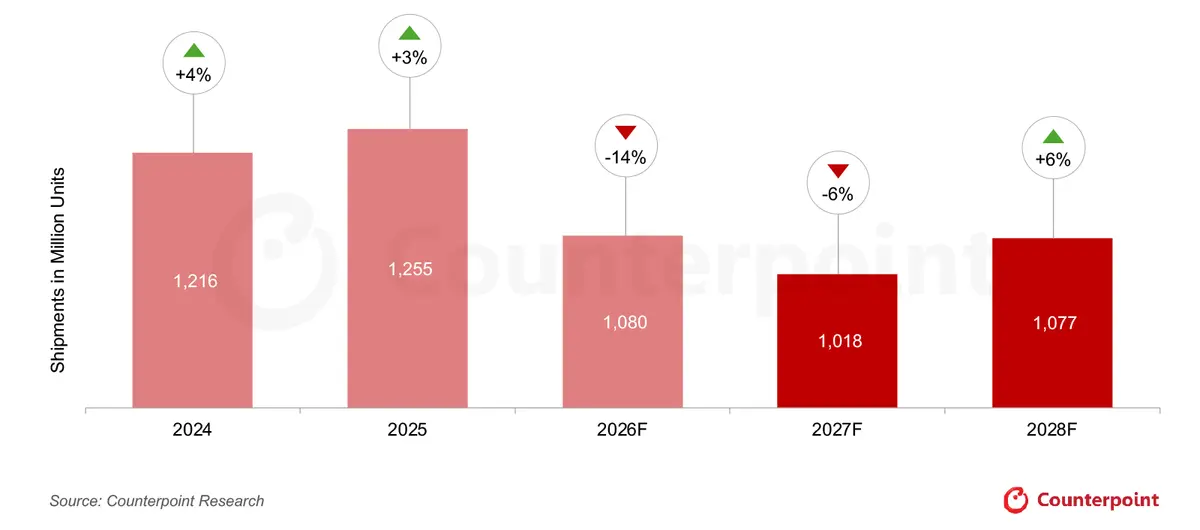
Source: Counterpoint Research Market Outlook
2027 downgrade driven by persistent memory constraints
The primary drivers for the weakened 2027 outlook are continued tight mobile DRAM allocation, further expected LPDDR price increases in early 2027 and limited evidence to suggest short term capacity increases to the smartphone sector from higher value AI and server applications.
Higher component costs are squeezing both supply and consumer affordability. OEMs are reducing the number of low memory configurations, raising minimum specifications and retail prices, and discontinuing products that no longer meet profitability targets. This is causing the market for models priced below $200 to shrink and become increasingly concentrated near the upper end of the price band. Some consumers will trade up, but others will defer replacement, retain devices for longer or move to refurbished products.
Apple and Samsung remain comparatively resilient
Apple is forecast to remain the largest smartphone vendor by shipments in 2026 and 2027. However, its lead over Samsung is narrow. Apple shipments are expected to decline 1% in 2026 and 4% in 2027. The company continues to benefit from premium positioning, financing, ecosystem loyalty and supplier priority. However, higher pricing and the exhaustion of the 2025-2026 peak replacement demand are expected to cap shipment gains.
Samsung shipments are forecast to decline 1% in 2026 and 3% in 2027, materially outperforming the wider market. Its internal component capabilities, broad portfolio and established operator and retail relationships give Samsung greater flexibility to secure supply and maintain availability. However, anticipated gains from the premium and foldable segments are unlikely to offset the weakness in Galaxy A-series shipment volumes.
Chinese OEMs face a second year of pressure
Leading Chinese smartphone OEMs are forecast to record further shipment declines in 2027 after substantial contractions in 2026. The OEMs remain more exposed to pressure on lower price segments, as component availability and price increases impact demand. Companies are therefore likely to rationalize their portfolios and withdraw from less profitable markets. Financial discipline will also become more important.
Huawei is the main exception in 2026, with shipments forecast to rise 12% YoY, supported by its strong China position, domestic component capabilities and continued progress with HiSilicon development. However, Huawei is expected to decline in 2027 as higher prices and supply constraints limit further growth. Elsewhere, industry consolidation remains Counterpoint's baseline scenario, with smaller vendors and marginal product lines facing the greatest risk.
Robust rebound possible in 2028
Global smartphone shipments are forecast to rebound 6% in 2028. The recovery is expected to be driven by improving memory availability, stabilizing component prices, easier year-on-year comparisons and the gradual return of replacement demand postponed during 2026 and 2027.
The scale of the rebound will depend on how quickly lower component costs translate into retail pricing. A faster improvement in mobile memory allocation during the second half of 2027 could bring replacement demand forward and create upside to the 2028 forecast. Conversely, continued competition from AI and server demand, or another round of handset price increases, would limit the recovery.
Wang added, “The unusually low 2027 base creates the potential for a robust rebound in 2028 once the memory bottleneck begins to ease. But this should not be interpreted as a return to the old market trajectory. Some low-end demand has been permanently lost, and the 2028 market will still be about 14% below 2025 shipments. The recovery will favor vendors with the scale, financing and channel strength to maintain their market presence through the downturn.”
vivo, HONOR, OPPO Group and Xiaomi are expected to post some of the strongest growth rates in 2028 as affordability improves and Android replacement demand returns, while Apple and Samsung recover more modestly from their comparatively resilient bases.
Foldables, on-device AI and AI agents should support product differentiation, specification evolution and ASPs, but are not expected to create a broad shipment super cycle. Wider availability of 6G-capable smartphones towards the end of the decade should provide an additional upgrade incentive. Still, the market is not forecast to regain its 2025 shipment level by 2030.
About Counterpoint Research
Counterpoint Research is a global market research firm specializing in products across the technology ecosystem. We advise a diverse range of clients – from smartphone OEMs to chipmakers and channel players to Big Tech – through our offices located in the world's major innovation hubs, manufacturing clusters and commercial centers. Our analyst team, led by seasoned experts, engages with stakeholders across the enterprise – from the C-suite to professionals in strategy, analyst relations (AR), market intelligence (MI), business intelligence (BI), product and marketing – to deliver services spanning market data, industry thought leadership and consulting. Our core areas of coverage include AI, Automotive, Consumer Electronics, Displays, eSIM, IoT, Location Platforms, Macroeconomics, Manufacturing, Networks and Infrastructure, Semiconductors, Smartphones and Wearables. Visit our Insights page to explore our publicly available market data, insights and thought leadership, and to understand our focus, meet our analysts and start a conversation.
Follow Counterpoint Research


