ENG
Insight

Global Premium Smartphone Sales Hit Record H1 High in 2025

2
September 8, 2025
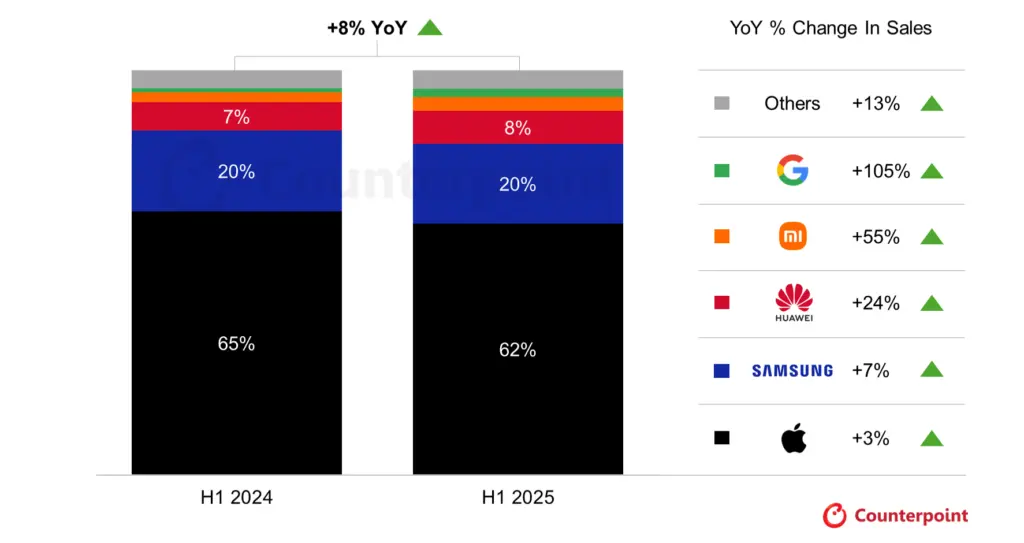
  • The global premium smartphone market’s unit sales grew 8% YoY in H1 2025, reaching the highest-ever mark for an H1.
  • Most of the brands and regions grew in the segment, riding the “premiumization” tailwind.
  • Apple grew 3% YoY, capturing over 62% of overall sales driven by gains in emerging markets.
  • Huawei was the #3 brand, as it remains a popular choice in China due to its loyal consumer base and a strong offline presence.
  • Xiaomi grew 55% YoY, with major growth coming from China. The halo effect of Xiaomi’s premium EV launch is benefiting its smartphone business.
  • Apple was followed by Samsung (7% YoY). The S25 series is performing better than the S24 series, driving Samsung’s growth.
  • Google broke into the top five premium smartphone brands after five years. Its sales doubled YoY, driven by strong performance of the Pixel 9 series, expansion into newer markets and more aggressive marketing efforts.


Seoul, Beijing, Berlin, Buenos Aires, Fort Collins, Hong Kong, London, New Delhi, Taipei, Tokyo – September 8, 2025


The global premium smartphone market’s unit sales grew 8% YoY in H1 2025, reaching the highest-ever mark for a first half, according to Counterpoint Research’s Handset Model Sales Tracker for July 2025. The growth was much faster than the overall smartphone market, which grew 4% YoY during the same period. There is a strong “premiumization” trend visible across geographies, as consumers continue to engage more with their smartphones and upgrade to premium devices for a better overall experience and due to increased affordability. Most of the brands and regions grew in the segment, riding the “premiumization” tailwind. Overall, the premium market contributed over 60% of global smartphone revenues, underscoring the strategic importance of the segment.

Apple remained the largest brand during H1, growing 3% YoY and taking 62% share of the premium market. However, its share declined as other OEMs grew much faster. Apple gained in emerging markets but lost share in China to Huawei and Xiaomi. Huawei remains a popular choice in China due to its loyal consumer base and a strong offline presence. The brand is consistently reclaiming its lost market share from Apple while gaining mindshare through the launch of devices with unique designs, such as the tri-folding Mate XT.  

Global Premium (>$600) Smartphone Market Unit Sales Share by OEM, H1 2025 vs H1 2024  


Source: Counterpoint Research Handset Model Sales, Q2 2025

Xiaomi also gained in the premium segment in China. The brand has been advancing its premiumization on all fronts, not only in smartphones but also in its EV and IoT businesses. The halo effect of its premium EV launch is benefiting Xiaomi’s smartphone business, which is tightly integrated with its EV and IoT segments.

Google broke into the top five premium smartphone brands after five years. Its sales doubled YoY, driven by strong performance of the Pixel 9 series, expansion into newer markets and more aggressive marketing efforts. Google has been focusing on differentiating its Pixel series by positioning it as AI-first devices with a clean software experience, rather than merely emphasizing hardware specifications. Consumer confidence in Pixel devices is growing.

Samsung grew on the back of the S25 series, which performed better than the S24 series. Going forward, the Z Fold7 is also expected to perform better than its predecessor owing to significantly upgraded hardware.

In terms of countries, the top 10 premium markets contributed close to 80% of sales in the segment and India (+37% YoY) was the fastest-growing market among them. India's growth was driven by Apple’s good performance and availability of easy financing, which has expanded the addressable market for premium devices. However, in terms of absolute volumes, China, the world’s largest premium market, was the biggest contributor to growth.

Foldables remain a niche but growing category. They have emerged as a key differentiator for brands and a strategic step to expand their luxury offerings. For consumers, foldables offer a refreshing change in form factor. Apple’s entry in 2026 will further help grow the segment.

In terms of AI, GenAI-capable devices contributed to over 80% of premium smartphone sales in H1 2025, with the premium segment driving overall GenAI adoption. Premium consumers remain consistently attracted to cutting-edge innovations, and smartphone brands are positioning GenAI as the next key differentiator in this segment. As hardware differences narrow, consumer choice will increasingly depend on the AI ecosystem.

About Counterpoint Research

Counterpoint Research is a global market research firm specializing in products across the technology ecosystem. We advise a diverse range of clients – from smartphone OEMs to chipmakers and channel players to Big Tech – through our offices located in the world's major innovation hubs, manufacturing clusters and commercial centers. Our analyst team, led by seasoned experts, engages with stakeholders across the enterprise – from the C-suite to professionals in strategy, analyst relations (AR), market intelligence (MI), business intelligence (BI), product and marketing – to deliver services spanning market data, industry thought leadership and consulting. Our core areas of coverage include AI, Automotive, Consumer Electronics, Displays, eSIM, IoT, Location Platforms, Macroeconomics, Manufacturing, Networks and Infrastructure, Semiconductors, Smartphones and Wearables. Visit our Insights page to explore our publicly available market data, insights and thought leadership, and to understand our focus, meet our analysts and start a conversation.

Follow Counterpoint Research
press(at)counterpointresearch.com     

Receive our insightful weekly newsletter and stay ahead of the competition.

Author

Varun Mishra

twitter_icon
linkedin_icon

Varun is a Principal Analyst at Counterpoint Research based out of Gurgaon. In Counterpoint, he closely tracks mobile devices and ecosystem with a focus on Apple. He started his career as a Consultant with Infosys Limited where he was able to identify strategic avenues for business growth through deep research and analysis of markets and companies in various domains. He holds a Master of Business Administration in Marketing from Institute of Management Technology, Ghaziabad and a bachelor's degree from Coventry University, UK.