ENG
Insight

Global POS Device Shipments Slip 3% YoY in 2024; Mobile, Cellular POS Adoption Reshaping POS Landscape

0
August 13, 2025
  • The broader POS market fell 3% YoY in 2024, driven by a mix of factors including mature markets in developed regions and muted global demand amid an unfavourable macroeconomic environment.
  • China dominates the global POS market with 45% share; emerging markets, especially India, are set for growth driven by digitization initiatives and rising digital payments.
  • Cellular POS devices have overtaken non-cellular and are projected to reach 77% of global shipments by 2032.
  • Mobile POS-type (mPOS) form factor is the key driver reshaping the global payment acceptance infrastructure landscape.


Beijing, Berlin, Buenos Aires, Fort Collins, Hong Kong, London, New Delhi, Seoul, Taipei, Tokyo – August 13, 2025

Global Point-of-Sale (POS) device shipments fell 3% YoY in 2024, according to Counterpoint Research’s latest Global POS Device Tracker and Forecast Report. The decline was mainly due to the weight of mature markets in developed regions and muted global demand amid an unfavourable macroeconomic environment.

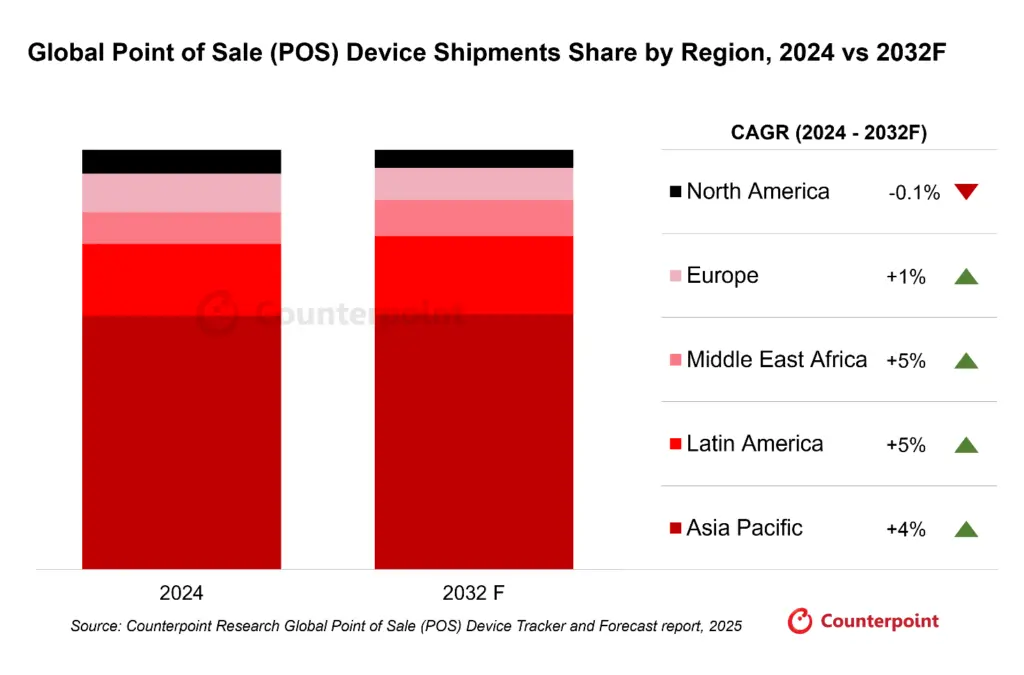
Commenting on the POS regional dynamics, Principal Analyst Tina Lu said, “China leads the global POS device market with a 45% shipment share, fueled by widespread adoption of mobile wallets and QR code-based payments, which is driving strong demand for mPOS devices. Chinese OEMs dominate the global POS market, with Newland, PAX Global Technology, Centerm, Tianyu, Vanstone (Aisino) and New POS Technology among the top players by shipment volume. Emerging markets such as India, the Middle East & Africa, and Latin America are projected to see robust growth, supported by government-led digitization initiatives and improving payment infrastructure. India, in particular, is projected to be the fastest-growing market, driven by rapid retail expansion and digital payment adoption.”

Global Point of Sale (POS) Device Shipments  Share by Region, 2024 vs 2032F

Commenting on the technology landscape, Research Analyst Hanumant Pawar said, “Cellular connectivity has become a convenient connectivity option for POS devices and is increasingly being adopted in newly deployed and replacement POS devices. Cellular POS devices have overtaken non-cellular ones and are projected to reach 77% of global shipments by 2032. The global shift towards wireless mobile transactions, contactless payments, and real-time analytics is driving the replacement towards cellular and Wi-Fi-enabled POS devices. This offers merchants robust connectivity, crucial for today’s fast-paced retail environments and uninterrupted payment processing.”

Enhanced mobility in digital payment solutions is a key trend shaping the POS market, driven by evolving consumer behavior for speed, convenience, and contactless experiences, particularly in service-centric sectors such as restaurants and hospitality, where mobility is essential. Small and Medium Businesses (SMBs), at the forefront of digital adoption, are rapidly embracing mobile POS (mPOS) solutions to meet these changing demands. The COVID-19 pandemic accelerated the consumer adoption of electronic payment for safety reasons, forcing businesses to acquire mPOS devices to bring the payment device closer to customers.

As mPOS adoption scales, cellular connectivity, especially 4G Cat 1 bis, has become the preferred choice for POS OEMs. Its affordability, wide network availability, and streamlined design make it ideal for portable, always-connected payment devices. This enables merchants to accept payments anywhere, without dependence on fixed-line infrastructure or Wi-Fi. Today’s mPOS systems leverage diverse connectivity options to offer secure, agile, and scalable payment experiences. By reducing hardware costs and simplifying deployment, mPOS has become a mainstream solution for businesses of all sizes. Its affordability, scalability, and strong security are fueling widespread adoption across retail and service industries.

For detailed research, refer to the following reports available for subscribers:

Counterpoint’s ‘Global Point of Sale (POS) Device Tracker and Forecast report provides market trends and dynamics, along with valuable insights into shipments across 5+ regions, 15+ leading brands, and technologies, including 2G, 3G, 4G, 5G, and non-cellular solutions. Covering the period from 2022 to 2032, it examines the regional and technological forces reshaping the industry. Key regions analysed include North America, Europe, Latin America, the Middle East & Africa, China, India, and the Rest of Asia-Pacific, each demonstrating unique growth patterns driven by accelerating digital payment adoption and infrastructure evolution.

About Counterpoint Research

Counterpoint Research is a global market research firm specializing in products across the technology ecosystem. We advise a diverse range of clients – from smartphone OEMs to chipmakers and channel players to Big Tech – through our offices located in the world's major innovation hubs, manufacturing clusters and commercial centers. Our analyst team, led by seasoned experts, engages with stakeholders across the enterprise – from the C-suite to professionals in strategy, analyst relations (AR), market intelligence (MI), business intelligence (BI), product and marketing – to deliver services spanning market data, industry thought leadership and consulting. Our core areas of coverage include AI, Automotive, Consumer Electronics, Displays, eSIM, IoT, Location Platforms, Macroeconomics, Manufacturing, Networks and Infrastructure, Semiconductors, Smartphones and Wearables. Visit our Insights page to explore our publicly available market data, insights and thought leadership, and to understand our focus, meet our analysts and start a conversation.

Follow Counterpoint Research

[email protected]

Receive our insightful weekly newsletter and stay ahead of the competition.

Author

Hanumant Pawar

twitter_icon
linkedin_icon

Hanumant Pawar, in Counterpoint's IoT research, focuses on the cellular IoT module market and applications like smart meters and point-of-sale devices. He holds a bachelor’s degree in mechanical engineering from Pune University.

Tina Lu

twitter_icon
linkedin_icon

Tina has extensive consulting and analysis experience across a number of industry sectors including more than 14 years in the technology industry. Before Counterpoint, Tina spent more than 9 years in Nokia working in multiple roles and geographic regions. Tina also worked in brand and product marketing for Bestfoods-Unilever and BGH. Tina holds an MBA degree from the Thunderbird School of Global Management.