

- Global PC shipments declined 21% YoY in Q3 2026 to 57 million units, as elevated memory and other component costs continued to push up PC prices and constrain demand.
- Lenovo retained its market leadership, while ASUS and Apple recorded smaller shipment declines than the overall market and gained market share.
- Consumer demand remained weak, while commercial replacement demand provided some support.
- Global shipments are forecast to decline 27% YoY in Q4 2026, with full-year 2027 volumes expected to remain broadly flat compared with 2026.
Seoul, Beijing, Berlin, Buenos Aires, Fort Collins, Hong Kong, London, New Delhi, Taipei, Tokyo – October 22, 2026
Global PC shipments declined 21% YoY in Q3 2026 to 57 million units, according to Counterpoint Research’s preliminary data. Shipments also fell 13.8% QoQ, as elevated memory and other component costs continued to push up PC prices and constrain demand.
Consumer demand remained weak as higher prices made replacement purchases harder to justify. Commercial demand was relatively resilient, supported by ongoing fleet replacement and Windows migration, but was insufficient to offset the broader market contraction.
The decline also came against a strong comparison period. In Q3 2025, purchases ahead of the Windows 10 support deadline and tariff-related inventory adjustments had supported shipment growth. This elevated base added to the YoY decline in Q3 2026.
Global PC Shipments by OEM, Q3 2026 vs Q3 2025 (In Million Units)

The competitive landscape in Q3 showed a widening gap between Apple and other leading vendors:
- Lenovo maintained its market leadership with shipments of 15 million units and a 26.3% market share, despite a 23% YoY decline.
- HP remained in second place with shipments of 10.3 million units and an 18.1% share. Its shipments fell 31% YoY, the largest decline among the top six vendors.
- Dell ranked third with shipments of 7.6 million units, down 25% YoY, and a 13.3% market share. Its decline shows that relatively resilient commercial demand could not fully shield vendors from the broader downturn.
- Apple’s shipments declined 11% YoY to 5.6 million units, giving it a 9.8% market share, up from 8.7% a year earlier. The MacBook Neo helped cushion the decline, allowing Apple to outperform the overall market.
- ASUS shipped 5.2 million units, down 7% YoY but up 19.4% QoQ. It recorded the smallest annual decline among the top five vendors, increasing its market share to 9.2% from 7.8% a year earlier.
Together, these five vendors accounted for 76.7% of global PC shipments. Other vendors shipped 13.3 million units, down 16% YoY.
QoQ Price Trends for PC Memory, Q3 2025 – Q1 2027
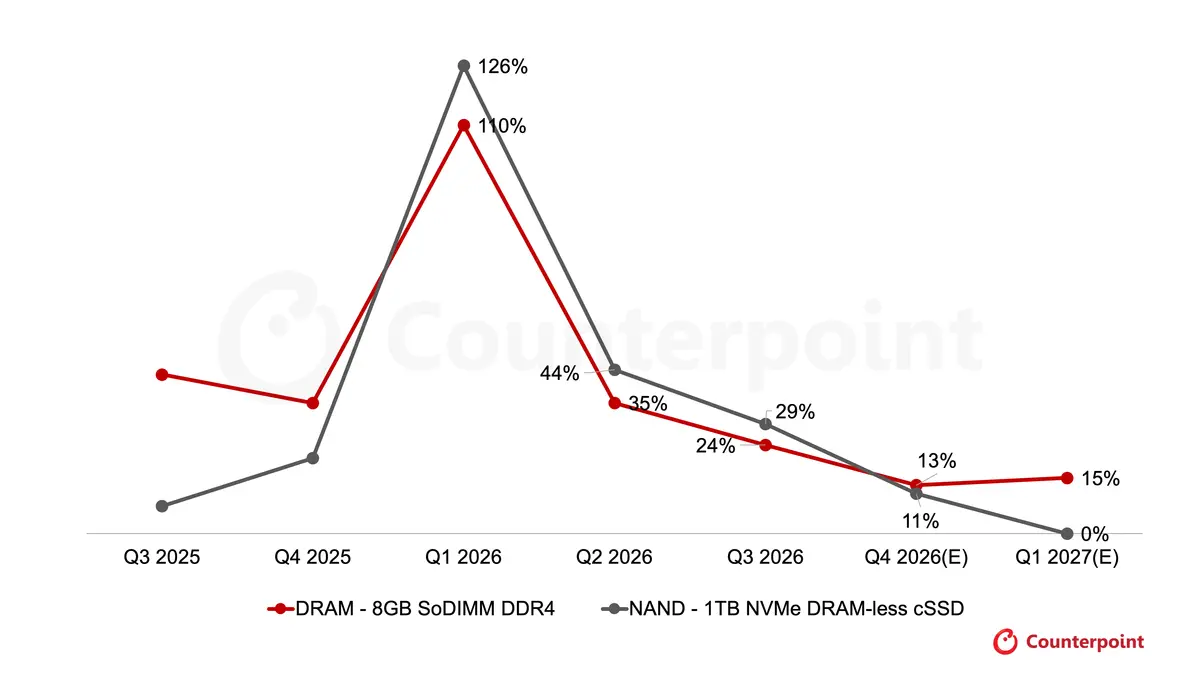
Source: Counterpoint’s Memory Price Tracker and Forecast*
*Prices in this report are based on the contract price.
Senior Analyst Minsoo Kang noted, “The global PC market is facing mounting pressure as rising memory and component costs push system prices higher and force consumers to delay replacement purchases. While commercial refresh cycles and Windows migration continue to provide some support, they are no longer enough to offset weakening demand. Apple and ASUS have demonstrated greater resilience, outperforming the broader market through differentiated product portfolios and competitive positioning. However, with affordability becoming an increasingly critical purchasing factor, even market leaders are struggling to maintain shipment momentum.”
The impact of higher costs extends beyond price increases. As vendors prioritize configurations that can better absorb component inflation, fewer affordable options can make replacement purchases more difficult for price-sensitive buyers. This creates a further constraint on shipment volumes, even where an underlying need to replace older devices remains.
Counterpoint Research expects global PC shipments to decline 27% YoY in Q4 2026. Full-year shipments in 2027 are forecast to remain broadly flat compared with 2026, indicating stabilization at a lower volume level.
Associate Director David Naranjo said, “The PC industry is entering a period of structural adjustment, where rising component costs, higher system prices and longer replacement cycles are fundamentally reshaping market dynamics. OEMs face a difficult balancing act between protecting margins and maintaining affordability, particularly as consumer demand continues to deteriorate. With global shipments expected to plunge 27% in Q4 2026 and remain broadly flat in 2027, stabilization should not be mistaken for recovery. AI PCs, premium displays and differentiated products will create opportunities, but the winners will be those that combine innovation with competitive pricing, supply-chain discipline and compelling value for consumers and businesses.”
About Counterpoint Research
Counterpoint Research is a global market research firm specializing in products across the technology ecosystem. We advise a diverse range of clients – from smartphone OEMs to chipmakers and channel players to Big Tech – through our offices located in the world's major innovation hubs, manufacturing clusters and commercial centers. Our analyst team, led by seasoned experts, engages with stakeholders across the enterprise – from the C-suite to professionals in strategy, analyst relations (AR), market intelligence (MI), business intelligence (BI), product and marketing – to deliver services spanning market data, industry thought leadership and consulting. Our core areas of coverage include AI, Automotive, Consumer Electronics, Displays, eSIM, IoT, Location Platforms, Macroeconomics, Manufacturing, Networks and Infrastructure, Semiconductors, Smartphones and Wearables. Visit our Insights page to explore our publicly available market data, insights and thought leadership, and to understand our focus, meet our analysts and start a conversation.