LLM |
Monthly Active Users (in Mn) in Jan-26 |
Monthly Active Users (in Mn) in Feb-26 |
Monthly Active Users (in Mn) in Mar-26 |
Monthly Active Users (in Mn) in Apr-26 |
|
Meta |
950 |
1000 |
1000 |
1200 |
|
OpenAI |
883 |
890 |
900 |
1000 |
|
|
670 |
700 |
750 |
1000 |
|
ByteDance |
230 |
270 |
300 |
345 |
|
Alibaba |
280 |
285 |
300 |
320 |
|
Baidu |
180 |
190 |
200 |
220 |
|
DeepSeek |
127 |
132 |
140 |
145 |
|
Others |
417 |
444 |
510 |
559 |
Market Highlights
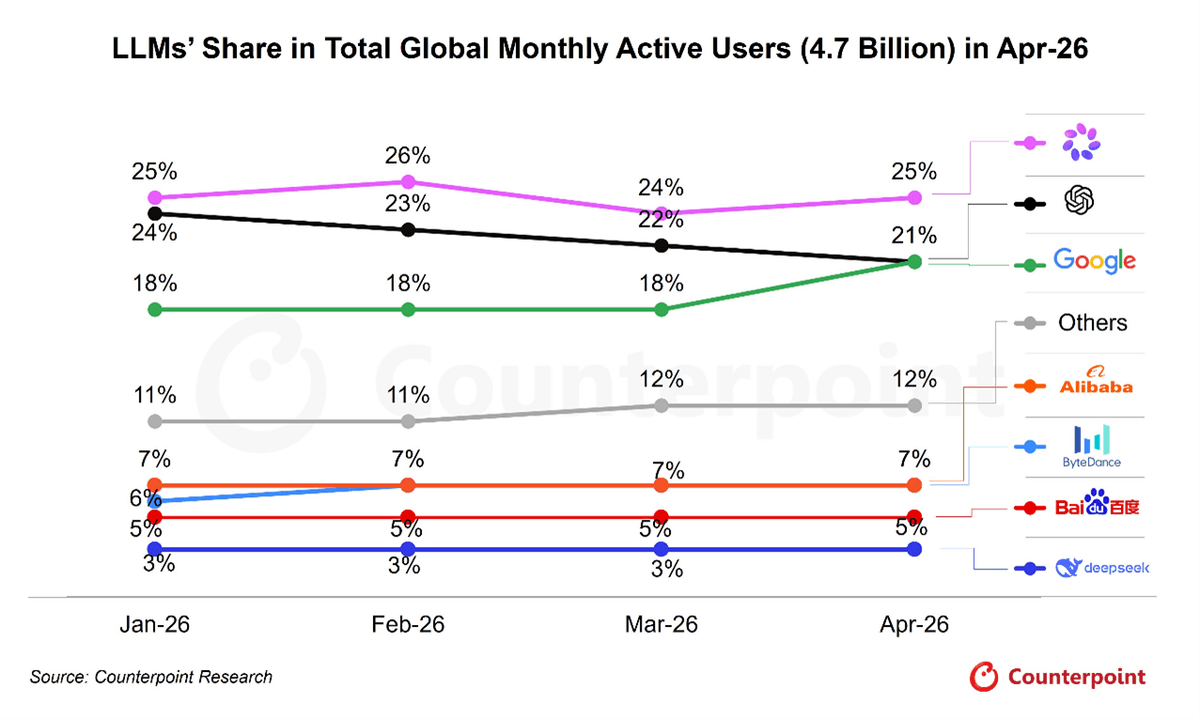
Total global LLM monthly active users surpassed 4.7 billion in April 2026, with Meta, OpenAI and Google holding the top three spots. The most notable development during the month was Google's remarkable surge, as it erased OpenAI's long-held lead to pull level in market share by April, a shift that signals a fundamental rebalancing of the LLM landscape. The next quarter will be closely watched as OpenAI looks to defend its position against an increasingly aggressive Google.
- Global monthly active LLM users accelerated to about 4.7 billion by April 2026 after reaching roughly 4.1 billion in Q1 2026, reflecting strong adoption in both consumer and enterprise segments.
- Meta retained its position as the global MAU leader, growing to 1.2 billion by April from 950 million in January – a 26% rise in just four months. Despite this growth, Meta’s market share dipped slightly to 27% from 28%, indicating the overall market is expanding faster than any single player.
- Google was the standout performer in April, with MAUs growing from 670 million to 1 billion (up 49%), bulking its market share to 23% from 20% and pulling level with OpenAI. This surge was likely driven by Gemini’s deep integration into search and Android which is clearly pulling users in at scale. The Apple partnership (building next-gen siri on Gemini, across 2B+ devices) is a massive structural competitive edge still playing out.
- OpenAI’s market share declined to 23% from 26% over four months. It remains a top-three platform, but the trend is uncomfortable and the pressure from Google is only going to increase.
- ByteDance was a standout performer over the period, climbing from 230 Mn MAUs in Jan-26 to 345 Mn MAUs by April-26, a gain of 115 Mn users in just four months. ByteDance is emerging as a serious challenger among Chinese LLM players and is well-positioned to close in on the top three (Meta, OpenAI, Google) if the current trajectory holds.
- Alibaba held steady with a 7%-8% market share throughout the period, maintaining its dominance among Chinese players ahead of Baidu. However, its share dipped slightly to 7% by April. Alibaba is worth monitoring given the intensifying domestic competition.
- Baidu showed consistent but modest growth, with MAUs rising to 220 million in April 2026 from 180 million in January 2026 while holding a stable 5% global share. Its steady trajectory suggests a loyal, largely China-based user base with limited international expansion.
For detailed insights on the data, please reach out to us at [email protected].
For any media enquiries, please contact us at [email protected].


