

• Global cellular IoT module shipments grew 11% YoY in Q2 2026, with China and India accounting for the three-fourth of incremental volume.
• 4G Cat 1 bis exceeded 50% of shipments for the first time, driven by aggressive pricing from chipset players that led to device OEMs buying chipsets ahead due to price hikes.
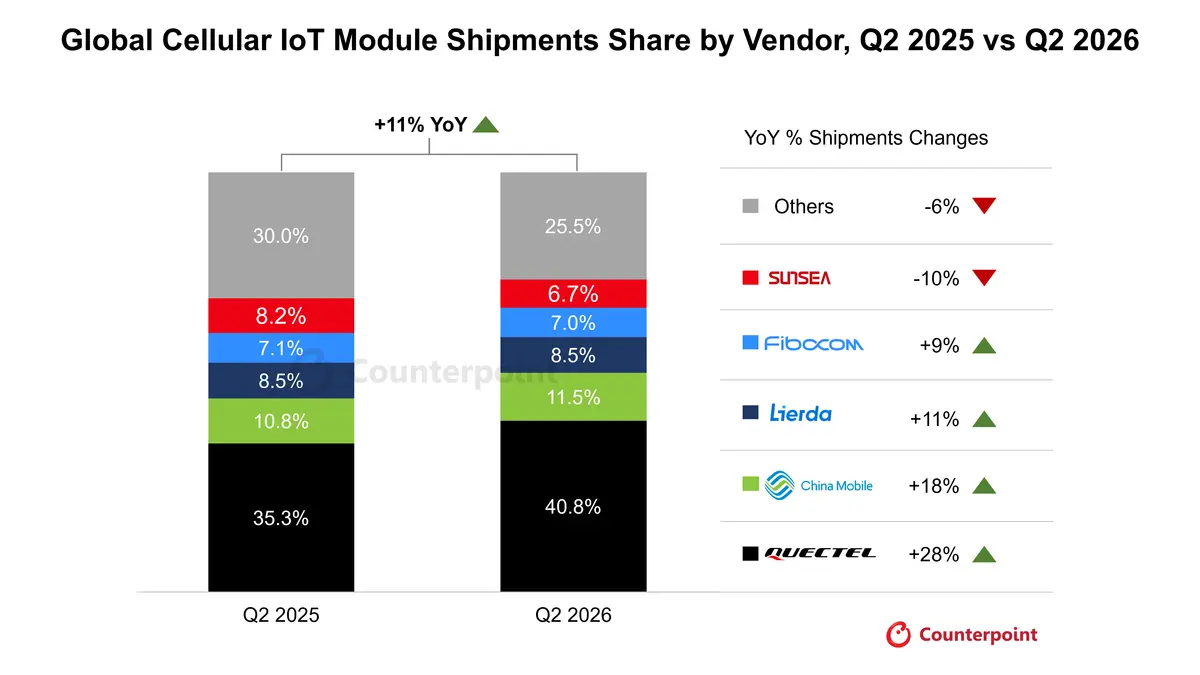
• Quectel extended its lead in the global market, lifting its share to 41% from 35% a year earlier, driven by China’s double-digit percentage market growth.
• Eigencomm emerged as the biggest YoY volume growth chipset player by offering the lowest-priced chipset supporting 4G Cat 1 bis. It benefited as its exclusivity agreement with Qualcomm expired in Q1 2026, allowing it to expand beyond the China market.
Beijing, Berlin, Buenos Aires, Fort Collins, Hong Kong, London, New Delhi, Seoul, Taipei, Tokyo – September 15, 2026
Global cellular IoT module shipments grew 11% YoY in Q2 2026, according to Counterpoint Research's Global Cellular IoT Module and Chipset Tracker, Q2 2026. The growth was driven by increased 4G Cat 1 bis sales due to stronger demand and more aggressive pricing, especially in China and India.
Commenting on the market’s dynamics, Senior Analyst Anish Khajuria said, “In Q2 2026, 4G Cat 1 bis accounted for more than half of global shipments for the first time ever. Smart meter and POS remain the main application for 4G Cat 1 bis, but because of the competitive pricing, the technology is finding a whole new pool of applications, which is also helping it grow.”
In India, IoT adoption is being driven by 4G Cat 1 bis, with the technology accounting for more than 80% of total module shipments in Q2 2026. Among the module brands driving Cat 1 bis adoption in India, Quectel was the top contributor, followed by Neoway and Fibocom. Together, they reported a double-digit percentage share in the country.
Vendor Performance
• Quectel maintained its global lead, with its share rising to 41% in Q2 2026 from 35% in the year-ago quarter. This was supported by strong presence across regions except the North America market, where it reported negative growth, hurt by geopolitical pressure.
• China Mobile’s market share grew to 18% YoY in China, driven by strong demand across POS and smart meters, supported by 4G Cat 1 bis technology in the country.
• Outside China, Telit Cinterion remained the leading international vendor, with shipments growing by double-digit percentage YoY, driven by market share gains in Europe and North America.
Global IoT Module Shipments Share by Vendor, Q2 2025 vs Q2 2026
Source: Counterpoint Research Global Cellular IoT Module and Chipset Tracker by Application, Q2 2026
Commenting on the chipset market dynamics, Principal Analyst Tina Lu said, "The global competitive landscape among chipset vendors shifted in Q2 2026 after Eigencomm’s exclusivity agreement with Qualcomm expired in Q1 2026. Eigencomm can now expand beyond China and sell its 4G Cat 1 bis chipsets internationally. This is already visible in India, where Fibocom has started shipping modules using Eigencomm chipsets. Consequently, Eigencomm emerged as the fastest-growing vendor among the world’s top three chipset players in Q2 2026, with its shipments jumping 20% YoY as the company offered its Cat 1 bis chipsets at the most affordable rate in the market, across high-volume, price-sensitive applications.”
For detailed research, refer to the following reports available for subscribers:
• Global Cellular IoT Module and Chipset Tracker by Application, Q2 2026
• Global Cellular IoT Module Tracker, Q2 2026
Counterpoint's 'Global Cellular IoT Module and Chipset Tracker by Application' tracks over 2,000 IoT module SKUs on a quarterly basis and provides forecasts on shipments, revenues and ASP performances for over 80 IoT module vendors, over 12 chipset players and over 18 IoT applications across 10 major geographies.
About Counterpoint Research
Counterpoint Research is a global market research firm specializing in products across the technology ecosystem, advising clients from smartphone OEMs to chipmakers, channel players and Big Tech. Our core areas of coverage include AI, Automotive, Consumer Electronics, Displays, eSIM, IoT, Location Platforms, Macroeconomics, Manufacturing, Networks and Infrastructure, Semiconductors, Smartphones and Wearables. Visit our Insights page to explore our publicly available market data and insights.
