
- In 2026, the manufacturing cost of an 11.1” iPad Pro OLED panel produced on Gen 8.7 is approximately 39% lower than that of a Gen 6 panel, driven by lower personnel, depreciation and indirect expenses, along with integrated OCTA touch technology.
- China Star's Oxide/IJP technology offers the lowest initial cost structure for 15.5” QHD OLED production, while Samsung Display's Gen 8.7 Oxide fab has a lower initial cost structure than LG Display's Gen 8.5 Oxide/FLiPP fab.
- A 15.6” FHD LCD panel costs approximately $31 in 2026, excluding the touch module. Higher resolutions increase costs significantly, with QHD adding approximately $10 and UHD approximately $42 compared with FHD.
- A 15.5” Inkjet OLED panel offers an approximately $14 cost advantage over a 16.2” MiniLED LCD panel in 2026, excluding touch integration, highlighting the potential cost competitiveness of next-generation OLED manufacturing.
Counterpoint Research has released its latest IT Display Cost Report, which provides detailed manufacturing cost analysis of OLED and LCD panels used in IT applications, including tablets, notebooks and monitors. It examines panel costs across different display technologies, sizes, resolutions, fab generations and manufacturing regions, with historical cost analysis from 2024 and forecasts through 2030.
Senior Analyst Nikhil Kishor said, “The global IT display industry is undergoing significant manufacturing and technology transitions, with larger-generation fabs, advanced backplane technologies and integrated touch solutions reshaping panel manufacturing economics. As OLED adoption expands across tablets and notebooks, understanding the cost differences between fab generations and manufacturing regions is becoming increasingly important for panel makers and technology suppliers.”
Gen 8.7 Offers a Significant OLED Cost Advantage Over Gen 6
The chart below compares the manufacturing cost structure of 11.1” iPad Pro OLED panels produced using Gen 6 and Gen 8.7 fabrication processes. The analysis covers tandem OLED panels with LTPO and Oxide backplanes, respectively, along with glass substrates and thin-film encapsulation (TFE). While component costs and SG&A remain identical between the two fab generations, Gen 8.7 benefits from lower personnel, depreciation and indirect expenses. In addition, OCTA (On-Cell Touch AMOLED) integrates the touch functionality directly into the display panel, eliminating the need for a separate touch layer. These advantages allow Gen 8.7 to achieve an approximately 39% lower manufacturing cost than Gen 6 in 2026.
Cost comparison of 11.1'' iPad Pro OLED panels - Gen 6 vs Gen 8.7
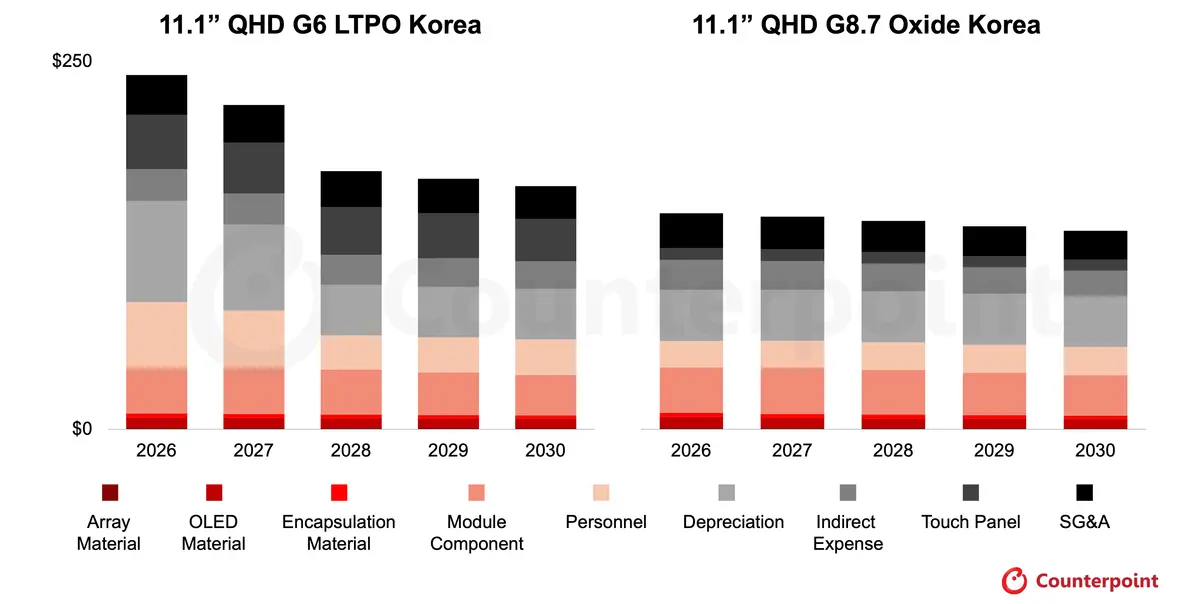
Source: Counterpoint Research's IT Display Cost Report
Regional Manufacturing Cost Competitiveness: South Korea vs. China
China is strengthening its cost competitiveness in OLED manufacturing as its historical disadvantage in manufacturing yields narrows. Lower personnel expenses, depreciation and indirect costs, combined with higher fab utilization and improved operational efficiencies, have enabled Chinese panel manufacturers to establish a clear cost advantage over South Korean counterparts.
Among the emerging manufacturing technologies, China Star's Oxide/IJP process demonstrates the lowest initial cost structure for 15.5” QHD OLED production, benefiting from integrated process efficiencies and stronger fab utilization.
The comparison also highlights differences among South Korean panel manufacturers. Samsung Display's Gen 8.7 Oxide fab has a lower initial cost structure than LG Display's Gen 8.5 Oxide/FLiPP fab in 2026, primarily due to lower personnel and indirect expenses.
LCD and MiniLED: Resolution and Backlight Costs Remain Key Drivers
LCD manufacturing costs continue to be influenced by backplane technology, resolution and backlight configurations. In 2026, a 15.6” FHD LCD panel costs approximately $31, excluding the touch module. Moving to QHD adds approximately $10, while UHD adds approximately $42 compared with FHD.
Higher resolutions increase module component costs, while the backlight becomes a particularly significant cost driver for UHD panels.
MiniLED technology carries a substantial cost premium over conventional LCD due to its more complex backlight architecture. Although this premium is expected to decline gradually, it is forecast to remain approximately $35 higher than conventional LCD panels by 2030.
Inkjet OLED Challenges MiniLED LCD on Manufacturing Cost
Despite OLED's advanced technology positioning, its manufacturing cost can be competitive with MiniLED LCD, depending on the fabrication process and production scale.
In 2026, a 15.5” Inkjet OLED panel offers an approximately $14 cost advantage over a 16.2” MiniLED LCD panel, excluding touch integration. The higher backlight component costs associated with MiniLED LCD contribute to this difference, while Inkjet OLED benefits from relatively lower depreciation expenses at the new fab.
This highlights the potential for next-generation OLED manufacturing processes to challenge MiniLED LCD not only on display performance but also on manufacturing economics.
"The transition towards larger-generation OLED fabs is creating new opportunities to improve manufacturing cost competitiveness in IT displays. Our analysis indicates that Gen 8.7 can deliver a significant cost advantage over Gen 6 for tablet applications, driven by lower depreciation, personnel and indirect expenses, along with integrated touch technology. At the same time, China's improving manufacturing efficiencies are reshaping the regional cost landscape," said Senior Analyst Nikhil Kishor.
As OLED adoption expands across tablets and notebooks, panel manufacturers will increasingly focus on optimizing fab utilization, improving yields, integrating manufacturing processes and reducing operating expenses. Meanwhile, the cost evolution of MiniLED LCD and emerging OLED technologies will play an important role in determining the competitive landscape of IT displays through 2030.
