

- Prescription hearing-aid sales are projected to exceed 31 million units by 2030, with nearly 50% featuring Edge AI.
- Hearing aids brands are using AI to shift from basic amplification to real-time speech separation, adaptive processing and personalization, improving speech clarity by separating noise and preserving key speech cues.
- AI-driven processing can significantly improve speech understanding in noisy environments, with brands reporting measurable improvements in SNR after integrating AI into their devices.
Almost every connected device today is marketed as “AI-powered,” but only a few integrate AI deeply enough to deliver meaningful value. In consumer healthcare, the real impact of AI depends on the data a device captures and how effectively it converts that data into actionable insights. Smart hearing aids are a strong example. Traditionally, hearing aids were designed to amplify all type of speech by only reducing all types of noise. AI-enabled models can now distinguish speech from background noise and enhance the sounds that matter most, making hearing aids more adaptive to the wearer’s surroundings.
According to WHO’s report on Deafening and hearing loss 2024 and Counterpoint estimates, as of 2025, around 1.7 billion people had some degree of hearing loss. This number is expected to continue rise with more than 500 million people to experience disabling hearing loss requiring rehabilitation by 2030. Between 2025 and 2030, the global population with hearing loss is expected to grow at a CAGR of 2%. As the affected population continues to grow, the demand for smarter and more effective hearing-care solutions is expected to increase. According to Counterpoint’s Global Edge AI Enabled Wearable Forecast, sales of prescription-based hearing-aid are projected to exceed 31 million units by 2030, growing at a CAGR of 4% between 2025 and 2030. With the growing adoption and benefits of AI in hearing aids, nearly 50% of total hearing-aid sales are expected to feature Edge AI capabilities by 2030.
Estimated Population (Million) with Hearing Loss, 2025 vs 2030F
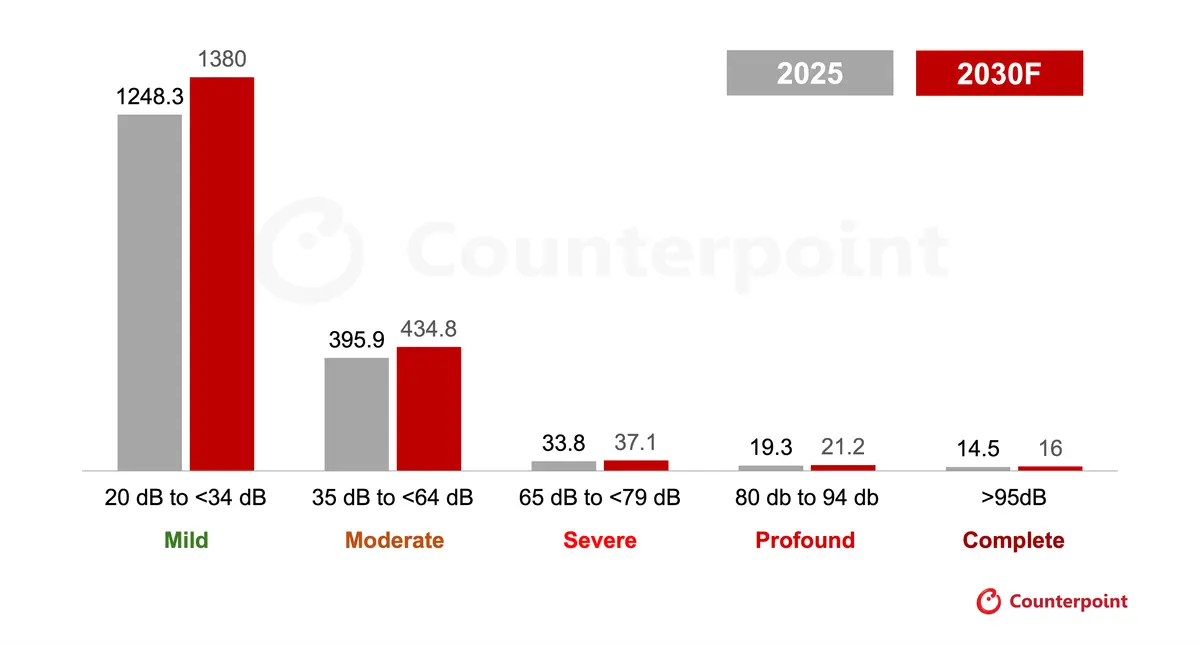
Source: WHO’s Deafening and Hearing loss report, 2024 and Counterpoint Estimates
From traditional devices to Smart AI devices:
For years, hearing aids became smaller, more connected and longer lasting, but one major challenge remained: understanding speech in noisy environments. Traditional hearing aids primarily relied on digital signal processing (DSP). Microphones captured sounds from the environment, the processor analyzed characteristics such as frequency and volume, and predefined algorithms determined which sounds to amplify or reduce. This worked well for predictable noise, such as an air conditioner or engine. However, real-world environments are much more complex. In a crowded restaurant, multiple conversations, music and clattering dishes can occur simultaneously, making it difficult for rule-based systems to determine which sound the wearer actually wants to hear. AI introduces a fundamentally different approach. Instead of relying only on predefined rules, AI models can learn the patterns that distinguish speech from competing sounds. Deep neural networks (DNNs), trained on millions of examples of speech and background noise, can identify a speaker's voice and suppress unwanted sounds in real time.
AI Transformation in Hearing Aids
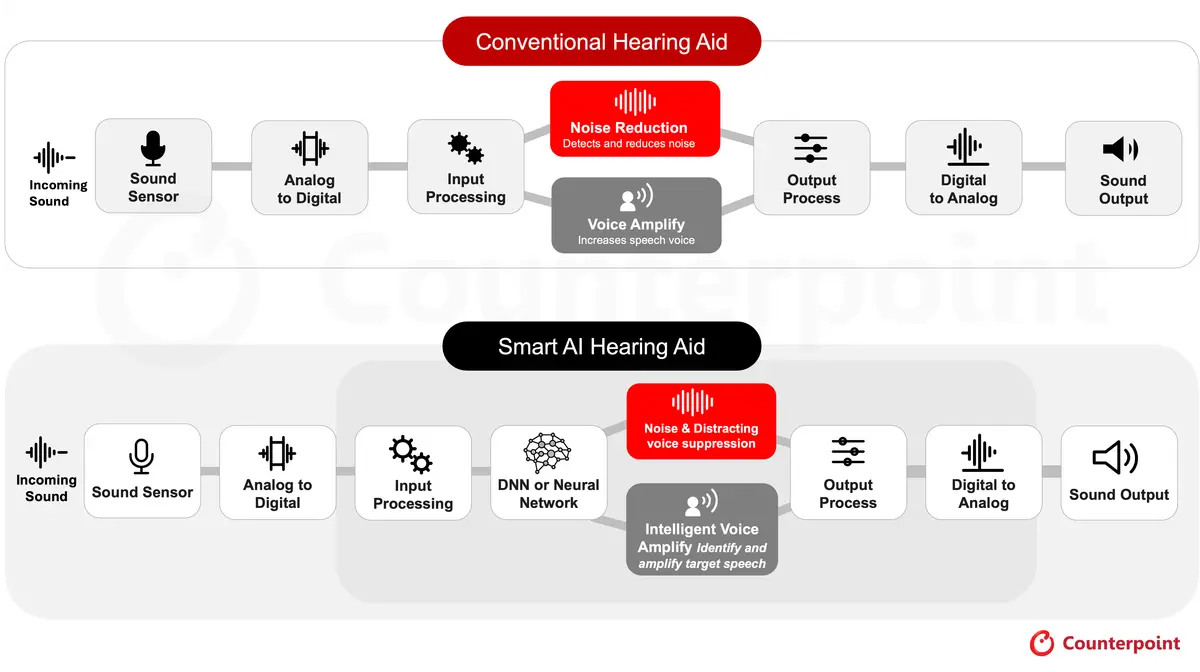
Source: Counterpoint insights
What AI adds?
AI is making hearing aids better at understanding speech in real-world environments. AI separates speech from noise, prioritize a speaker, improve spatial awareness and continuously adapt to changing environments. This is particularly valuable for distinguishing subtle, easily confused speech sounds such as “s,” “f,” “t,” “sh” and “th,” helping users differentiate words and also between numbers such as 15 vs. 50 or 17 vs. 70, and so on. By preserving these fine speech cues, AI can improve actual speech understanding, not just loudness, in places such as restaurants, meetings and crowded streets.
In clinical speech-in-noise testing, a normal-hearing listener typically needs a signal-to-noise ratio (SNR) of about 2 dB to correctly identify 50% of key words. For listeners with mild-to-moderate sensorineural hearing loss, that requirement can rise to around 8 dB. This extra margin lifts many wearers above the level they need to follow speech in noise and it is where AI can make a measurable difference. In Phonak's testing, a fixed directional microphone with Phonak’s conventional setting improved the SNR by 6.4 dB compared with an omnidirectional microphone. Adding Spheric Speech Clarity increased the improvement to 9 dB at its default strength and 10.2 dB at maximum strength. This creates the difference between following a conversation across a restaurant table and nodding along to it. AI also makes hearing aids more automatic and personalized. Machine learning now-a-days can adapt sound processing to individual preferences and listening environments, reducing manual adjustments while lowering the cognitive effort required to follow conversations. This can mean less listening fatigue, fewer requests for repetition and greater confidence in everyday interactions. These gains are however not free. Running a neural network continuously costs battery life and physical space, which is why the most capable AI devices are often available in the fewest styles.
The EDGE AI Constraint:
A hearing aid can only accept a very slight processing delay. The complete journey from capturing sound to processing it and delivering it to the ear must happen roughly in 10 milliseconds or less to feel natural. This makes hearing aids fundamentally different from most other AI devices. A smartphone can send data to the cloud, wait for an AI response and then act on it. A hearing aid cannot afford that round trip. Even a small delay can create a mismatch between what the user sees and hears or make their own voice sound unnatural. For real-time speech processing, therefore, the AI has to run on the hearing aid itself, rather than on the user’s smartphone or the cloud. This is where Edge AI becomes critical: sound is analysed and processed locally, close to the microphones and receiver.
The challenge is fitting that intelligence into a device with a tiny battery, limited computing power and strict size constraints. Both AI models and processors have to be highly optimized to deliver speech separation and noise reduction while consuming minimal power. Running a neural network continuously can significantly decrease battery. For example, Phonak’s Audéo Infinio Ultra Sphere (2025) offers a normal battery life of 56 hours which reduces to just 10 hours if AI features are used continuously. This makes smart AI hearing aids a strong example of Edge AI and demonstrates the real-world cost of running on-device intelligence.
Inside a Smart AI hearing Aid
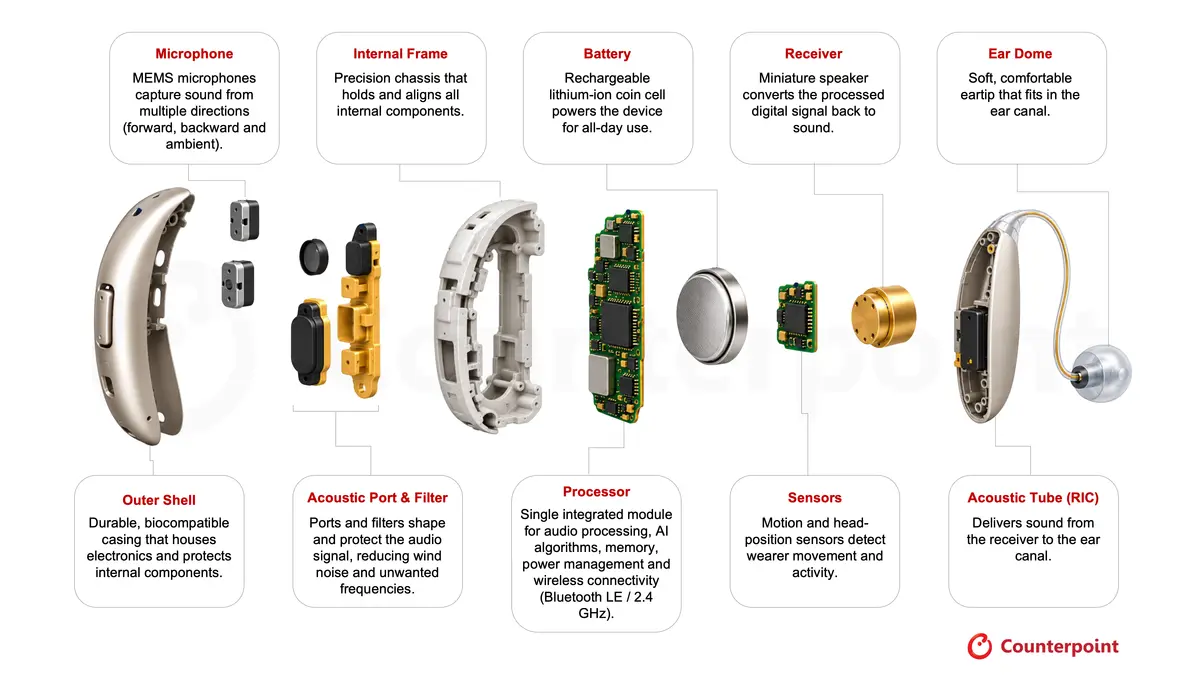
Source: Counterpoint Insights
Integrating Edge AI makes a hearing aid smart and integrating Edge AI efficiently is what makes it hard to build. Every gain in speech clarity costs battery life and space, and the drop from 56 hours to 10 hours with AI working continuously on Phonak’s Audéo Infinio Ultra Sphere (2025) shows how high that cost is. The next generation of hearing aids will be defined by how well AI works quietly in the background, delivering clearer speech, lower listening effort and more personalised hearing without draining the battery or making the device bigger. That race is already underway, and Part 2 dives deep into it.

