In 2018, the global NAND flash market reached US$58 billion. Mobile phones and PCs account for 42.1% and 16.2% of the overall NAND market demand, respectively.
The demand for NAND on the PC continues to increase because of the decreasing price, improving performance and higher density driven sleeker notebook designs. The mainstream capacity of SSD in PC is moving to 512GB from 256GB. The average capacity has also risen to 321GB. However, while the price per GB has dropped significantly, it is still higher than that of an HDD. Therefore, we expect to see the penetration of SSDs in PCs continuing to increase and cross the 50% mark this year. Though, SSD will still coexist with the HDD in the next five years and won’t completely replace the HDD.
Although the sales of mobile phones have seen a decline for the first time in 2018, the demand for NAND in smartphones will continue to increase due to 5G, new camera functions, and decreasing prices. According to our research, the average storage capacity of smartphones will rise to more than 80GB by end of 2019. Mainstream storage capacity configurations in smartphones have shifted to 64/128GB in Q1 2019 from 32/64GB in Q2 2018.
Figure 1: Global Smartphone Sales by NAND Flash Storage Share % by Capacity
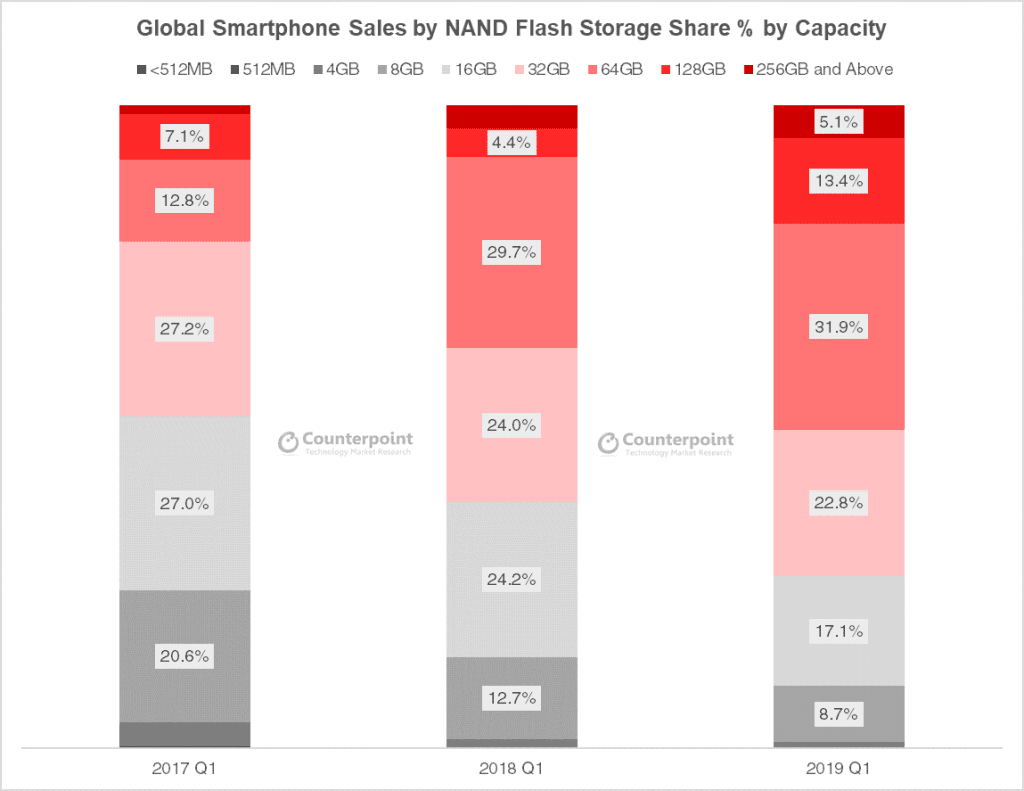
Source: Counterpoint Research - Global Smartphone Memory Capacity Tracker, May 2019
Most mobile phone EMS and ODM players are located in China and have consumed more than 30% of global NAND flash in 2018. The ratio is still increasing. Further, some Chinese OEMs have also gained a significant share in the global smartphone market, with rising of Huawei, OPPO, vivo, Xiaomi, and others. At the same time, OEMs have also gained more purchasing power and will play a critical role in the NAND flash business. In order to gain more control of NAND flash production, investment from the Chinese government and investors on NAND flash design and production has also been increasing dramatically in the past few years.
The NAND flash manufacturing technology has been migrating from 2D to 3D and in terms of configuration from Multiple-Level-Cell (MLC) to Triple-Level-Cell (TLC) and now to Quad-Level-Cell (QLC), creating a significant entry barrier for the followers. The current mainstream technology of 3D NAND is 64 layers and TLC though move to QLC a will pack in more density and reduce the production cost further. This has given a significant edge to mature suppliers such as Samsung, SK Hynix, Toshiba, and Western Digital.
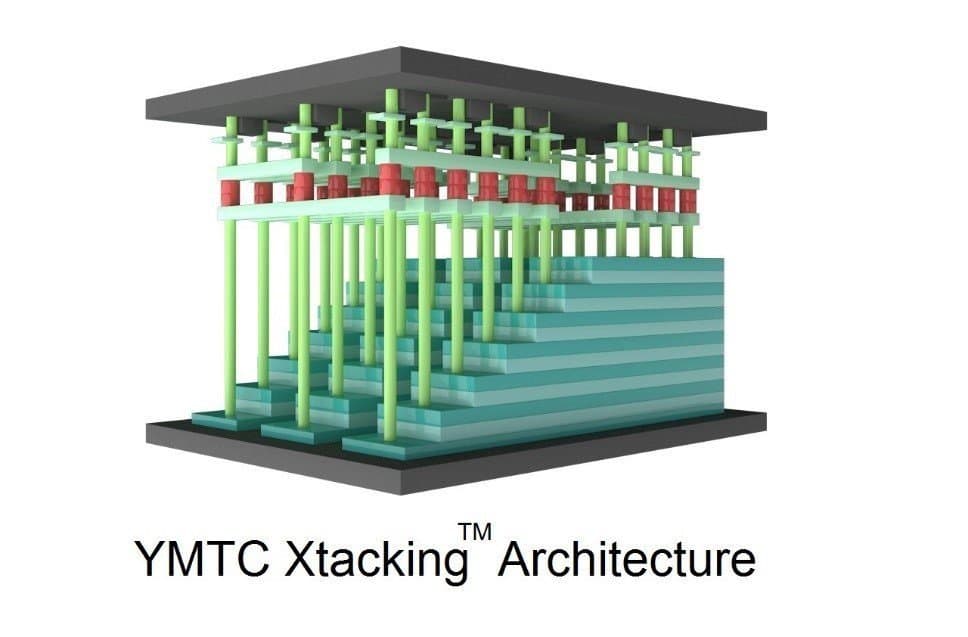
The critical stage of NAND flash production has changed to etching in 3D from lithography in 2D. This is different from the challenge posed by manufacturing a logic chip in a foundry. However, due to the experience of NOR flash production in the past, YMTC now is the leading NAND flash vendor in China, and its manufacturing process has reached 32-layer 3D NAND Flash though still behind the global competitors. However, 32-layer stacking process is not cost-effective, and YMTC needs to mass produce 64-layer soon. YMTC recently started testing 64-layer NAND samples with Xtacking architecture.
 UNIC Memory Technology, a subsidiary of Unigroup, recently launched two consumer-grade SSD which used NAND chips (Intel) and controller from a third party (Phison). The technology of NAND flash chips will determine the production cost. However, the quality of the NAND flash controller is also critical and will determine the performance of the SSD. The controller can be either designed in-house or by a third party. Currently, all the leading NAND flash vendors have in-house control chips to reduce the time-to-market and provide tailored controllers for cutting-edge NAND flash chips. However, NAND flash vendors also leverage controllers from third parties for cost reduction. There are many good IC design houses in China. Therefore, the proportion of in-house design will increase for YMTC as its NAND production technology matures.
Unlike client-SSDs, the challenge to produce embedded storage for mobile phones is much higher. This is because the internal space of the mobile phone is much less, and the demand for branding in mobile phones is even higher. The good news is that YMTC can leverage its domestic market in some entry-level applications, such as SD Card, USB driver, and even some mid-to-low-end mobile phones.
We expect to see competitive technology offerings from YMTC in 2021 and a fully built up ecosystem and capacity in early 2022. These capacities will have a meaningful impact on the NAND flash market in 2023. Through 2023, other NAND vendors will inevitably have to cut prices to reduce the impact of Chinese memory supply ecosystem.


