

- Strong demand for AI accelerators and data centers with pricing growth drove Q3 DRAM revenue up nearly 5x YoY.
- Samsung kept its lead in Q3 2026 with a 38% DRAM share, while SK hynix narrowed the gap after revenue grew over 40% QoQ.
- New HBM generations and rising prices are expected to push major memory suppliers to new earnings records next quarter.
Seoul, Beijing, Berlin, Buenos Aires, Fort Collins, Hong Kong, London, New Delhi, Taipei, Tokyo – November 5, 2026
Strong demand for AI accelerators and data centers pushed the memory pricing and thus supplier earnings to record highs, as DRAM revenue grew a massive 369% YoY.
According to Counterpoint Research's Q3 2026 Global Memory Tracker, Samsung led the DRAM market with a 38% market share. SK hynix posted stronger sequential growth, with revenue up over 40% QoQ, helping it recover some of the share it lost earlier this year. Micron also posted strong results on demand for AI data center memory but grew more slowly than Samsung and SK hynix. CXMT's share slipped from 10% in Q2 to 9% in Q3. As rivals start shipping HBM4, which sells at a premium, from Q4, CXMT's share is likely to remain under pressure.
Q3 2026 DRAM Revenue Market Share
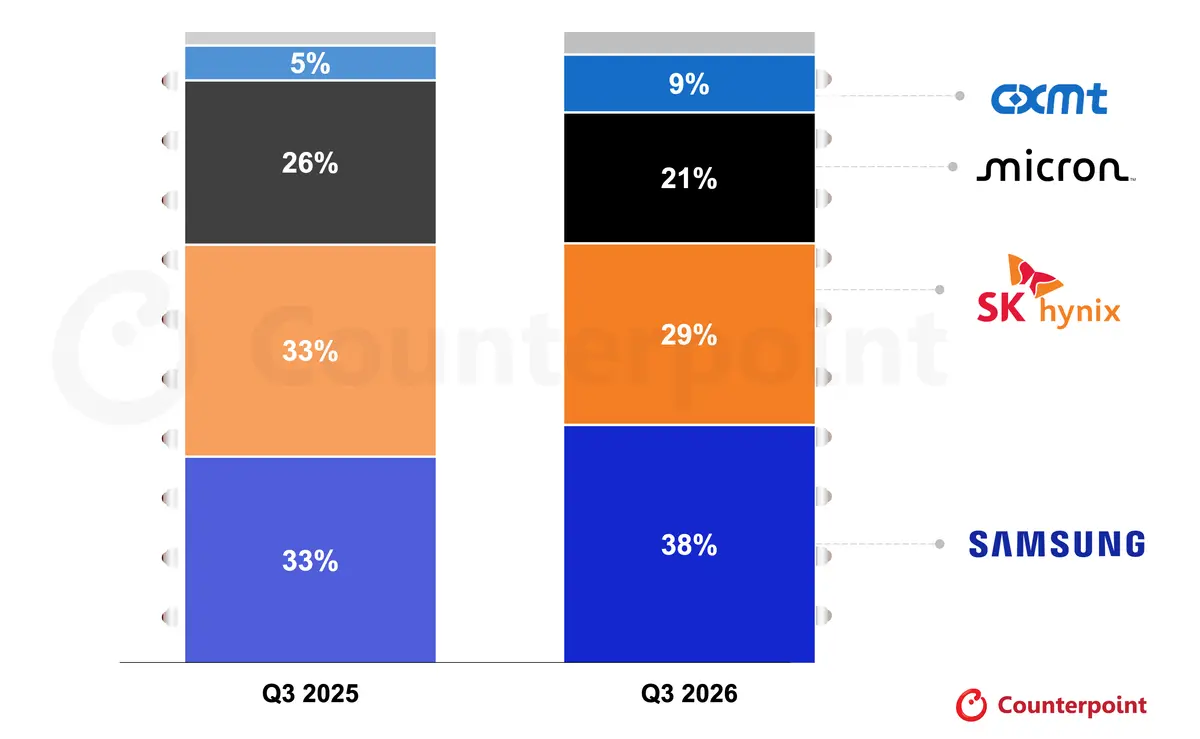
Source: Counterpoint Research Global Memory Tracker 2026 Q3
"This is a pricing super-cycle, not yet a volume cycle," said Jeongku Choi, Senior Analyst at Counterpoint Research. "Bit shipments rose only about 4% this quarter, yet DRAM revenue reached nearly $200 billion, close to 5x a year ago. AI has turned memory from a commodity into a valuable scarce resource, and buyers are now competing for supply rather than negotiating on price. With prices still rising, suppliers are on track to set new earnings records again next quarter."
Higher DRAM average selling prices (ASPs) were the main driver of Q3 growth. Although price increases slowed from the steep rise in the first half of the year, ASPs reached $1.9 per gigabit (Gb), lifting overall DRAM revenue.
"Every new HBM generation is resetting the leadership position," said MS Hwang, Research Director at Counterpoint Research. "SK hynix dominated HBM3E, but its growth has slowed, while Samsung's HBM4 is being well received by customers. After turning its earnings around this year, Samsung is expected to take the top spot in HBM next year."
MS Hwang added, "Memory prices should stay strong next year. HBM prices, which lagged commodity DRAM this year, are now catching up. Long-term agreements (LTAs) are supporting prices, and supply will stay tight because major new fabs will not start production until 2028. LTA terms may cause results to differ between suppliers in the short term, but over time they should all follow the same upward trend”.
Looking at the mix, HBM's share of DRAM revenue declined even though HBM revenue almost doubled, as conventional DRAM (DDR/LPDDR) grew even faster. Commenting on the mix shift, Associate Director Brady Wang said, "The rise of agentic AI is driving unprecedented demand for conventional DRAM. According to our Cloud AI compute tracker, the GPU-to-CPU ratio has narrowed considerably from 4:1 to 2:1 and is even trending towards 1:1. For example, in NVIDIA's Vera Rubin rack, CPU DRAM per socket rises almost threefold to 1.5 TB versus the previous generation."
Brady Wang added, "The massive demand has driven DDR and LPDDR ASPs to record highs, and as a result their revenues have grown 500% and nearly 400% YoY, respectively. We see a significant uptick in server CPU consumption, and hence in conventional DRAM consumption, which will drive ASP per Gb even higher next year and create headwinds for edge markets."
Counterpoint Research's memory research covers DRAM, NAND flash, and HBM, including supply and demand, pricing, bit and revenue tracking, and the impact of AI across applications from data centers to edge devices. For the latest data, outlooks, and analyst views, see Counterpoint's Memory reports.
About Counterpoint Research
Counterpoint Research is a global market research firm specializing in products across the technology ecosystem. We advise a diverse range of clients – from smartphone OEMs to chipmakers and channel players to Big Tech – through our offices located in the world's major innovation hubs, manufacturing clusters and commercial centers. Our analyst team, led by seasoned experts, engages with stakeholders across the enterprise – from the C-suite to professionals in strategy, analyst relations (AR), market intelligence (MI), business intelligence (BI), product and marketing – to deliver services spanning market data, industry thought leadership and consulting. Our core areas of coverage include AI, Automotive, Consumer Electronics, Displays, eSIM, IoT, Location Platforms, Macroeconomics, Manufacturing, Networks and Infrastructure, Semiconductors, Smartphones and Wearables. Visit our Insights page to explore our publicly available market data, insights and thought leadership, and to understand our focus, meet our analysts and start a conversation.
Follow Counterpoint Research
