

CoreWeave beat on almost every line in Q3 (July–September 2026). Demand for AI compute is significant but revenue per MW, and how much each MW costs to run, are the metrics shaping the neocloud landscape. At the same time, CoreWeave’s ambitions are expanding as it moves up the stack with CoreWeave Forge.
Q3 2026: Demand-Supply Imbalance Drives Revenue and Capex
Industry demand: Through the roof
-
Demand for AI compute is still running ahead of supply. In fact, CoreWeave re-signed older Ampere and Hopper GPUs at prices 30–50% higher than the previous quarter, and above what customers paid when the chips were new.
-
Older chips going up in price is a clear leading indicator of strong demand for compute, from hyperscalers to enterprises.
-
The constraints are power, sites and the money required to build the supply infrastructure.
Revenue: Growing but not faster than costs
-
CoreWeave's revenue was $3.66bn, up 168% year on year and $1.1bn more than Q2.
-
That came in above the top of its own guide ($3.45–3.60bn) and above the Street at about $3.55bn.
-
Full-year guide is now $13.0–13.3bn, up from $12.4–13.2bn. That implies about $4.7–5.0bn in Q4.
Operating margins: Improving but not enough
-
Adjusted operating income was $379mm, a 10% margin. It was 1% in Q1 and 5% in Q2.
-
That was above management's guidance of $200–260mm, and reached double digits earlier than expected.
-
Adjusted EBITDA was $2.26bn, a 62% margin, the best in five quarters.
-
Higher prices, more short-term business, and scale were the key drivers.
Cash flow: Still negative as the build-out phase continues
-
Operating cash flow was $1.98bn.
-
Cash spent on equipment was $9.44bn.
-
So, free cash flow was about −$7.5bn for the quarter. Operating cash flow is still not enough to cover the build-out.
Capex: $38 billion and counting
-
Capex was $14.5bn, above its $11.5–13.5bn guide, as deliveries came in early.
-
Full-year capex guidance is $37–39bn.
-
Since capex for the first nine months is already $30.65bn, Q4 should drop to roughly $6.4–8.4bn. This is mostly because Q3 pulled spending forward.
Debt and interest: The cost to build
-
Total debt is about $47bn.
-
Interest was $846mm in Q3, more than double its adjusted operating income. Q4 interest will end up at $1bn+.
-
It is getting clear that debt is getting more expensive, which is something to watch.
“The quarter saw strong demand, but the race to build AI infrastructure keeps earnings in the red.”
Megawattonomics: The Key Performance Indicator
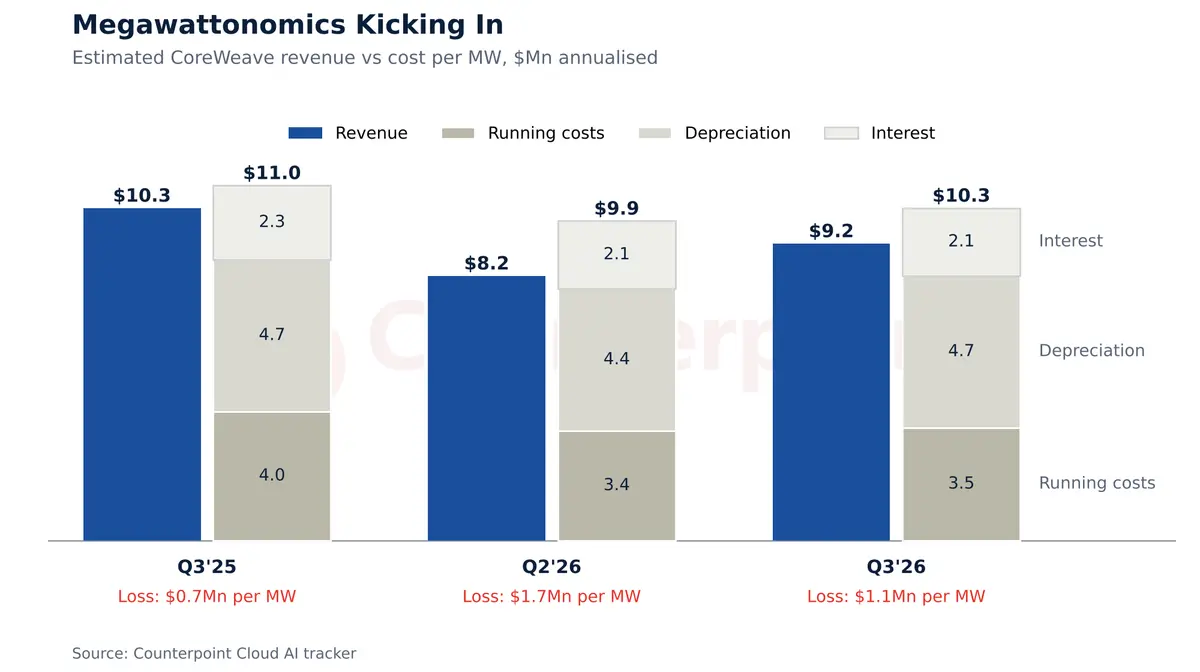
Growing capex shows CoreWeave is serious about the AI race. But revenue and cost per megawatt are the key indicators. The metrics we track are average active power, and revenue and costs per MW in each quarter, annualised.
All about Megawattonomics
-
CoreWeave is earning $9Mn/MW a year on average, up sequentially as capacity switched on in June started billing. But it is still down from a year ago.
-
Running costs are only about $3.5Mn/MW, so the cash margin is healthy at 62%. The operating business works.
-
However, depreciation and interest add about $6.8Mn/MW, which keeps the business below breakeven.
-
We estimate breakeven is roughly $10Mn/MW. CoreWeave is about $1Mn short, and the gap is closing.
-
For context, recent short-term deals priced at about $40Mn/MW. If CoreWeave can command that at scale, it will push well above breakeven.
-
Further, a MW of the latest Blackwell or Rubin earns more than a MW of Hopper, but it also costs more to build. The mix is improving revenue per MW. Scaling the infrastructure with new compute is what is driving build-out costs up.
“Think of it like a hotel. Adding rooms matters less than what each room earns compared with what it costs to build and run.”
Contracted Power & Customers = Healthy Backlog
New customer wins
-
Enterprise: CoreWeave is seeing the customer mix improve with more enterprises. New additions include Canva, Wayve, Substack, Serve Robotics, Parallel Web Systems.
-
AI labs and AI natives: Bigger deals with existing customers continue: OpenAI, Perplexity, Jane Street, Cohere, Hippocratic AI, Chan Zuckerberg Initiative.
-
Public sector: Leidos for defence and intelligence work, and a managed AI cloud for DARPA biology research.
-
More than half of CoreWeave's new customers this year came from outside AI and tech. That spreads the risk beyond a handful of AI labs.
Revenue backlog: $132.5bn
-
Backlog is revenue from contracts already signed, to be earned over coming years. Now it's up to CoreWeave to deliver the capacity to capture the opportunity in front of it.
-
It grew 138% year on year and $28bn in one quarter. About $34bn of it is expected in the next 24 months. The rest is a longer-term opportunity.
Contracted vs active power
-
Contracted power is capacity CoreWeave has secured for the future. Active power is what is switched on driving revenues today.
-
Contracted power is above 4.6 GW, up 900 MW in the quarter. More than 1.3 GW of that is outside the US, including India, Indonesia and Spain.
-
Active power is above 1.7 GW, up just over 200 MW and double where it started the year. Year-end target is above 1.85 GW.
-
The gap between the two, nearly 3 GW, is both the growth story and the risk. CoreWeave pays interest on equipment and sites that aren't earning yet.
“Contracted power is the leading indicator of CoreWeave's business. Active power is the rear-view mirror: it shows what is already earning. Contracted power is the road ahead: it shows how big the business can get.”
Moving up the stack with Forge

-
Forge is CoreWeave's new platform for building and improving AI models and agents: run them, watch how they behave, fix what fails, fine-tune and test new versions, all in one place.
-
It builds on the Weights & Biases tools CoreWeave bought, so it starts with an existing developer base.
-
CoreWeave has to diversify beyond just renting GPU hours, which is price-driven. Developer tools can bring both monetization and platform stickiness, if they add enough value on top of existing stacks to optimize, monitor and drive efficiencies.
-
A good start. It will be worth watching how CoreWeave drives monetization as it moves up the stack into hyperscalers' territory.
“CoreWeave needs to move up the stack to lock in its growing customer base and earn more from each customer. Forge is how it plans to do that.”
What we are watching
-
Revenue per MW. Does it keep climbing toward $10Mn and beyond as new sites turn on?
-
Contracted vs active power. Nearly 3 GW still has to be switched on. Delays need to be kept to a minimum, and innovations from partners such as NVIDIA's DSX POD are critical for time to market.
-
Cost of money. Q4 interest of about $1.1bn, bond yields that have topped 16%, and a new share sale programme. The cost of new debt will be critical going forward.
-
Older chip pricing. Hopper prices rising is the good surprise this quarter. If it holds through renewals, the older fleet pays back more than expected.
-
Forge ahead. We will watch how CoreWeave builds out the developer story and forges ahead.
-
Supply Chain Partnerships:
-
Entered into a multi-year agreement with Solidigm securing priority access to enterprise SSD capacity. These are solid indicators and we will see across supply chain.
-
Wrapping up
-
Demand is real and customers are paying more, not less.
-
The next 12–18 months will show whether the industry can keep raising money at a reasonable cost and scale into more profitable compute-as-a-service.
-
We estimate that if revenue per MW reaches about $12Mn with costs unchanged, margins after interest could climb to about 18%.
-
Nebius and many other neoclouds are running on a similar template, albeit at a smaller size and with a different balance sheet. For example, Nebius's Q2 revenue was $582Mn against CoreWeave's $2.6bn. But it carries far less debt, and it held about $8bn of cash. It is also earlier in the cycle: it plans $20–25bn of capex this year on a much smaller revenue base. All eyes are on its Q3 results on November 12.
-
CoreWeave has more scale and a longer track record. Nebius has more room on its balance sheet. However, the entire game comes down to Megawattonomics.
“The AI build-out race is entering a phase where the winners are those who capture the most demand at the right price and cost.”

