- Global consumer wearables revenue is expected to grow at 12% CAGR between 2026 and 2032.
- Smart eyewear is projected to account for nearly one-fifth of total consumer wearables revenue by 2032.
- Smart pendants, smart rings and smart eyewear will be the fastest-growing categories, although pendants will expand from a small base.
- Smartwatches and TWS (True Wireless Stereo) will remain the largest wearable categories, generating more than half a trillion dollars in combined revenue between 2026 and 2032.
Beijing, Berlin, Buenos Aires, Fort Collins, Hong Kong, London, New Delhi, Seoul, Taipei, Tokyo – August 19, 2026
The global consumer wearables market is forecast to generate more than $1 trillion in revenues cumulatively between 2026 and 2032 as consumers shift towards more capable, higher-priced devices, according to Counterpoint Research’s Global Consumer IoT Wearables Tracker 2024–2032F. Smart hearables and smartwatches will remain market leaders, backed by large user bases, emerging health tracking features and AI-driven use cases. AI is also driving growth in smart eyewear, smart rings and AI pendant categories by delivering an hands-free experience and continuous health monitoring.
Consumer Wearables $1 Trillion opportunity, 2026-2032
Estimated Cumulative Market Value From 2026-2032 in Bn USD
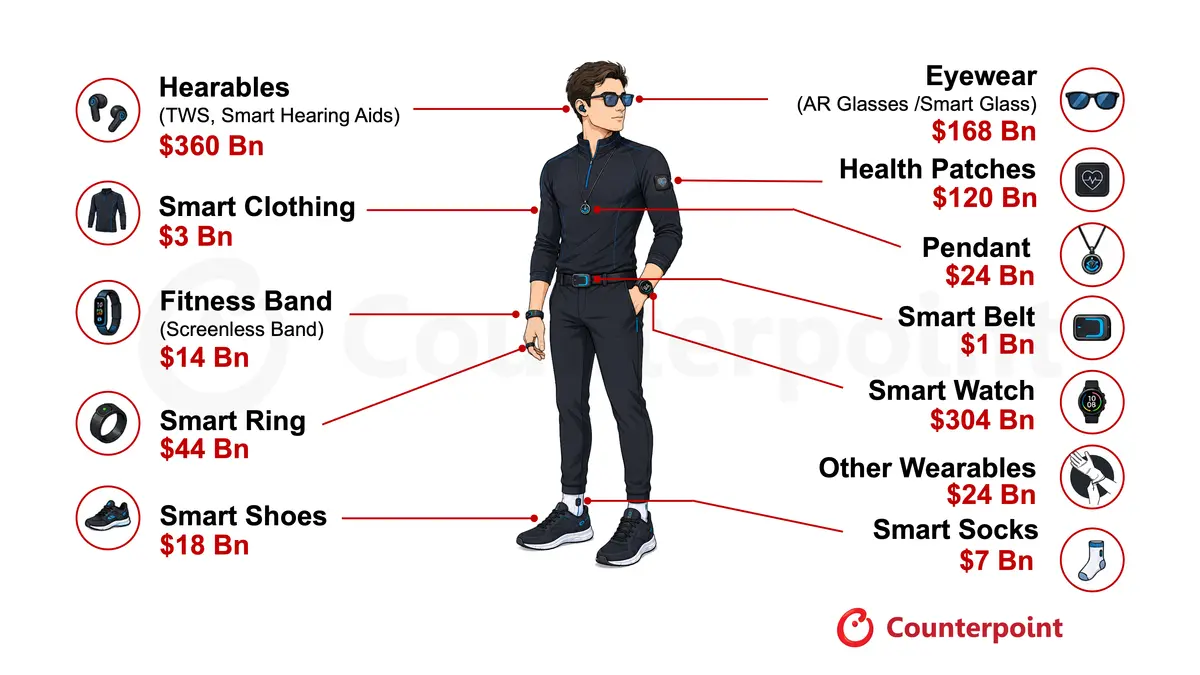
Commenting on the market dynamics, Principal Analyst Anshika Jain said, “The wearables market is entering a value-driven phase, where the revenue is growing at 12% compared to 6% for the unit shipments as buyers trade up to devices that enable continuous health monitoring. Use cases are moving beyond fitness towards preventive healthcare, where the device flags a problem before the user notices. That shift is what turns a wearable from an accessory into something people replace regularly, and it is why the category is a $1 trillion opportunity until 2032.”
Smart eyewear (AR Glasses/Smart Glasses) revenue is forecast to reach $44 billion by 2032, accounting for one-fifth of wearables revenue. Cameras, microphones, speakers and displays will enable communication, translation, navigation and real-time assistance without requiring users to frequently access their smartphone. Display-less AI glasses will drive volume through familiar designs, lower prices and camera-and-audio led use cases, while AR display glasses capture higher value through digital overlays for productivity, navigation, training and entertainment. Together, they will broaden adoption and lift the category’s revenue potential. After smart eyewear, AI pendants and smart rings will be the fastest-growing categories supplementing the overall wearables ecosystem, driven by their discreet form-factor, always-on assistance, and accurate sensing capabilities.
Smartwatches and TWS will remain the largest wearable categories, together generating an estimated cumulative revenue of $558 billion between 2026 and 2032. Their scale is supported by large installed bases, replacement demand, everyday use across health, communication and entertainment, and close integration with smartphone ecosystems. Premium hardware, cellular connectivity, advanced health sensors and on-device AI will support rising smartwatch ASPs and expand the category into a preventive-health and personal-computing platform, while TWS value growth remains constrained by feature standardization and price competition.
Commenting on the silicon opportunity, Research Director Mohit Agrawal said, “In wearables, on-device AI is a thermal and battery problem before it is a software problem. The device sits against skin, senses continuously, and still has to last the day. That constraint, not raw compute, is what will separate the chipmakers over the next few years.”
Overall, the competitive advantage will shift from individual device specifications to ecosystem control. Along with hardware, OEMs that can focus on interoperable software, trusted data governance, developer ecosystems and industry partnerships will build longer customer relationships and recurring value.
In this report, “consumer wearables” refers to the broader category of connected, sensor-enabled electronic devices designed to be worn on the body, not specifically to artificial intelligence (AI)-powered products.
About Counterpoint Research
Counterpoint Research is a global market research firm specializing in products across the technology ecosystem. We advise a diverse range of clients – from smartphone OEMs to chipmakers and channel players to Big Tech – through our offices located in the world's major innovation hubs, manufacturing clusters and commercial centers. Our analyst team, led by seasoned experts, engages with stakeholders across the enterprise – from the C-suite to professionals in strategy, analyst relations (AR), market intelligence (MI), business intelligence (BI), product and marketing – to deliver services spanning market data, industry thought leadership and consulting. Our core areas of coverage include AI, Automotive, Consumer Electronics, Displays, eSIM, IoT, Location Platforms, Macroeconomics, Manufacturing, Networks and Infrastructure, Semiconductors, Smartphones and Wearables. Visit our Insights page to explore our publicly available market data, insights and thought leadership, and to understand our focus, meet our analysts and start a conversation.


