China Smartphone Market Saw Sharper Contraction After 618
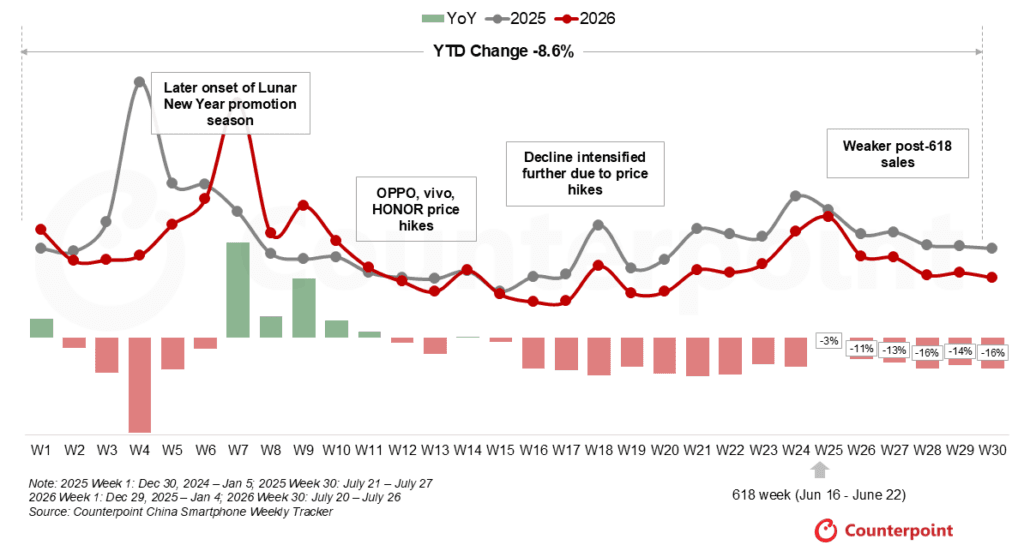
- China’s smartphone sales declined 8.6% YoY in the first 30 weeks of 2026, with the decline returning to double digits after the 618 shopping festival amid seasonal weakness and continued memory cost inflation.
- Huawei retained its top position with its weekly sales share holding above 20% since Q2, fueled by robust demand for the Enjoy 90 Pro Max and a stable pricing strategy across its portfolio.
- Apple’s demand softened significantly after 618 as it entered a seasonal slowdown ahead of the new iPhone lineup.
- Cost pressures are expected to intensify in H2 2026, with rising memory and SoC costs forcing OEMs to raise prices further.
Beijing, Berlin, Buenos Aires, Fort Collins, Hong Kong, London, New Delhi, Seoul, Taipei, Tokyo – August 13, 2026
China’s smartphone sales declined 8.6% YoY in the first 30 weeks of 2026 amid persistently weak demand, according to Counterpoint Research’s China Weekly Smartphone Sell-Out Tracker. Sales saw a sharper contraction after the 618 shopping festival, with the YoY decline returning to double digits as the market entered its seasonal slowdown amid continued memory cost inflation.
China Smartphone Weekly Sales, Week 1 – Week 30

Huawei continued to lead China’s smartphone market during the period, with its weekly sales share remaining above 20% since Q2. Its strong performance was driven by robust demand for the Enjoy 90 Pro Max and stable pricing across its portfolio. Huawei recently highlighted that smartphone prices may need to rise to offset higher costs. This indicates that the brand is likely to raise prices in the second half of the year.
Since July, Apple has entered its seasonal slowdown. With regular pricing restored across channels and a meaningful portion of demand already pulled forward around the 618 shopping festival, Apple appears to have entered a quieter organic demand phase, which is likely to persist until the new iPhone lineup approaches.
Xiaomi’s sales share rose to second place in week 30, driven by the July 14 launch of the REDMI Note 17 series. The REDMI Note 17 Pro remained the volume driver, but specification downgrades and a price increase versus its predecessor resulted in weaker sales than the previous generation. In August, Xiaomi initiated a second round of price hikes, with broader coverage across the Xiaomi 17 series, REDMI K90 series and Turbo 5 series, ranging from CNY 300 to CNY 500 depending on the model. This is expected to put further pressure on sales in the second half.
As for other brands, OPPO and vivo typically benefit from strong summer demand among younger consumers and students, but weaker promotions amid rising costs have weighed on their performance this year. In addition, OPPO’s three brands are undergoing consolidation across regions, product positioning, after-sales services and software systems, with short-term challenges expected during the transition. HONOR saw a recovery following the launch of the HONOR X80 Pro Max in late June. Meanwhile, its Robot Phone, which features a gimbal-mounted camera, is set to hit the market soon. The model will serve as a technology flagship aimed at strengthening HONOR’s brand equity.
Looking ahead, pressure is set to intensify as rising memory and SoC costs push OEMs toward further price hikes. Meanwhile, increasing investment in agentic AI is becoming a competitive necessity rather than a differentiator. The market is likely to become even more challenging, with laggards at risk of falling further behind.
About Counterpoint Research
Counterpoint Research is a global market research firm specializing in products across the technology ecosystem. We advise a diverse range of clients – from smartphone OEMs to chipmakers and channel players to Big Tech – through our offices located in the world's major innovation hubs, manufacturing clusters and commercial centers. Our analyst team, led by seasoned experts, engages with stakeholders across the enterprise – from the C-suite to professionals in strategy, analyst relations (AR), market intelligence (MI), business intelligence (BI), product and marketing – to deliver services spanning market data, industry thought leadership and consulting. Our core areas of coverage include AI, Automotive, Consumer Electronics, Displays, eSIM, IoT, Location Platforms, Macroeconomics, Manufacturing, Networks and Infrastructure, Semiconductors, Smartphones and Wearables. Visit our Insights page to explore our publicly available market data, insights and thought leadership, and to understand our focus, meet our analysts and start a conversation.
Follow Counterpoint Research
Receive our insightful weekly newsletter and stay ahead of the competition.
Author
Ivan Lam
Ivan is a Senior Research Analyst at Counterpoint Research, based in Hong Kong. He has more than 15 years of experience, with a major focus on mobile and network devices. He has spent years in Southeast Asia markets working in business development, brand management, and channel management. In addition to his expertise in Southeast Asia, he is also well connected with the ODM and OEM sectors. Prior to joining Counterpoint Research, Ivan served at TCL Communication, KaiOS Technologies Inc., and Wiko Mobile, mainly leading business development, go-to-market strategy, and strategic planning. Ivan holds a Master's degree in Business Administration from the Hong Kong University of Science and Technology.