

In a joint statement from Google and Apple, it is now official that Apple will integrate Google’s Gemini models into its next generation of foundation models. These models will further power Apple Intelligence, including the much-debated major overhaul of Siri starting in 2026. The deal looks more like a licensing agreement where Google will provide an updated, custom version of Gemini developed specifically for Apple. This version is likely to be tuned, ensuring it is efficient at handling inquiries and reasoning without activating the entire model—which would be incredibly expensive to run.
Apple has notably lagged in the AI race, particularly with Siri, which has faced consistent development delays. Users have been waiting for the contextually aware Siri, which was showcased at WWDC 2024. The future of AI is also shifting toward agentic AI where voice might become the dominant way of interacting with smart devices. In this context, a sophisticated Siri is no longer just a luxury—it is a foundational requirement, and Apple can’t leave it too late. Moreover, considering Apple is looking to expand its smart home category, Siri will play an important role in interacting with the ecosystem. Apple can no longer afford to delay these features and has decided that partnership is the right way to go forward.
While there are limited details on the partnership as of now, the fine print highlights that it is a win-win for both companies.
A Step Forward for Apple Intelligence
Apple’s struggle to develop a competitive language model has been widely discussed over the last two years since WWDC 2024. This challenge is likely a technical byproduct of the company's strict privacy foundations—the very thing that differentiates the iPhone. However, maintaining such high privacy standards limits the data access required to build a frontier LLM on par with Google, whose business model is built on vast, diverse data collection.
Despite a perceived lag in AI, Apple has remained resilient, even securing the top spot in global smartphone shipments in CY 2025. However, 2026 marks a turning point as Google gains significant 'mind share' through its advanced Gemini models and a growing list of AI-driven use cases. This partnership further strengthens Gemini’s positioning in the GenAI space.
For Apple, it will help it divert the uncomfortable questions from investors around not taking concrete steps in the AI space. Additionally, this might find Apple attracting back talent in the same space.
AI Feature Rollout Timeline by Key Smartphone OEMs
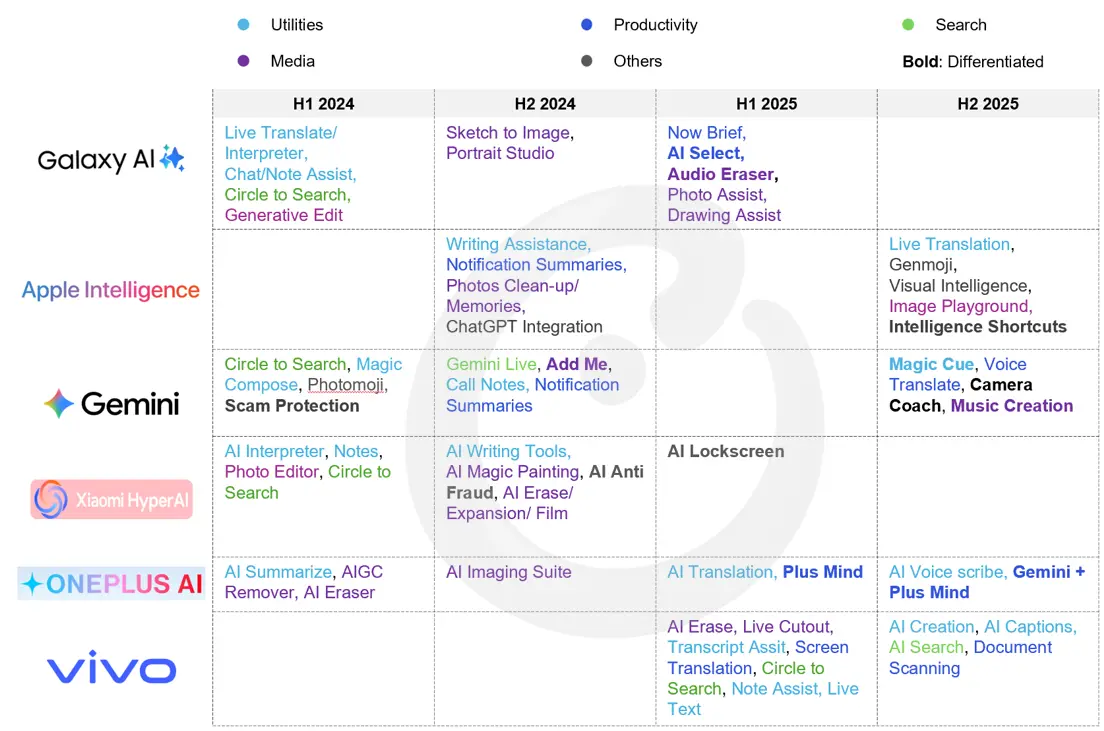
Apple will still have time to work on its own model, but catching up on some of the existing models will take time and talent. Something Apple needs to look into. We have already seen Apple taking a cooperative approach rather than a competitive approach and then slowly finding its way to an in-house model strategy
A Validation for Gemini:
With the partnership, Google just got a validation from the largest consumer-facing company in the world and a stamp of approval on its Gemini models. It also means Gemini running on millions of devices, providing immediate scale. This will further give Google more negotiation powers when it comes to the deployment of Gemini on Android and building use cases.
Gemini is likely to take over Siri’s prompts when it comes to reasoning, planning, or even summarizing while working in the background, and the consumer-facing experience will still be marketed by Apple intelligence. While we will get clearer details during WWDC 2026. It’s unlikely Google will get any branding in this space, and Google might be just happy with it.
Privacy to be Key
In the joint statement from Google and Apple about the partnership, the companies also address the privacy bit, stating that “Apple Intelligence will continue to run on Apple devices and Private Cloud Compute, while maintaining Apple's industry-leading privacy standards.” Which might mean that Google will not have access to users’ personal data. This is important because privacy has been one of the strong promises of the Apple ecosystem. In our Apple iPhone Consumer Survey Report published in early 2025, more than half of iPhone users admitted that data safety and privacy are most important to them. 4 out of 5 also admitted that Apple is relatively safe (or safest) at data safety and privacy. Hence, Apple will have to assure its users about the data privacy angle in more detail in WWDC 2026.
The Google Apple deal is also a concentration of power in AI, with Google becoming the dominant choice of model in smartphone AI across both major mobile platforms. This might bring more scrutiny to the Apple-Google relationship.

