

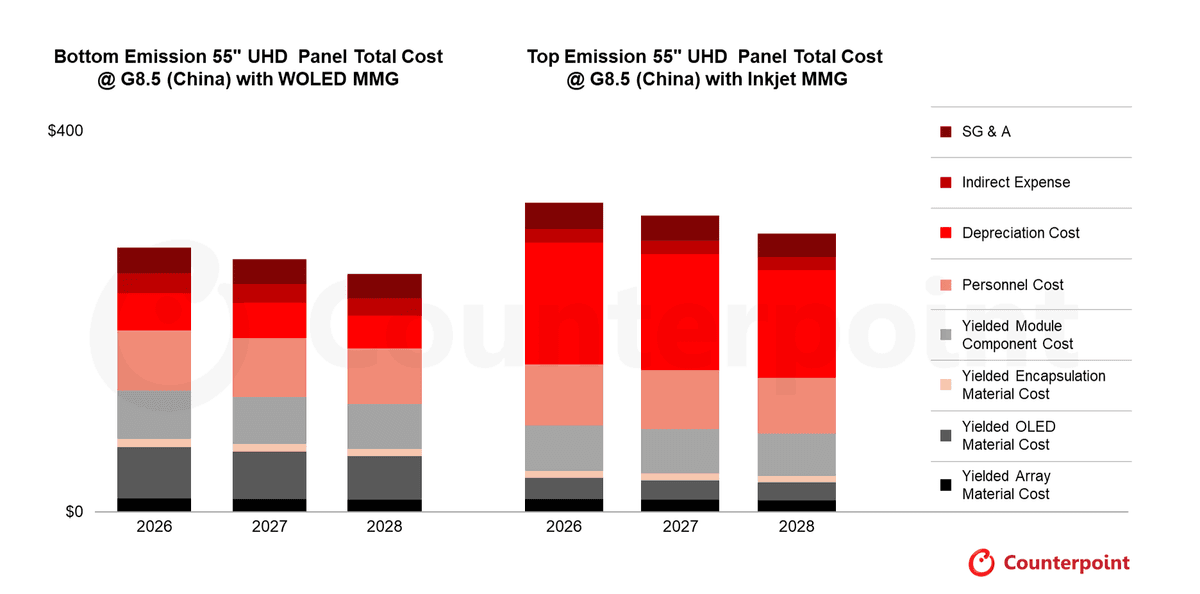
- IJP should result in a reduction in material costs through better utilization and less waste. But depreciation costs for a new IJP line are substantially higher than for a fully depreciated WOLED line.
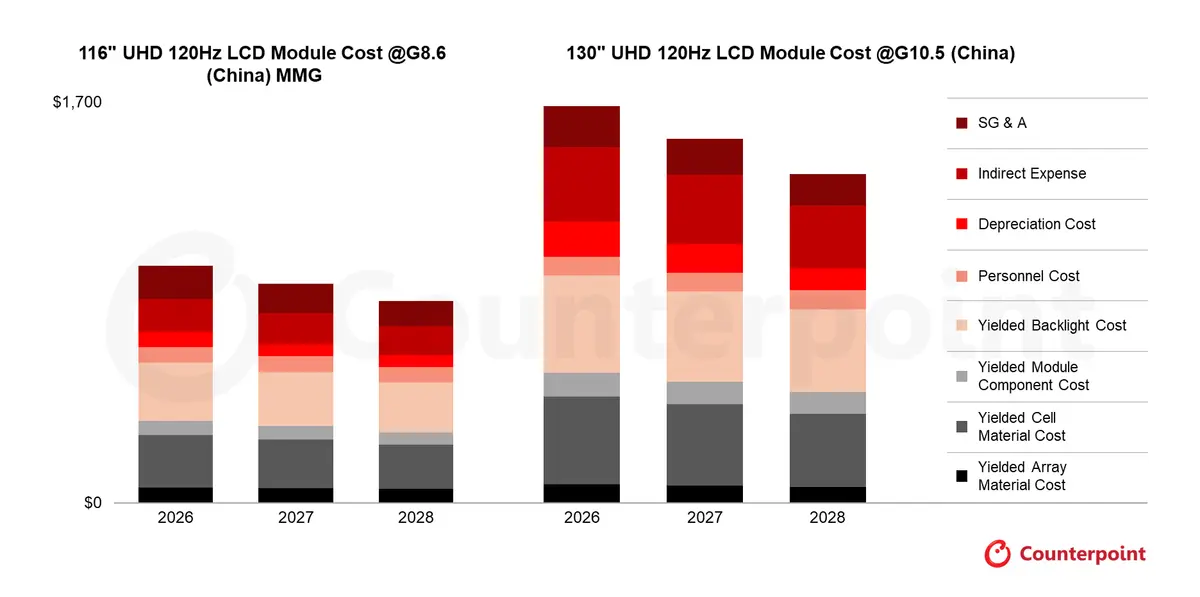
- In 2026, a 130” UHD LCD module would cost nearly 1.5x the cost of a 116” UHD LCD module.
- Higher depreciation cost and SG&A make the QD-OLED panel cost 60%-65% higher compared to a WOLED of the same size.
Counterpoint Research has released its latest Advanced TV Display Cost Report, with updates to OLED and LCD cost profiles. The H2 2025 edition includes updates to all sizes of WOLED panels and 55” to 130” LCD modules, including LCD with MiniLED backlights, and cost profiles for 34” and 49” new gaming monitors and 55”, 65” and 77” legacy QD-OLED panels from SDC. In addition to the 98”, 100”, 115” and 116” UHD-LCD panels that were added in H1 2025, now we have also added new cost profiles of 43” FHD and 130” UHD LCD panels, manufactured on Gen 8.5, Gen 8.6, and Gen 10.5 substrates in China.
The chart below, by Research Director Bob O’Brien, shows a comparison of the costs for WOLED and IJP OLED for 55” UHD panels from 2026 through 2028, with breakdown by cost components and the corresponding estimates of yield. It demonstrates that IJP should result in a reduction in material costs through better utilization and less waste. But depreciation costs for a new IJP line are substantially higher than for a fully depreciated WOLED line.
Panel Cost for 55” UHD WOLED and IJP on Gen 8.5 in China
Source: Counterpoint’s Advanced TV Display Cost Report
The chart below, by Research Vice President Yoshio Tamura, shows the cost profiles for 116” vs 130” LCD panels from 2026 through 2028, with breakdown by cost components and the corresponding estimates of yield. The 116” LCD panel combines MMG on Gen 8.6 lines to improve the efficiency. These sizes are used for flagship models with new technology such as RGB MiniLED. In 2026, a 130” UHD LCD module would cost nearly 1.5x the cost of a 116” UHD LCD module.
116”/130” UHD 120Hz LCD Module Cost in China
Source: Counterpoint’s Advanced TV Display Cost Report
Senior Analyst Nikhil Kishor states that the QD-OLED panel cost is dramatically higher than any other flat panel of the same screen size due to lower yield and higher depreciation cost. In the last few years, yields for QD-OLED panels have improved faster than expected and currently, the yield estimates for 2025 are under 85% for 55” and 65” TV panels. He estimates that QD-OLED panel yields are close to WOLED, but higher depreciation cost and SG&A make the QD-OLED panel cost 60%-65% higher compared to a WOLED of the same size.
