- A fresh round of battle has started for DLSR-like imaging performance in smartphones, with more newly launched premium flagship models sporting Sony’s IMX989 in their main cameras.
- The implementation of true 1-inch capability further narrows the gap between mobile photography and professional photography.
- The 1-inch optical format is a key milestone in smartphone sensor development.
Smartphone OEMs’ quest to bring professional photography experiences to their consumers has led the flagship models to increasingly adopt the 1-inch large-area image sensor. The newly launched Xiaomi 13 Pro and vivo X90 Pro/Pro+ flagship models are equipped with Sony’s IMX989 sensor, whose size has reached a level equal to that of a digital camera sensor, a key milestone in the development of mobile photography sensors.
History of 1-inch CIS in smartphones
OEMs have been trying to equip smartphones with large-size CMOS image sensors for many years. As early as Q4 of 2014, the Panasonic Lumix DMC-CM1 carried a 20MP 1-inch image sensor. This model also used some professional camera function settings and solutions, together with Leica lenses. Compared with other smartphones of the same era, this model was thicker and heavier. It seems Panasonic was trying to leverage its ability to produce compact digital cameras and combine it with the then fast-developing Android smartphone design. The model was only sold in Japan. Though it was innovative, it failed to become a success. In Q2 2021, Sharp’s Aquos R6 was launched with Sony’s Exmor RS 1-inch image sensor in its main camera. Further, in Q4 2021, Sony’s Xperia PRO-I also came equipped with the same sensor. Both models were leveraging the image sensor primarily designed for digital camera applications. As of Q4 2022, the sales volume of these two models was around 130,000 units.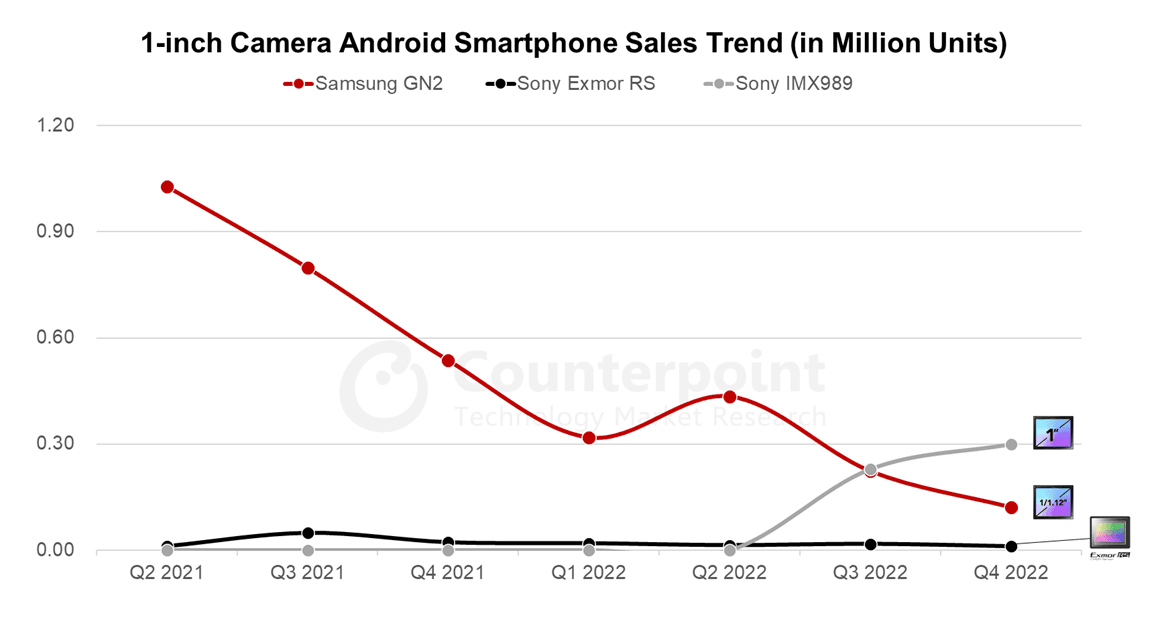
Source: Counterpoint Smartphone Model Level Shipments Tracker
In the pre-1-inch era, the largest image sensor in terms of mobile photography was Samsung’s GN2 with a sensor size of 1/1.2" and 50MP resolution. Xiaomi’s Mi 11 Ultra/Pro and Honor’s Magic 4 Ultimate used it as the main camera image sensor. According to Counterpoint Research’s Market Pulse Service, the models equipped with the GN2 reached a combined sales volume of 3.46 million by Q4 2022. The IMX989 released by Sony in Q2 2022 officially brought mobile image sensors into the 1-inch era. As of now, the models equipped with this 1-inch CIS as the main camera include the Sharp Aquos R7, Xiaomi 12s Ultra, vivo X90 Pro, vivo X90 Pro+ and Xiaomi 13 Pro. The total shipments of models equipped with the IMX989 reached around 530,000 units by Q4 2022.
Performance improvement
A large-area image sensor can bring better background blur effects to photographs. It is worth mentioning that unlike the blur effect simulated by computing photography, the depth of field brought by a large-area sensor is much more natural. In a dark or complex environment, a large-area image sensor has better imaging effects and a shorter waiting time for taking photographs. What is more, photographs taken with a large-sensor camera have more detailed information. The gap between smartphone photographs and digital photographs is getting narrower and narrower. The 1-inch optical format smartphone image sensor has been a milestone in mobile photography development.
Outlook

Large image sensors will undoubtedly increase the cost of smartphones and bring more challenges to their internal design. But for OEMs that want to further improve their photographic performance and differentiate their portfolio, a larger image sensor would be a good solution. We will see more flagship products with 1-inch image sensors in 2023.
Background
Counterpoint Technology Market Research is a global research firm specializing in products in the technology, media and telecom (TMT) industry. It services major technology and financial firms with a mix of monthly reports, customized projects and detailed analyses of the mobile and technology markets. Its key analysts are seasoned experts in the high-tech industry.