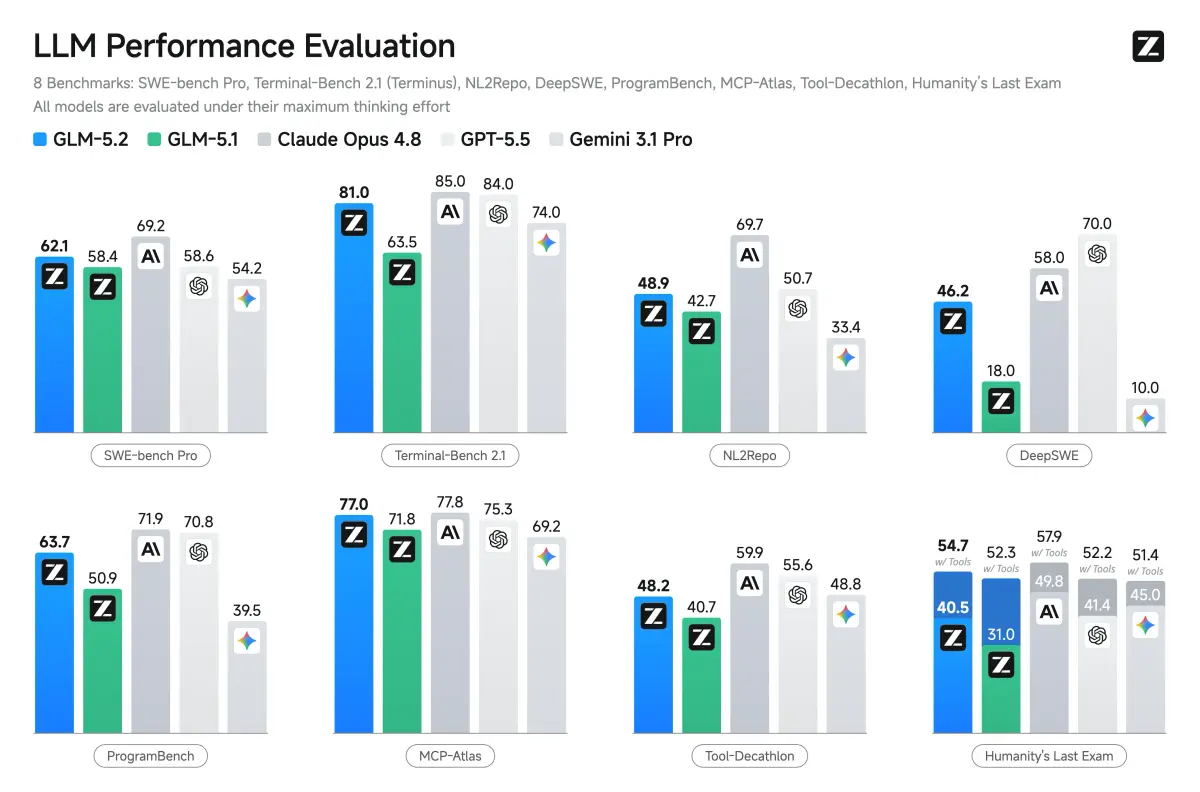
- China’s Z.ai released a new open-source AI model, GLM-5.2, that nears the gap between US frontier models.
- The overall performance and cost makes GLM-5.2 highly efficient and attractive for enterprise solutions, though enterprise adoption can be complicated.
- China is unlikely to restrict access as GLM-5.2 gives China a competitive advantage in the global AI race.
Chinese open-source AI models have been in the chase with US frontier models at the performance level for quite some time, and their cost efficiency is really winning the hearts of those who consume large volumes of tokens. Currently, Z.ai charges around $3 per million output tokens while Anthropic’s Fable 5 charged $50 at the same output.
Enterprise AI adoption is possible, but will take time.
Independent developers outside of China have been testing GLM-5.2 and responding very positively to the overall package, especially the combination of performance and cost. We’ve also seen discussion among European companies about whether it could be used in enterprise settings.
However, enterprise adoption is a much more complicated subject. Choosing a model for production use takes time and involves many layers of evaluation, particularly around compliance, security, privacy, data governance and customer acceptance. Legislation can also directly or indirectly limit the use of Chinese AI models. In the EU and U.S., some clients, partners and regulated industries may simply be unwilling to accept Chinese models in their AI stack, regardless of technical performance or price.
US-closed frontier labs should view GLM-5.2 as a real threat operating at two levels.
The first is performance. GLM-5.2 appears to be approaching the level of leading frontier systems in some important benchmarks — for example, coming close to Anthropic’s Opus on FrontierSWE, and reportedly outperforming OpenAI’s GPT-5.5 on GDPval-AA. That matters because the gap is no longer only theoretical; it is becoming visible in task-level evaluations.
The second level is openness. GLM-5.2 is released under an MIT license, which makes it far more accessible to developers, startups and enterprises than closed U.S. frontier models. At the moment, the US does not have a comparably competitive open model that can clearly replace it.
Contrary to the US government’s approach, China is unlikely to restrict access.
China’s AI strategy has increasingly leaned toward open source as a way to compete in the global AI race. The DeepSeek-R1 was a clear example. And this can help pave the way to become a central part of the global developer ecosystem by making capable, low-cost and accessible models widely available.
Restricting access would work against that strategy. The value of models like GLM-5.2 is, also, not only their technical performance, but their ability to attract developers, startups, enterprises and researchers into a China-linked AI ecosystem. The more widely these models are adopted, fine-tuned and integrated, the stronger China’s position becomes in the broader AI stack.
That said, there could still be selective controls around sensitive use cases, national security concerns, or overseas deployment in politically sensitive markets. But a broad restriction on access would be counterproductive to China’s current open-source advantage. In my opinion, China is more likely to use open-source AI as leverage than to lock it down in the same way the U.S. government may approach frontier closed models.
For more analysis on AI, view AI 360 Pulse - Industry Trends, Intelligence and Impact, May 2026
A curated monthly AI newsletter that distills the most important developments in AI, analyzing their impact across key ecosystem players: semiconductors, big tech, cloud players, AI models, regulators, and users. Designed to cut through the noise, it connects the dots to help you see where the industry is heading and why it matters.
