

- L6+L10 shipments account for more than 90% of NVIDIA AI GPUs in 2024, but more than 70% of NVIDIA AI servers are shipped as L11 racks in 2026.
- The minimum computing unit has turned into a rack-scale system, as the weights of giant models exceed the memory of a single chip (only 288GB on a B300 GPU), and as token usage surges (Google processed 3.2 quadrillion tokens per month, which is 330x the 2024 level).
- While Tier-2 ODMs have been building L10/L11 capabilities since 2023, whole-rack shipment is still dominated by Tier-1 ODMs in 2026, as they have further scaled up their integration capabilities to the rack-scale computing unit.
Server shipment norms are changing, from “boards plugged into servers” in 2024, to “whole rack” in 2026. In 2024, more than 90% of the NVIDIA AI GPUs were assembled on the HGX board (motherboard, L6) and then built into servers (L10) before shipping. However, in 2026, more than 70% of the NVIDIA AI servers are shipped in racks (L11). The power that drives the same company to adopt different server deliverables lies in token consumption of super AI models.
Scale-up AI servers are pushing ODMs from L6 boards to L11 integration
As shipping units move from L6 to L11, both the manufacturing threshold and the value-add increase. L6, L10, and L11 are the terms ODMs usually use to measure their deliverables, as shown in the image below. L6 refers to board level assembly. L10 takes a step further to combine all software and hardware in a tray, including CPU, GPU/ASICs, memory, and power, etc. L11 expands into whole rack assembly, including switch, cabling, cooling, and even power distribution integration. The point is, from L6 to L11, not only does the number of components increase, but integration capability also becomes paramount in order to offer the clients a solution with coordinated sub-systems.
ODMs Manufacturing Level
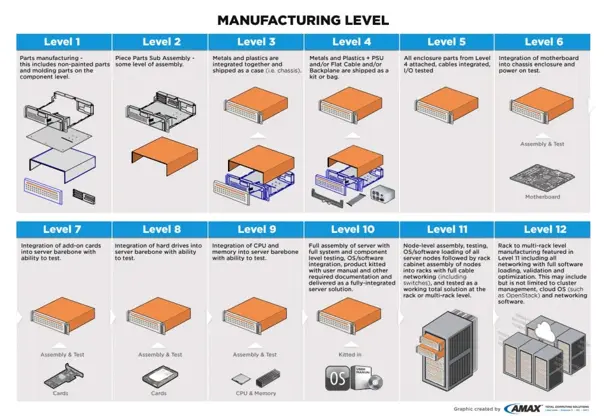
Source: AMAX