- Tesla’s deliveries and revenue showed significant growth in Q2 after a decline in Q1.
- The announcement of the Tesla Cybercab has been postponed to October.
- Tesla aims to diversify its revenue streams by focusing on advanced autonomy and Optimus robots.
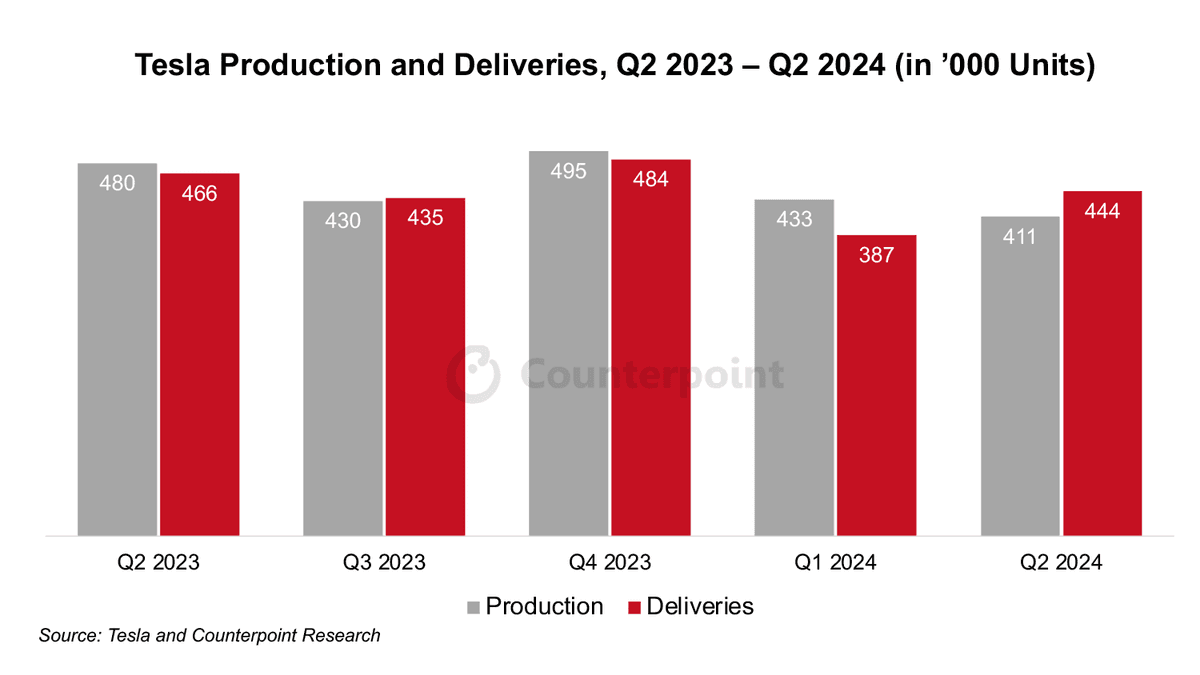
Tesla’s revenue increased by 20% YoY in Q2 2024 to reach $25 billion driven by a 15% YoY rise in deliveries. The company delivered 443,956 units during the quarter, marking a significant rebound from the previous quarter’s notable declines in both revenue and deliveries. The US continued to be Tesla’s largest market, followed by China and Europe. During the same period, BYD, one of Tesla’s biggest competitors, delivered 426,039 EVs, trailing Tesla by around 18,000 units and signaling that it is quickly narrowing the gap.
In the Q2 2024 earnings call, Tesla CEO Elon Musk and his team covered several important topics, especially the timeline for the Tesla Cybercab, developments related to Optimus robots, and the potential impacts of the upcoming US election on the Inflation Reduction Act (IRA) incentives.
Tesla Cybercab timeline
Tesla CEO: “Regarding full self-driving and Robotaxi, we have made a lot of progress with full self-driving in Q2. And with version 12.5 beginning rollout, we think customers will experience a step change improvement in how well supervised full self-driving works.”
Analyst take: The Robotaxi or Cybercab has always been part of Tesla’s long-term vision. Each update to its full self-driving (FSD) software, especially with breakthroughs like FSD V12, brings Tesla closer to this goal. The new Robotaxi will rely on FSD 12.5 or newer. Tesla has delayed the launch from August to October for some technical updates, but as data collection progresses, the company aims to introduce unsupervised machine learning, potentially rolling out the Robotaxi by next year.
Optimus robots
CEO: “And at that point, we’ll be providing Optimus robots to outside customers. That will be a production Version 2 of Optimus. For the energy business, this is growing faster than anything else. This is – we are really demand constrained rather than production constrained.”
Analyst take: As Tesla nears the limit in reducing manufacturing costs for its S3XY model line-up, the company is now focusing on diversifying its business model. One potential major development is the Optimus robot. Initially showcased in 2021 and used only in Tesla’s production facilities, the upgraded Optimus robot is expected to be launched in 2026. In the long term, this new product could potentially generate revenue equivalent to Tesla's automotive segment.
Effect of upcoming election on USA IRA tax credit
CFO: “And that is the way internally, also even when we're looking at battery costs, yes, IRA, there are manufacturing credits which we get, but we always drive ourselves to say, OK, what if there is no IRA benefit? And how do we operate in that kind of an environment?”
Analyst take: The increase in EV sales in the US can be largely attributed to the IRA. It has significantly helped in reducing BEV prices. If IRA benefits are reduced or curbed following the upcoming US elections, brands like Ford, GM, BMW, Hyundai, Rivian and Volkswagen may get more adversely affected compared to Tesla. Tesla has over 50% share of the US EV market. Its efficient production processes, in-house development of major components and robust supply chain management enable it to lower the average selling price (ASP) of its vehicles and offer them at more competitive prices, even lower than some ICE vehicles.
Financial highlights
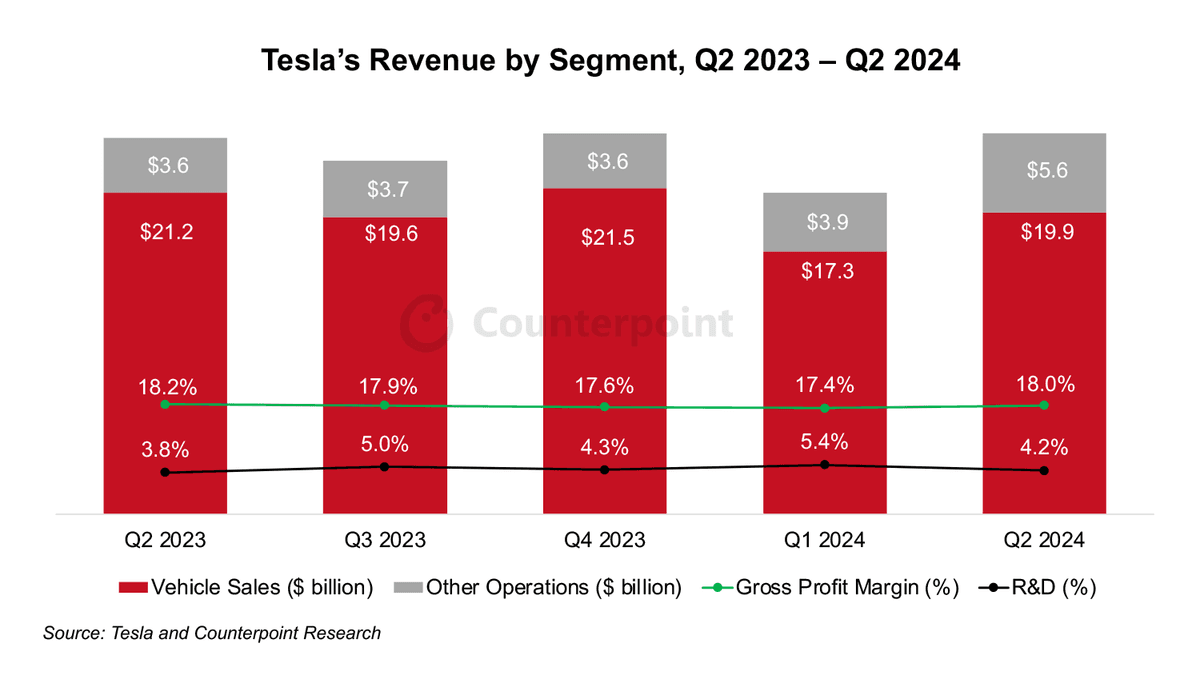
In Q2 2024, Tesla’s automotive sector revenue increased by over 14% YoY to reach $19.9 billion. Revenue from regulatory credits doubled from last year to nearly $1 billion, the highest level ever. The reduced ASP of Tesla models is one of the main reasons for the company’s less-than-expected revenue.
Income from other ventures such as energy storage deployment, charging networks, and additional services rose 54% YoY to reach $5.6 billion. Revenue generation from solar panels and energy storage reached over $3 billion, an 84% YoY increase.
During the quarter, Tesla’s gross profit amounted to $4.5 billion, marking a 24% YoY rise. This rise can be attributed to high energy storage deployments, increased Cybertruck deliveries, low vehicle and battery manufacturing costs and low raw material costs.
Outlook
Earlier this year, Tesla suggested that its annual growth would be modest due to constraints related to ASP reduction. Sales are expected to reach between 1.8 and 1.9 million units by the end of 2024. With the introduction of the Tesla Roadster and a new EV priced under $30,000, Tesla may see better sales growth than the current growth. Tesla also intends to diversify its revenue streams by advancing in autonomy and developing Optimus robots, as the automotive sales growth approaches a plateau.


