

- Robotaxis could create a $26 billion insurance market by 2035 as risk shifts from human drivers to autonomous technology, vehicles, and fleet operations.
- The insurance risk is moving from individual human drivers to autonomous systems, vehicles, and fleet operations.
- Vehicle telemetry, data from the autonomous driving system, and information from the sensors will become the new kind of driver history for insurers.
Seoul, Beijing, Buenos Aires, Hong Kong, London, New Delhi, San Diego, Taipei, Tokyo – Oct 12, 2026
The global robotaxi market is moving from pilot deployments toward commercial scale, creating a new and rapidly evolving insurance opportunity. Counterpoint Research estimates that the global robotaxi insurance market could reach $25.8 billion by 2035, driven by the expansion of autonomous fleets and the growing number of miles these vehicles are expected to travel.
From Driver Risk to Technology Risk
Automotive insurance has always been based on the human driver, relying on factors like driving behaviour, driving history, and claims records when evaluating the level of risk; robotaxis, on the other hand, operate on a different basis in which the performance of the technology and data from the vehicle become more important.
For insurance companies this might involve a change from asking “Who is driving?” to “How is the autonomous system performing?”
Market scales to $26B by 2035 while premium per mile falls ~30%
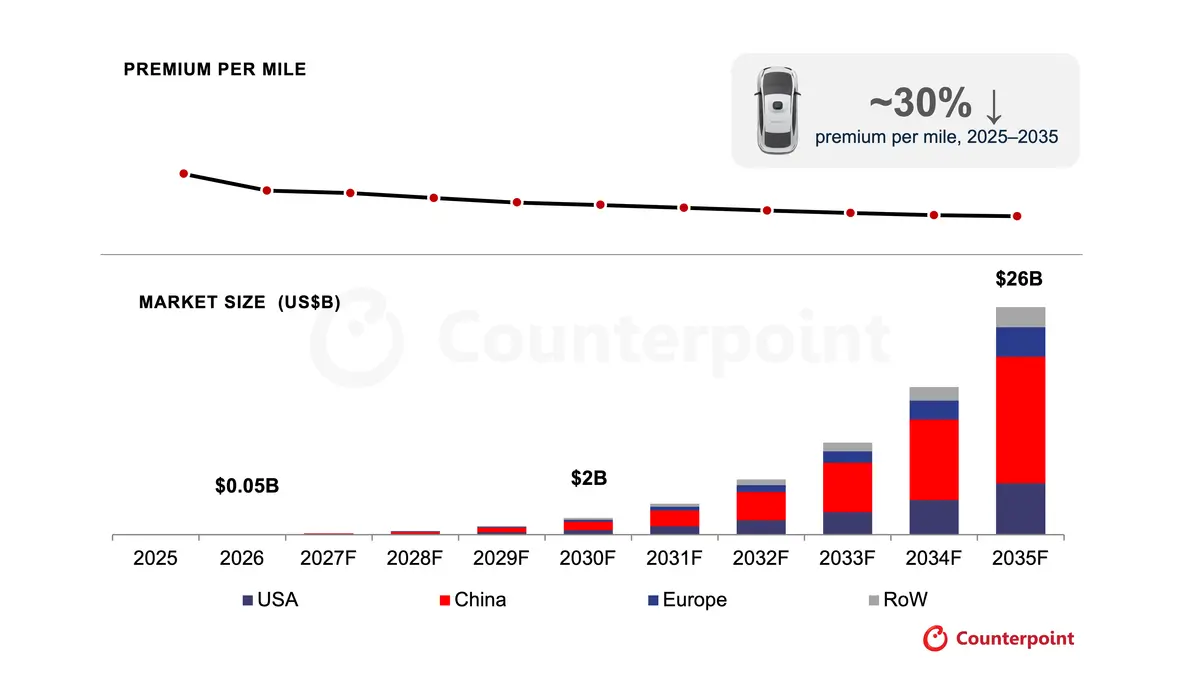
Source: Counterpoint Research
Counterpoint Research's analysis indicates that modelled premium per mile will likely fall with advances in autonomous technology, safety, and the growing prevalence of robotaxis on the roads around the world.
Research Director, Peter Richardson said, “The motor insurance market has refined its approach to managing risk over many decades. The emergence of robotaxis and, ultimately, Level 4 personal cars, flips the script. Liability and risk will no longer be with a human vehicle driver, but they will co-exist in environments where human-driven cars are present. Furthermore, robotaxis can be almost always operational, enabling them to accumulate impressive annual mileage but exposing them to greater risk of accidents - even if the fault lies outside the autonomous system. These dynamics require new ways of managing risk that pioneering insurance players are already working on as they eye a significant new business opportunity.”
Data Could Become the New Driver History
Robotaxis generate a continuous stream of data, from vehicle telemetry and autonomous driving logs to sensor health, safety events, OTA updates and maintenance records. This could give insurers new ways to underwrite risk and assess claims, moving insurance toward vehicle- and system-level assessments.
At the same time, liability becomes more diffused. An incident could involve the robotaxi operator, OEM, autonomous driving software provider or other technology partners, creating new approaches to risk allocation, insurance and reinsurance.
Safer Per Mile, Bigger Opportunity
The more robotaxis drive, the less risky each mile of driving will be, potentially reducing the price of insurance. Meanwhile, the overall insurance market will grow due to an increase in the number of robotaxis on the road.
The insurance industry is already starting to adapt to the rise of autonomous mobility. Apollo ibott is developing insurance solutions for autonomous vehicles and has worked with Uber on its AV insurance program, while Allianz is working with Waymo on insurance and safety for autonomous vehicles. INSHUR is also focusing on the growing needs of autonomous fleets, working with technology companies, fleet operators and mobility providers to develop tailored insurance solutions for self-driving vehicles. These early moves show how insurance is beginning to shift from assessing the driver to understanding the technology, vehicle and data behind each journey.
Counterpoint Research has profiled the companies and insurance structures emerging to meet this need, including insurers, reinsurers, brokers, InsurTechs, and the mobility companies themselves.
Forecast Methodology
Counterpoint Research's forecast uses a bottom-up model combining robotaxi fleet growth, vehicle miles travelled and modelled insurance cost per mile, incorporating regional assumptions around utilization, liability, physical damage, repair costs and autonomous safety improvements. The forecast covers the US, China, Europe and Rest of World through 2035.
The driver may disappear from the vehicle, but insurance risk does not. It is shifting across the vehicle, autonomous technology and wider mobility ecosystem, creating a fundamentally different insurance market.
The robotaxi insurance report ‘Shift to Driverless: The Evolution of Robotaxi Insurance’ is now available for purchase at report.counterpointresearch.com
Feel free to reach us at [email protected] for questions regarding our latest research and insights.
About Counterpoint Research
Counterpoint Research is a global market research firm specializing in products across the technology ecosystem. We advise a diverse range of clients – from smartphone OEMs to chipmakers and channel players to Big Tech – through our offices located in the world's major innovation hubs, manufacturing clusters and commercial centers. Our analyst team, led by seasoned experts, engages with stakeholders across the enterprise – from the C-suite to professionals in strategy, analyst relations (AR), market intelligence (MI), business intelligence (BI), product and marketing – to deliver services spanning market data, industry thought leadership and consulting. Our core areas of coverage include AI, Automotive, Consumer Electronics, Displays, eSIM, IoT, Location Platforms, Macroeconomics, Manufacturing, Networks and Infrastructure, Semiconductors, Smartphones and Wearables. Visit our Insights page to explore our publicly available market data, insights and thought leadership, and to understand our focus, meet our analysts and start a conversation.
Follow Counterpoint Research

