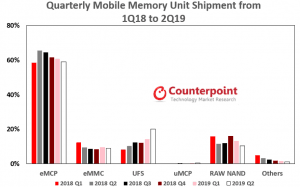
The share of eMCP in mobile memory unit shipments has declined for the fourth consecutive quarter in Q2 2019 to 58.9% from 65.4% in Q2 2018, according to the latest research from Counterpoint. On the other hand, shipments of UFS grew rapidly at a rate of 44.3% quarter-on-quarter (QoQ) in Q2 2019, as almost all Android smartphones, priced around US$400 use UFS memory units.
We expect the growth momentum in UFS shipments to continue in the coming quarters as it has a higher read/write speed and input/output operations per second (IOPS), especially for applications that have to handle a large amount of data such as video and images. We expect UFS' share in mobile memory unit shipments will increase to 35.5% in 2023 from 10.3% in 2018. The technology will be particularly dominant in the interface of high-end smartphones, especially due to the strong demand for 5G smartphones. Such a scenario is advantageous for WD (Western Digital) and TMC (Toshiba Memory Corporation) which have cutting-edge NAND flash technology but no DRAM production facility.
Exhibit 1: Quarterly Mobile Memory Unit Shipment, 1Q18 – 2Q19
Source: Counterpoint Research Sep 2019
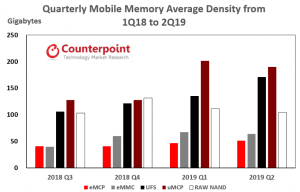
Since 2014, eMCP has become the mainstream of mobile phone memory interface. However, the shares of WD and TMC in smartphones has remained low because they do not have their own DRAM production facility. But eMCP’s time is rapidly coming to an end with a demand for higher speed memory and larger storage capacity. In Q2 2019, the average capacity of UFS was 170.1GB, which is three times higher than eMCP's 51GB and even higher than iOS' 104.2GB in the same quarter.
Exhibit 2: Quarterly Mobile Memory Average Density, 1Q18 – 2Q19
Source: Counterpoint Research Sep 2019
Further, in Q2 2019, the overall UFS bit shipment was approximately 10,073 millions of GB, which was also higher than the eMCP's 9,273 millions of GB. In order to take the opportunity to increase NAND flash sales, WD and TMC should work with smartphone OEMs to provide customized UFS mobile memory. They should also work with third-party NAND controller companies to provide UFS at a reasonable price and corresponding performance.
With the rapid adoption of uMCP, failing to push UFS aggressively do so will mean WD and TMC will hand over the advantage to companies like Samsung, SK Hynix, and Micron, who have both DRAM and NAND capacity.
Our data reveals that though the share of uMCP in Q2 2019 remained low compared to eMMC or UFS, its quarter-on-quarter (QoQ) and year-on-year (YoY) growth was at a record high of 91.5% and 1,882%, respectively as the base was low. Although the growth rates might normalize, we expect the demand for uMCPs to keep increasing.
For the mid-end smartphone market, we expect uMCP to become the mainstay. It is a combination of UFS controllers and low power DRAM, thus giving it the advantages of UFS’ fast speed and MCP’s small footprint. Therefore, uMCP is expected to replace the eMCP in the mid-end smartphone market and also eMMC in the high-end smartphones market.
Counterpoint will release its Q2 2019 quarterly tracker and forecast of mobile memory by interface and OEM early next week. In the Q1 2019, Counterpoint pointed out that that eMCP's share in smartphones will continue to decline in response to demand for high-speed and high-bandwidth memory.


