

- Mahindra & Mahindra and Mobileye have strengthened their collaboration to bring next-generation advanced driver assistance systems (ADAS) to Mahindra’s upcoming passenger vehicles.
- India’s ADAS passenger vehicle sales grew its share of the overall market from 6.43% in 2024 to nearly 8.41% in 2025, recording a 38% YoY increase.
- Even with advanced sensor suites and the rising adoption of Level 2 ADAS in India, real-world usage remains constrained by infrastructure limitations.
Indian automaker Mahindra & Mahindra and global autonomous driving company Mobileye have strengthened their collaboration to bring next-generation advanced driver assistance systems (ADAS) to at least six of Mahindra’s upcoming passenger vehicles. This partnership leverages Mobileye’s SuperVision and Surround ADAS hands-free, eyes-on driving assistance systems. The production of these vehicles is expected to begin in 2027.
Earlier, in October 2025, Mobileye partnered with India-based VVDN Technologies to localize next-generation ADAS solutions for both India and global markets, thereby enhancing local engineering and manufacturing capabilities.
These partnerships are built on Mobileye’s proven global track record with OEMs like Volkswagen, Ford and Toyota, further strengthening its position as a trusted ADAS technology leader.
India’s ADAS market outlook
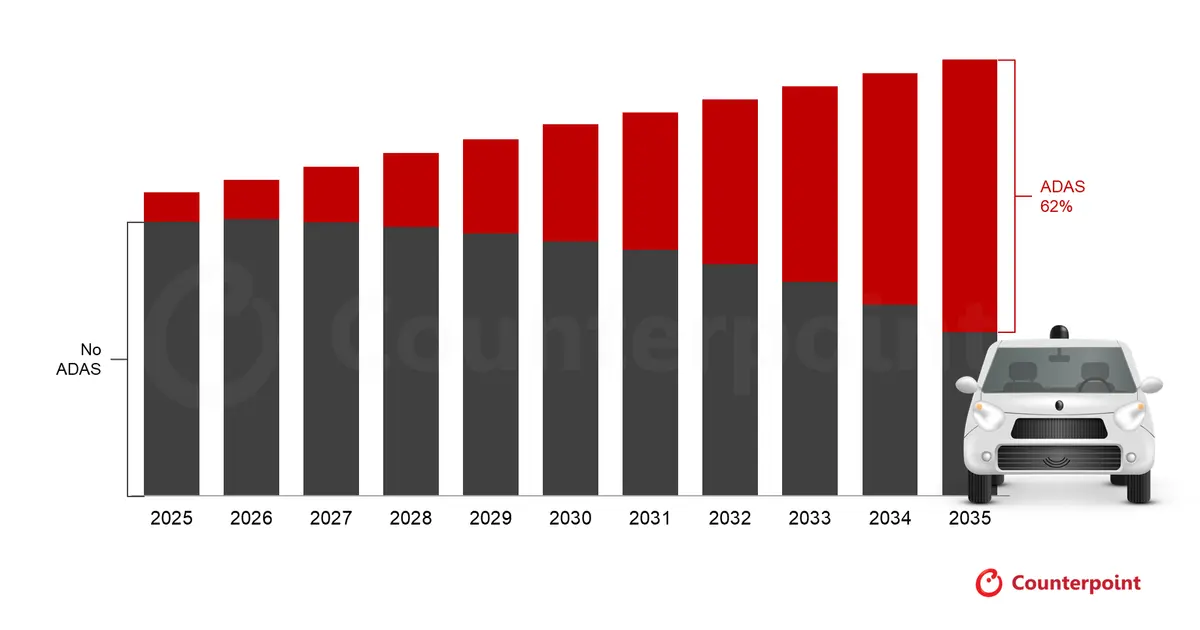
India Autonomous Passenger Vehicle Sales Forecast, 2025-2035
Source: Counterpoint Research
India’s ADAS market grew its share of the overall passenger vehicle market from 6.43% in 2024 to nearly 8.41% in 2025, recording a 38% YoY increase and highlighting accelerating consumer acceptance of advanced safety technologies.
Among India’s top five automakers in 2025 for Level 2 ADAS, Mahindra emerged as the market leader, followed by Hyundai-Kia Automotive Group, Honda, Tata Group and Toyota Group.
India is a price-sensitive car market, where buyers carefully evaluate value for money before the purchase. Unlike some developed markets where ADAS adoption has been driven by regulations, the growth of ADAS in India’s cars has so far been mainly driven by consumer demand. Customers are increasingly choosing vehicles with advanced technology and safety features, especially as awareness grows, driven by voluntary vehicle safety ratings from Bharat NCAP. As a result, features that were once limited to luxury cars, such as Adaptive Cruise Control (ACC) with Stop and Go, Lane Keep Assist, Automatic Emergency Braking and Smart Pilot Assist (SPA), are now gradually becoming common in mass premium SUVs.
At the same time, Maruti Suzuki, India’s largest mass-market car brand, has also entered the Level 2 ADAS space with the launch of models like Victoris and e-Vitara, signalling how advanced safety features are becoming part of mainstream expectations in India.
Mobileye tech in Mahindra vehicles
Mahindra’s leadership is driven by its aggressive rollout of Level 2 ADAS across recent SUV launches, such as the Thar Roxx, XUV 7XO, XEV 9e and BE 6. These models offer advanced driver assistance features like Adaptive Cruise Control, Smart Pilot Assist and Lane Keep Assist in specific variants, with similar capabilities expected in upcoming launches as well. By introducing these features in targeted variants rather than across the entire range, Mahindra has accelerated Level 2 adoption while maintaining pricing flexibility, strengthening its competitive position in the Indian SUV market.
The Mobileye SuperVision system, powered by two EyeQ6H chips and supported by up to 11 cameras with optional radars, is designed to enable advanced navigate-on-pilot capabilities in designated areas and conditions. The Surround ADAS platform, powered by a single EyeQ6H with five cameras and radars, supports hands-off, eyes-on highway driving, along with parking and DMS (Driver Monitoring System) features. By consolidating multiple functions into a unified platform, Mobileye’s solutions reduce ECU complexity while enabling scalable deployment across different vehicle segments.
Challenges for ADAS adoption in India
Even with advanced sensor suites and the rising adoption of Level 2 ADAS in India, real-world usage remains constrained by infrastructure limitations. Inconsistent lane markings, unstructured roads, dense mixed traffic, and unpredictable driving behaviour often restrict the effective use of features such as Adaptive Cruise Control and Lane Keep Assist, especially outside controlled highway environments.
Overcoming India’s Level 2 ADAS limitations will require systems that are better adapted to local driving conditions, along with gradual improvements in road infrastructure. ADAS software needs to be trained specifically for Indian traffic, where mixed road users, unclear lane markings and unpredictable driving behavior are common. Combining camera and radar inputs can improve reliability in such environments. At the same time, better highway development and clearer lane markings will naturally enhance system performance. As localization improves and costs come down, Level 2 features are expected to become more practical and widely used across India’s growing passenger vehicle market. In fact, India is mandating ADAS in commercial vehicles from April 2026.
Future of ADAS in India
According to Counterpoint’s Global Autonomous Vehicle Forecast, India’s ADAS market is expected to achieve 62% adoption (or penetration) in new car sales by 2035 at 25% CAGR between 2025 and 2035. This growth will be driven by rising consumer adoption, particularly among younger buyers who are more tech-aware and value advanced safety and convenience features. In addition, as technology matures and localization increases, vehicle and ADAS system costs are expected to decline, making these features more accessible across a wider range of models.
Strategic collaborations such as the partnership between Mahindra & Mahindra and Mobileye will further accelerate this momentum by enabling scalable, cost-efficient ADAS deployment tailored to Indian road conditions.
Analyst takes
- This partnership between Mahindra and Mobileye shows that India’s car market is moving beyond just adding features for marketing. It is now focusing on scalable, software-driven ADAS that can be used across multiple models. By introducing Level 2 features early and aggressively in its SUV lineup, Mahindra has built a strong image around safety and technology, giving it an edge over competitors.
- India’s road and traffic conditions are highly unpredictable, with unclear lane markings, mixed traffic (cars, two-wheelers, autorickshaws, pedestrians), and frequent sudden maneuvers. Because of this, ADAS systems must be specially trained and tuned for Indian driving behavior while also remaining affordable; otherwise, adoption will remain limited to a small premium segment.
- Looking ahead, ADAS growth in India will depend on three key things - software trained for Indian driving conditions, cost-effective hardware, and gradual improvements in road infrastructure. Partnerships like Mahindra-Mobileye are not just about technology; they are long-term strategic moves that could shape who leads India’s next phase of automotive innovation.


