

The Background
- On September 24, US President Donald Trump met Chinese President Xi Jinping at the White House, with both sides emphasizing strategic stability even as competition continues across trade, technology and AI.
- Xi’s key message was that “the Thucydides Trap can be overcome.” The concept describes how rivalry between a rising power and an established power can become a self-reinforcing cycle of fear, defensive action and counteraction – even when neither side actively seeks conflict.
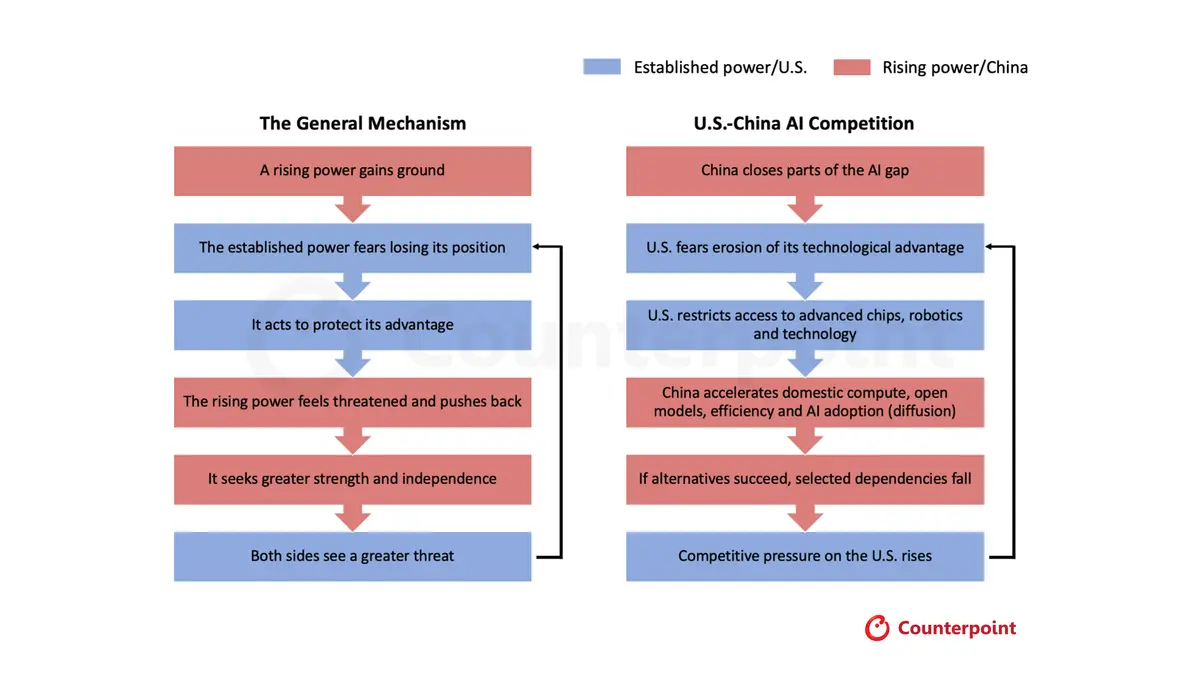
- But for the AI industry, the more interesting question is not whether the US and China are destined for conflict, but whether they can keep an accelerating AI race from becoming self-reinforcing, which means that each side’s attempt to protect its technological position creates stronger incentives for the other side to accelerate. A Chinese capability gain can trigger tighter US restrictions; those restrictions can then accelerate China’s push for domestic compute, model efficiency and technological independence – feeding the next round of competitive pressure.
Three points matter:
- The Thucydides Trap is fundamentally a feedback loop, not a prediction of technological cold war. As China narrows parts of the AI gap, US concern over losing technological advantage can produce tighter restrictions. And those restrictions, in turn, strengthen China's incentives to develop domestic compute, more efficient models and alternative AI ecosystems.
- Xi explicitly said that “The Thucydides Trap can be overcome.” This formulation points toward bounded competition: continue competing but build mechanisms that prevent competitive pressure from automatically escalating into confrontation.
- That would not end the US-China AI race. It could change what winning the race means. As in our previous research, “Measuring China’s AI Diffusion Velocity Lead Over the US”, the increasingly important metric is not only frontier-model leadership, but AI diffusion velocity (Our self-developed 4A Framework) – how rapidly intelligence moves from Access to Adoption, Absorption and ultimately economic Advantage.
What the Thucydides Trap Actually Means
Strip away the Greek history and the concept is remarkably intuitive. Imagine one country has been ahead for decades. Another begins catching up. The existing leader becomes increasingly worried about losing its advantage, so it takes measures to protect it. The challenger interprets those measures as an attempt to stop its rise and responds by accelerating its own capabilities.
Neither side necessarily wants confrontation. But each side's attempt to make itself more secure can make the other side feel less secure.
That is the trap.
The AI Thucydides Trap is a Feedback Loop
Source: Counterpoint Research
The key point is that the trap is not created simply because two countries compete.
It emerges when fear of what the other side might become begins driving today's decisions.
AI makes this particularly important because governments are not responding only to existing capabilities. They are responding to expectations about where models, agents, robotics, and autonomous systems may be several generations from now.
AI Can Make the Thucydides Dynamic Faster
The US-China AI relationship contains an unusual contradiction. By several measures of resources, the US retains substantial advantages. US private AI investment reached $285.9 billion in 2025 versus $12.4 billion in China, according to Stanford's 2026 AI Index, although Stanford notes that private investment alone understates Chinese state-backed investment. The US also hosts far more data centers.
Yet, model capability has converged far more rapidly than the investment numbers would suggest. Stanford reports that US and Chinese models traded the lead several times beginning in 2025 and that, as of March 2026, the leading US model's measured advantage was only 2.7% on its benchmark aggregation.
That creates exactly the kind of perception problem that makes the Thucydides framework useful. A large resource advantage no longer guarantees an equally large capability advantage.
And capability itself no longer guarantees diffusion. This distinction matters because the two countries increasingly are competing through various parts of the AI value chain.
The US has enormous strengths in capital, frontier compute, hyperscale infrastructure and leading proprietary laboratories. China has responded to tighter compute constraints with stronger incentives around model efficiency, domestic hardware, open-weight ecosystems, lower-cost inference, and deployment.
Current US rules still place significant restrictions on advanced computing items going to China, even as the Trump administration has shifted toward more targeted and case-by-case treatment in some areas.
The strategic effect is therefore more complicated than simply “restriction slows China.”
Restriction can slow access to one technological pathway while increasing the incentive to build another.
This is where diffusion becomes the missing variable. In the previous report, we argued that the US-China AI race should increasingly be measured through relative diffusion speed, using four stages:
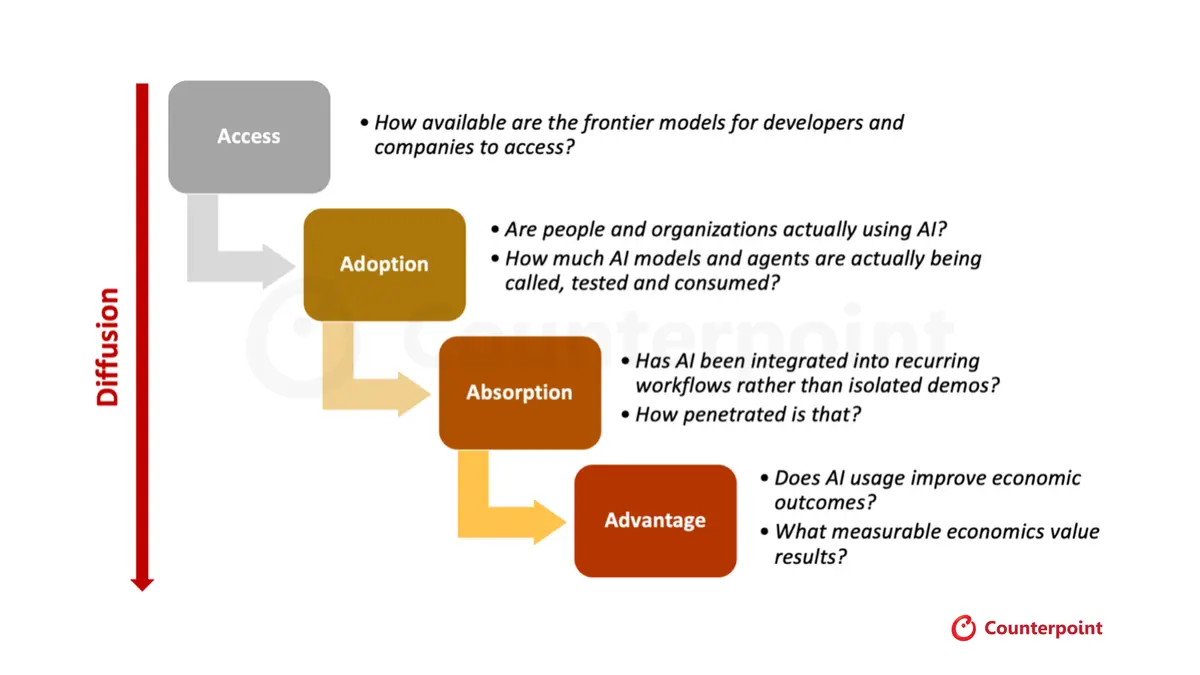
Our Self-developed 4A Framework on Measuring AI Diffusion Speed
That framework becomes even more important through the lens of the Thucydides Trap. If advanced compute becomes harder for Chinese companies to obtain, China's strategic response does not have to be simply building an identical substitute for every US technology.
It can also try to make intelligence cheaper to access, easier to customize and faster to diffuse.
What Xi Means by Saying the Trap “Can Be Overcome”
At the White House on September 24, Chinese President Xi Jinping said, “The Thucydides Trap can be overcome.” The remark argued that competition between the two countries need not disappear, but should remain within bounds, while dialogue and crisis-communication mechanisms should continue.
Taken at face value: overcoming the trap does not mean removing the competition. It means trying to prevent competition from becoming automatically escalatory.
In AI terms, that could mean separating two things that are often bundled together:
competition for technological advantage and management of technological risk.
According to the White House, the two governments established a bilateral dialogue covering the risks and benefits of what they termed “super intelligence,” together with a communication channel for AI-related incidents. That mechanism will not eliminate export controls, semiconductor competition, model rivalry, or national AI strategies.
However, the significance is that it creates the possibility of a circuit breaker. If an AI-enabled cyber incident occurs, if an autonomous system behaves unexpectedly, or if one country's AI deployment is interpreted by the other as a strategic threat, communication becomes critical precisely because competitive pressure is already high.
Our Prediction: Competition with Circuit Breakers
The next test comes quickly. September did not resolve the broader US-China technology rivalry, but it did produce something more operational: a bilateral channel for AI incidents and a new AI dialogue, with the next exchange scheduled for November. November is arguably more important than the September summit, because it becomes the first test of whether the new “competition with circuit breakers” framework produces anything operational.
In a longer time frame, over the next 12 months, the US-China AI race may become more intense, but also more bounded. If Washington and Beijing gain confidence that strategic competition can be contained, clearer crisis-management mechanisms could reduce escalation risk without slowing the underlying race.
That would also make the competition more multidimensional. The US is likely to keep pushing frontier compute, semiconductors and closed models, while China competes through efficiency, open weights, domestic substitution and faster industrial diffusion. The result would be neither technological globalization nor a clean Cold War, but competition with circuit breakers.
The implication is that a one-model leaderboard will matter less. What increasingly matters is relative diffusion speed: how quickly each side converts AI capability into broad economic advantage.
