

• ADAS and autonomous driving industry shifts focus to scalable, mass-market ADAS and autonomous solutions.
• Hardware, software, and human-like AI models converge for safer, smarter driving.
• Value chain players push into Europe with affordable, high-performance sensors, software and hardware platforms.
Advanced driver assistance systems (ADAS) and autonomous technology took center stage at IAA Mobility 2025, held in Munich on September 9-14, indicating that autonomous driving is evolving both in ambition and in deployment readiness in Europe. Below are highlights of some of the key moves and trends from major players toward safer, smarter, more automated mobility:
ADAS and Autonomous Driving Full Stack and SoC players at IAA Mobility 2025
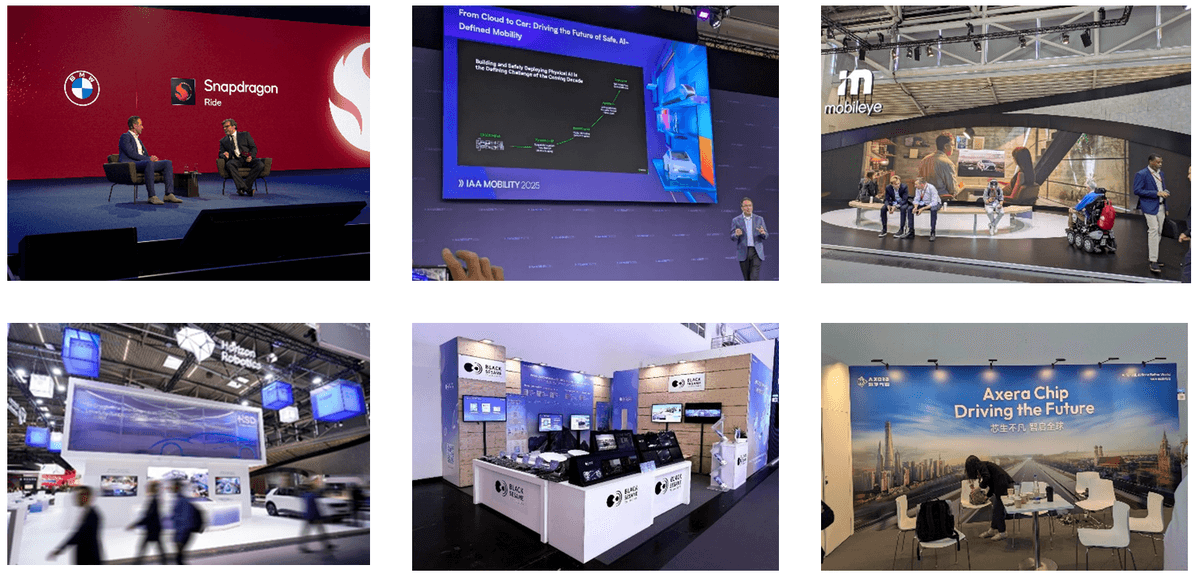
Full Stack and SoC Players:
Qualcomm: Snapdragon Ride Pilot in the BMW iX3 is validated in 60+ countries, enabling global scaling. Key features include advanced sensors, contextual cues for maneuvers, and a focus on scaling ADAS from basic to complex driving scenarios. This will open the doors for Qualcomm to many more OEM partnerships.
NVIDIA: NVIDIA highlighted generative and agentic AI, digital twins and industrial AI themes. Emphasis on cloud-to-vehicle workflows (from simulation & validation to in-vehicle inference), safety, and in-cabin experiences.
Mobileye: Demonstrated AI-powered autonomous driving solutions and advanced driver-assistance systems (ADAS), featuring their latest imaging radar technology for enhanced hazard detection and safety.
Horizon Robotics: Showcased Journey 6 processing hardware and its Horizon SuperDrive (HSD) autonomous driving solution. Announced the establishment of its European headquarters in Munich, a strategic move to support the global expansion of Chinese automakers.
Black Sesame: Showcased its Safety Intelligent Platform and the Wudang C1200 chip series for intelligent driving. The company highlighted its growing partnerships with major Tier-1 suppliers and automakers, emphasizing its role in providing scalable, secure hardware for mass-produced autonomous vehicles.
Axera: Axera Semiconductor made its global debut, unveiling an all-in-one front-view perception Advanced Driver-assistance System (ADAS) solution based on its M57 SoC. The system is aimed at the global automotive market and is set to be ready for mass production in 2026.
ADAS and Autonomous Driving Software Platform-only players at IAA Mobility 2025

Software Platforms
Momenta: Highlighted "Flywheel Big Model" AI, powered by reinforcement learning. Announced partnership with Uber to test Level 4 autonomous taxis in Munich starting in 2026.
QCraft: Announced the setting up a European HQ in Germany and partnership with Qualcomm. QCraft aims to bring full stack Navigate on Autopilot (NOA) to Europe, the US, Japan, and South Korea by 2026.
DeepRoute.ai: Launched its DeepRoute IO 2.0 platform, a proprietary Vision-Language-Action (VLA) featuring human-like reasoning to navigate complex driving scenarios. The company announced plans to expand globally, focusing on international markets like Europe and Japan.
ADAS and Autonomous Driving Sensor players at IAA Mobility 2025
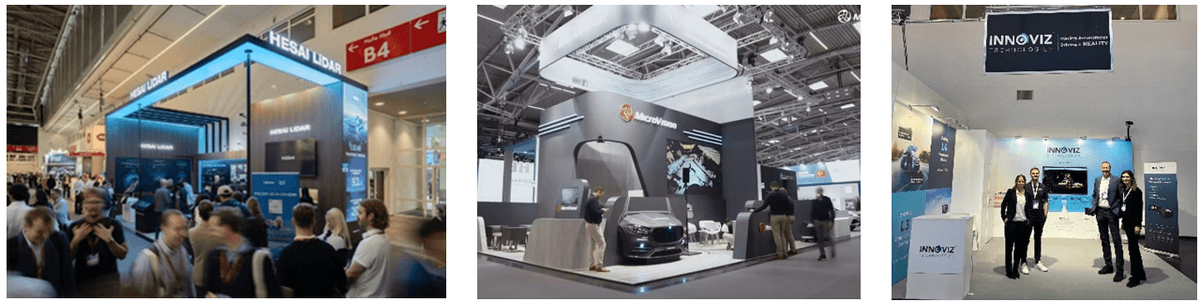
Sensor Players:
Hesai: Unveiled its latest LiDAR sensors – ETX, an ultra-long-range lidar with a focus on cost reduction and mass-production readiness for L3 and L4 autonomous driving; and the FTX, a fully solid-state LiDAR designed to cover blind spots with an ultra-wide field of view.
RoboSense: Showcased high-performance LiDAR systems EM4 and E1 series with integrated perception software, designed to accelerate OEM adoption worldwide. It announced the integration of its latest digital LiDAR systems with the NVIDIA DRIVE platform.
MicroVision: Unveiled a new compact, low-cost LiDAR system that combines short- and long-range sensors and are designed to be smaller, lighter, and more power efficient than traditional setups. A 40%-50% cost reduction is estimated with additional benefit of discreet integration behind windshields or in-vehicle grilles instead of roof mounts.
Innoviz Technologies: Presented solid-state LiDAR, delivering high-resolution and reliable perception focusing on its collaboration with Volkswagen for its of ID. Buzz AD shuttles set for a 2026 launch. The company also announced a new partnership with a major global automaker for a Level 3 vehicle program.
Zendar: Demonstrated a software-defined radar with high-resolution sensing and high-precision perception under low visibility and at a low cost. It has tie-ups with Tier 1s to supply their radars to OEMs.
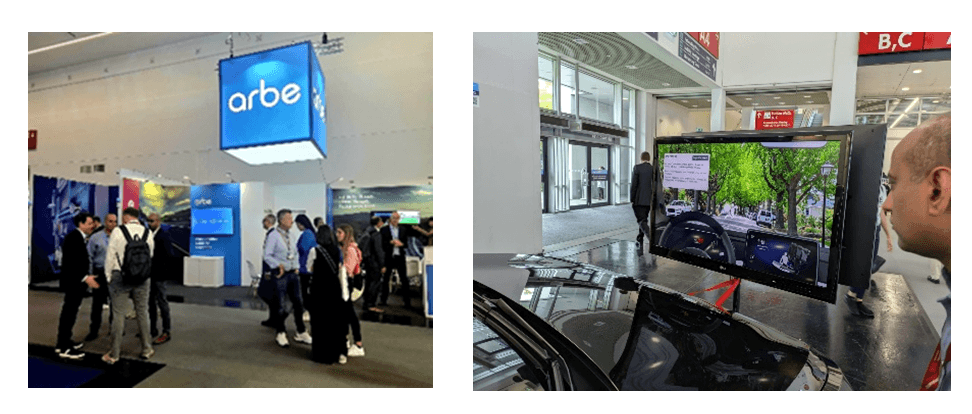
Arbe: Showed 4D imaging radar-enhancing long-range detection and offered live demonstrations of its radar solutions, capable of providing detailed, real-time imaging for autonomous vehicles. Arbe emphasized the importance of radar as complementing other sensor technologies, such as LiDAR and cameras, to enhance the safety and reliability of ADAS and autonomous vehicles.
IEE: Demonstrated its advanced driver and occupant monitoring systems. Combining seat, steering sensing with camera-based sensing has enabled a higher vital safety layer for assisted and autonomous driving.
Key Themes:
Hardware and Software Integration: Companies are combining AI, SoCs, and sensor platforms into cohesive, scalable solutions for global markets. Innovation is through collaborations and end-to-end, full-stack solutions are being developed that combine perception, processing, and decision-making into a cohesive system. This was demonstrated through Qualcomm’s partnership with BMW, which has enabled faster development cycles, better safety validation, and easier scaling across multiple vehicle platforms and OEMs.
Sensor Innovation and Cost Competitiveness: Focus is on long-range, solid-state, and integrated LiDAR systems as well as smaller form factors and lighter LiDAR systems that can improve perception and lower costs. Radars are also being developed with higher resolutions and longer ranges to further complement the LiDAR and cameras. Better sensors at lower costs will enhance safety validation and enable higher autonomy levels.
Mass Production Readiness: Many companies, including Axera, Black Sesame, Hesai, and MicroVision, highlighted solutions for mass production starting 2026, demonstrating the commercial readiness of ADAS and autonomous driving solutions. Cost-efficient and power-optimized designs are critical to meet both viable price points and OEM requirements.
European Expansion and Regulatory Alignment: Chinese companies like Horizon Robotics, Momenta, QCraft, and DeepRoute are establishing European headquarters and R&D centres and forming strategic partnerships with local OEMs. This approach will help them navigate regulatory environments and address safety standards as well, accelerating adoption and building trust with global OEMs based out of Europe.
Human-like AI Reasoning and Context-aware Autonomy: Advanced AI models, such as Momenta’s Flywheel Big Model and DeepRoute.ai’s VLA platform, enable vehicles to reason out complex traffic scenarios and make safer driving decisions. These capabilities move beyond reactive systems toward anticipatory and context-aware driving, which is critical as we progress toward Level 4/5 autonomy.
IAA Mobility 2025 confirms that the autonomous driving industry has moved beyond early experimentation. Full-stack, production-ready solutions, sensor innovation, global expansion strategies, and human-like AI reasoning are all converging. The focus is on scaling in a safe, cost-effective, and global manner, enabling the future of autonomous mobility. Counterpoint Research Forecasts 1 in 4 vehicles globally to have SAE Level 3 or Level 4 autonomy by 2035
