

AI is emerging as a game-changer for both consumer and IoT MVNOs, enhancing services and improving efficiency.
Consumer MVNOs use AI to boost acquisition, retention, and engagement through personalization and automation.
IoT MVNOs apply AI for network optimization, predictive maintenance, and reliable device connectivity.
Challenges remain, but best practices like modular deployment and vertical-specific models can ease adoption.
AI solutions are rapidly gaining traction and are becoming central to Mobile Virtual Network Operators’ (MVNO) strategies, as operators seek to differentiate and scale through smarter, more efficient resource management. The introduction of AI into internal operations and service offerings also aligns well with the digital-first brands that are known for agility. According to Counterpoint’s IoT CMP and eSIM orchestration reports, many MVNOs, supported by MVNEs, MVNAs, and software partners, have begun deploying AI-driven solutions tailored to their respective industries.
However, AI strategies differ between consumer-focused and IoT-focused MVNOs due to variations in target markets, end users, and the nature of connected devices. Despite these differences, several AI applications are common across both models, including:
Natural Language Processing (NLP): Enables intelligent support bots, automated documentation search, and internal operational tools.
AI-enabled Support: Chatbots and virtual agents that resolve common user or device queries with low response time and higher precision.
Plan Recommendation Engines: Analyze usage behavior and budgets to suggest the most suitable plans for users or enterprise clients.
Use of AI by Consumer and IoT MVNOs
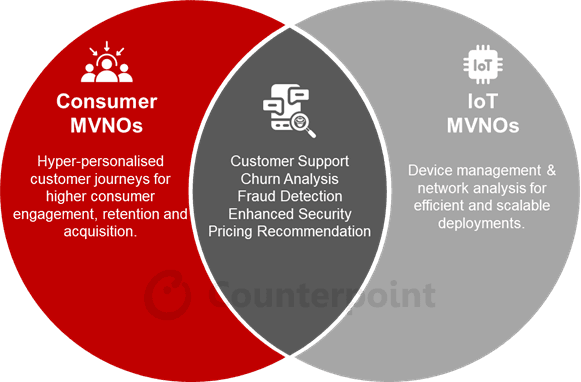
Source Counterpoint Research
The B2C market is more churn-prone, with shorter contract cycles than B2B, requiring MVNOs to be proactive in customer retention and engagement. Consumer MVNOs should leverage AI not only for hyper-personalized offerings but also to drive engagement and acquisition. AI can power campaign management by tailoring promotions, upsell offers, and retention strategies based on real-time user behavior and segmentation. Lifecycle marketing tools, automated through AI, can trigger targeted outreach via SMS, push notifications, or email, based on usage patterns or inactivity. These applications can help boost customer satisfaction and sustain ARPU in a highly competitive market.
In the B2B market, MVNOs typically work with enterprise clients under long-term contracts, supporting thousands of IoT devices deployed in the field. The dynamics shift here, with a stronger focus on device performance, reliability, and security rather than individual user engagement. AI plays a critical role in this context – enabling network prediction, anomaly detection, fraud prevention, and advanced security monitoring. Given the vast diversity of connected devices, use cases, and underlying radio access technologies, it becomes essential for MVNOs to embed AI into their Connectivity Management Platforms (CMPs). This allows for real-time data analysis to maintain high uptime, ensure seamless connectivity, and deliver consistent service quality across heterogeneous device environments.
Advantages and Benefits of using AI
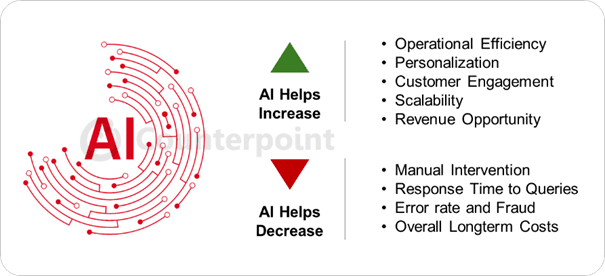
Source: Counterpoint Research
Although AI continues to mature with widespread adoption across other industries, the technology faces several hurdles in implementation within MVNOs. This is largely due to MVNOs’ structural dependence on parent MNOs and their limited control over network infrastructure.
Data access limitations are a major challenge. Many MVNOs lack direct access to granular network and user data, making it difficult to generate actionable insights around customer behavior and purchase patterns.
Resource constraints are another barrier. Smaller or emerging MVNOs often lack the financial capacity to build dedicated in-house AI teams, slowing down innovation.
In such cases, MVNOs rely on third-party software vendors, which can lead to challenges around solution flexibility, customization, and alignment with specific business needs.
Finally, ensuring data privacy, regulatory compliance, and integration of AI across fragmented infrastructure layers adds further complexity to successful deployment.
Based on insights from Counterpoint’s eSIM Orchestration and Connectivity Management Platform (CMP) research, as well as conversations with vendors at events like MVNOs World 2025, several best practices have emerged for MVNOs looking to adopt AI effectively:
Pick Your Battles: MVNOs should define a clear AI roadmap and prioritize implementation in areas where measurable outcomes, such as reduced churn, improved ARPU, or operational efficiency, can be achieved.
Adopt a Modular Approach: A modular AI framework allows MVNOs to gradually integrate various capabilities (e.g. customer support, anomaly detection, recommendation engines). This should be accompanied by early efforts to consolidate scattered data sources across systems.
Leverage Ecosystem Partnerships Wisely: To avoid vendor lock-in, MVNOs should partner with providers that promote operational transparency and offer accessible insights and controls. This ensures faster pilots, iterative feedback loops, and scalable deployment.
Upskill Internal Teams: It is critical to train internal teams so they understand AI workflows and contribute to human-in-the-loop feedback, ultimately driving more contextual and actionable intelligence from AI systems.
Simultaneously, identifying challenges and adopting best practices will be crucial for MVNOs to unlock the tangible benefits of AI. As the MVNO landscape across both consumer and IoT segments becomes increasingly competitive, Counterpoint expects AI implementation to emerge as a key differentiator. The ability to scale and adapt AI solutions rapidly in response to changing market dynamics will be vital to staying relevant and competitive in this ‘survival-of-the-fittest’ environment.
Insight


