Operator Roaming Revenues to Decline by a Third by 2030 as Travel eSIMs Gain Popularity
- Global retail consumer roaming revenues are projected to reach $16 billion in 2025, a 6% YoY growth, marking a complete rebound from the pandemic-related downturn.
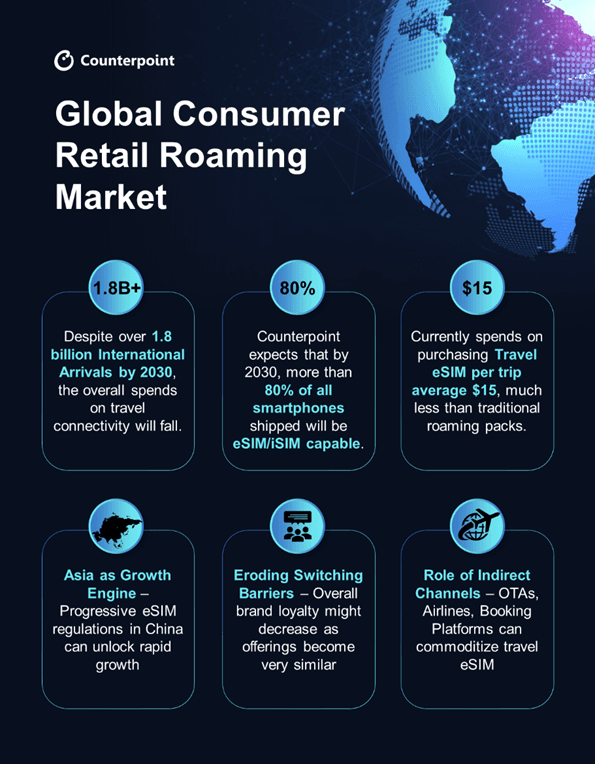
- Despite the recovery in roaming revenue, Counterpoint now forecasts global operator retail roaming revenues to fall by one third by 2030, as travellers increasingly turn to eSIM for cheaper and more flexible connectivity.
- To remain competitive, operators are expected to lower roaming tariffs and launch affordable travel eSIM apps and packs targeting both inbound and outbound roamers.
- By 2030, over 35% of all international trips will involve buying Travel eSIMs pre-arrival, as eSIM penetration in smartphone steadily increases.
Seoul, Beijing, Berlin, Buenos Aires, Fort Collins, Hong Kong, London, New Delhi, Taipei, Tokyo – September 16, 2025
Global spend by international travellers on roaming-related connectivity is projected to reach $16 billion in 2025, according to Counterpoint’s Global Retail Roaming Market Outlook 2025. The market had recorded a 20% YoY rise in 2024, fuelled by the return of international travel to pre-pandemic levels.
Growth is expected to stabilize in the short term as international travel sustains momentum, but revenues are projected to decline over the longer term as low-cost travel eSIMs continue to gain traction. Since 2021, travel eSIM MVNOs have expanded rapidly, offering seamless pre-departure connectivity and more affordable alternatives to traditional roaming packages from incumbent MNOs.
Commenting on the market dynamics, Research Analyst Siddhant Cally said, “Travel eSIMs have disrupted the market by offering travellers convenient, digital-first, and cost-effective alternatives. However, adoption still faces barriers such as low awareness, complex KYC requirements, and regulatory hurdles, which may slow growth in certain regions.”
The growing penetration of eSIM-capable smartphones is expected to accelerate this transition. While eSIM-only devices remain limited for now, their wider adoption in the coming years is expected to significantly reduce the traditional practice of purchasing a SIM card on arrival. At the same time, digital-first MVNOs are aggressively marketing their offerings, challenging incumbents to rethink their strategies.
Mohit Agrawal, Research Director at Counterpoint, added: “MNOs need to move beyond defending legacy roaming revenues and adopt proactive strategies against low-cost travel eSIM MVNOs. By targeting inbound travellers, leveraging their unique ability to bundle voice and SMS, or even launching sub-brands, operators can deliver offerings that go beyond price competition. The time is now for MNOs to get aggressive, differentiate, and protect their share of the travel connectivity market.”
Counterpoint highlights that travel remains the single largest use case for eSIM and is set for rapid growth. This momentum is underscored by global operators such as Vodafone launching independent travel eSIM apps for international users. Looking ahead, competition is expected to intensify across the travel ecosystem. Beyond MNOs and MVNOs, booking platforms, travel agencies, airlines, and other travel service providers are increasingly embedding travel eSIM offerings, enabled by advanced MVNA/MVNE (Mobile Virtual Network Aggregators/Mobile Virtual Network Enablers) offerings and white-label eSIM solution providers. This trend will further commoditize the product, making brand loyalty easier to shift and forcing providers to compete on pricing, partnerships, and customer experience. The result will likely be downward pressure on ARPU/ARPT (Average Revenue Per User/Average Revenue Per Trip), leading to sustained price erosion despite growing travel volumes.
About Counterpoint Research
Counterpoint Research is a global market research firm specializing in products across the technology ecosystem. We advise a diverse range of clients – from smartphone OEMs to chipmakers and channel players to Big Tech – through our offices located in the world's major innovation hubs, manufacturing clusters and commercial centers. Our analyst team, led by seasoned experts, engages with stakeholders across the enterprise – from the C-suite to professionals in strategy, analyst relations (AR), market intelligence (MI), business intelligence (BI), product and marketing – to deliver services spanning market data, industry thought leadership and consulting. Our core areas of coverage include AI, Automotive, Consumer Electronics, Displays, eSIM, IoT, Location Platforms, Macroeconomics, Manufacturing, Networks and Infrastructure, Semiconductors, Smartphones and Wearables. Visit our Insights page to explore our publicly available market data, insights and thought leadership, and to understand our focus, meet our analysts and start a conversation.
Follow Counterpoint Research
press(at)counterpointresearch.com
Receive our insightful weekly newsletter and stay ahead of the competition.
Author
Siddhant Cally
With more than 8 years of rich experience in the telecommunications industry, Siddhant is currently a Senior Analyst at Counterpoint Research. He has previously worked with global leaders such as Bosch and Ericsson, and has managed networks for prominent operators including Claro, Sprint, and RCOM. In his current role, Siddhant focuses on researching and analyzing wireless technologies and their business outlook. He holds an engineering degree in Electronics and Communication, and MBA from IIT Delhi.
Mohit Agrawal
Mohit is responsible for tracking Digital Transformation and Internet of Things (IoT) at Counterpoint Research. He has over two decades of rich industry experience having worked with large tech companies like Accenture, Airtel, Nokia, and Microsoft in the past. Before joining Counterpoint, Mohit was the co-founder & CEO of a start-up in the competitive and market intelligence space utilizing big data and AI. He is a keen follower of the developments in devices and key internet technologies like IoT, Blockchain, AI, etc. Mohit is an engineer, MBA and a certified project management professional. He is based out of The Hague in Netherlands.