

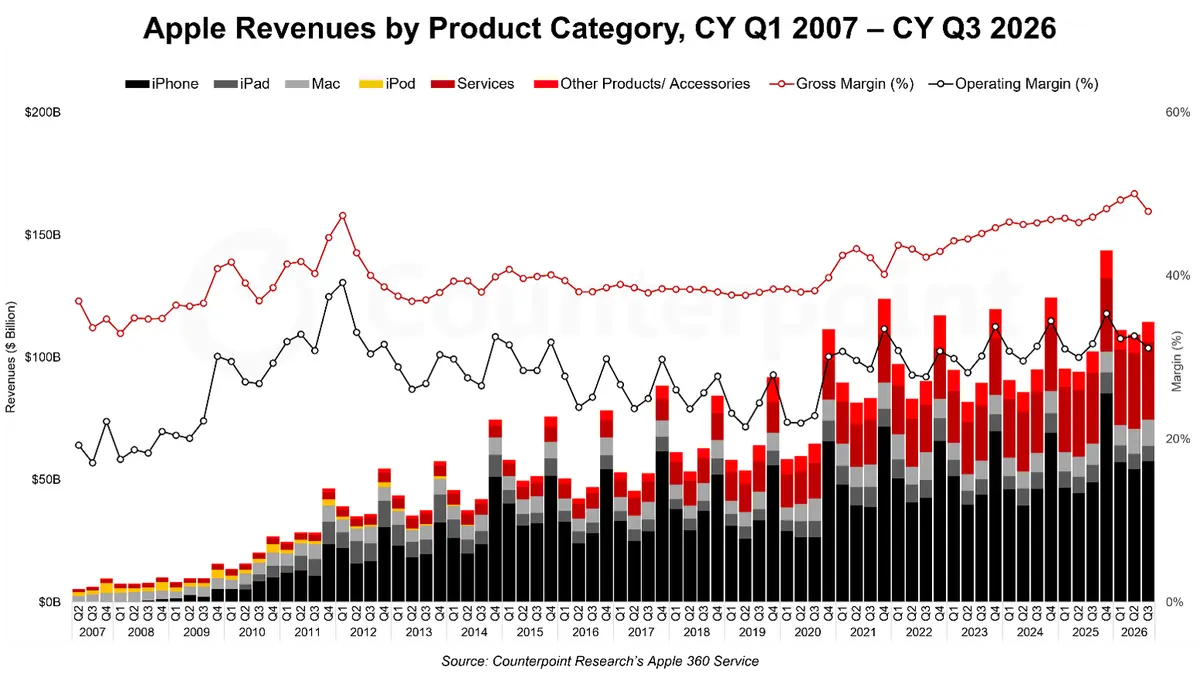
- Apple's revenue grew 12% YoY to $114.5 billion, a September-quarter record and the fifth straight quarter with $100 billion+ in revenue.
- iPhone revenue was driven by a higher share of Pro models and price increases, making Q3 2026 the first third quarter in which iPhone's wholesale average selling price (ASP) crossed $1,000.
- iPhone 18 Pro series sales grew 3.1% globally in the first three weeks despite a $100 price increase, reflecting resilient premium demand amid mixed regional performance.
- Apple Mac revenue grew 24% YoY to $10.8 billion, outperforming the PC market facing rising memory costs, supply constraints, and weakening consumer demand.
- Services segment revenue continued its double-digit growth, delivering a September-quarter record.
Seoul, Beijing, Berlin, Buenos Aires, Fort Collins, Hong Kong, London, New Delhi, Taipei, Tokyo – November 02, 2026
Apple's Q3 2026 revenue (Q4 of its fiscal year) grew 12% YoY, reaching a September-quarter record of $114.5 billion. This marked the fifth consecutive quarter with revenue above $100 billion. Hardware revenue grew 12% YoY, while Services revenue increased 10%. Apple’s installed base has reached a record across every major product category and geographic market.
iPhone revenue grew 17% YoY, crossing $50 billion for the first time in a September quarter. Commenting on iPhone’s performance, Senior Analyst Karn Chauhan said, “This was a standout quarter for iPhone, with record September-quarter revenue driven by a higher mix of Pro models and price increases. For the first time in a third quarter, iPhone’s wholesale average selling price (ASP) exceeded $1,000, underscoring Apple’s pricing power in the premium segment. Apple raised prices on the newly launched iPhone 18 Pro and Pro Max, as well as on older models. After keeping prices steady longer than competitors, the company has begun passing rising memory costs on to consumers without weakening demand for its top-end models. The quarter also reflected a deliberate shift in launch strategy. Apple introduced only premium models this fall, the iPhone 18 Pro series and iPhone Duo, while postponing the base iPhone 18 until spring 2027. Combined with weaker overall smartphone market demand, the absence of a new mainstream model contributed to a 1% decline in iPhone shipment volumes.”
Commenting on the early performance of the iPhone 18 Pro series, Research Director Tarun Pathak said, “iPhone 18 Pro series unit sales rose 3.1% globally during the first three weeks after launch, compared with iPhone 17 Pro series sales over the same period last year, though regional performance was mixed. China led with 29% growth, while sales fell 4% in the USA and 27% in Japan, reflecting differences in market conditions, pricing and perceived upgrade value.”
A price hike with iPhone 18 Pro unit sales still growing indicates that top-end demand is largely inelastic for iPhones, but elasticity won't be uniform by region, and this will set the tone for the important upcoming holiday season. Apple is likely to optimize value over volume in a market facing rising memory costs and soft overall demand.
On Mac’s performance, Associate Director David Naranjo said, “Apple's Mac revenue of $10.8 billion in Q3 2026 represents an impressive performance, increasing 24% YoY at a time when the broader PC market is facing significant headwinds from rising memory costs, supply constraints and weakening consumer demand. Apple's ability to sustain double-digit revenue growth highlights the strength of its Apple Silicon ecosystem, premium product positioning and loyal customer base.”
Commenting on the foldables, Associate Director Liz Lee said, “With the iPhone Duo, Apple has entered the foldable market and the device is set to become a meaningful revenue driver for the company in 2027. Pre-order demand has been strong and continues to exceed supply, with production constraints further extending wait times. We forecast up to 6 million iPhone Duo shipments in 2026. That said, the launch has not been without friction. Long waits, reports of screen cracks near the hinge on a small number of units and mixed feedback on app optimization may dampen excitement among some mainstream buyers. These are typical first-generation challenges and as supply ramps up and the software ecosystem matures, we expect Apple’s foldable shipments to nearly triple in 2027.”
Memory prices continue to rise in the short term, keeping pressure on the smartphone market. Consumers are becoming increasingly price-sensitive, particularly in emerging markets, where affordability remains a key constraint. The premium segment has proven more resilient than the mass market, helping Apple gain share while Android OEMs face mounting pressure.
About Counterpoint Research
Counterpoint Research is a global market research firm specializing in products across the technology ecosystem. We advise a diverse range of clients – from smartphone OEMs to chipmakers and channel players to Big Tech – through our offices located in the world's major innovation hubs, manufacturing clusters and commercial centers. Our analyst team, led by seasoned experts, engages with stakeholders across the enterprise – from the C-suite to professionals in strategy, analyst relations (AR), market intelligence (MI), business intelligence (BI), product and marketing – to deliver services spanning market data, industry thought leadership and consulting. Our core areas of coverage include AI, Automotive, Consumer Electronics, Displays, eSIM, IoT, Location Platforms, Macroeconomics, Manufacturing, Networks and Infrastructure, Semiconductors, Smartphones and Wearables. Visit our Insights page to explore our publicly available market data, insights and thought leadership, and to understand our focus, meet our analysts and start a conversation.
Follow Counterpoint Research

